
Sports court construction is a site and operations decision before it is a color decision. HOAs, resorts, schools, parks, clubs, military facilities, and property managers across Hawaii need a court that drains, stays playable in salt air and intense sun, and fits the sports people will actually use. A multi-sport pad can serve tennis, pickleball, basketball, or volleyball, but only if the footprint, lines, fencing, and equipment are chosen together.
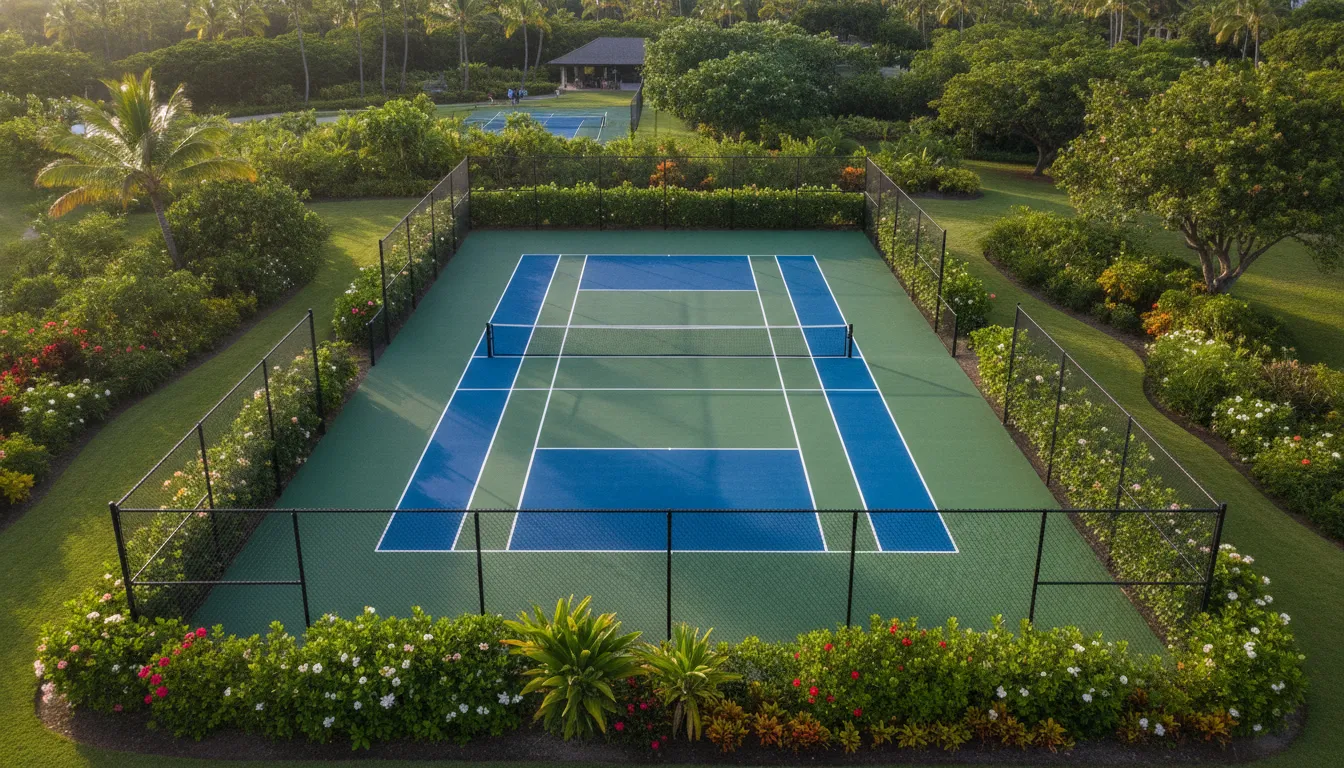
This guide is the planning hub. It walks the shared sequence: use, site, drainage, base, surface, lighting, fencing, equipment, budget, and phases. Sport-specific dimensions and cost detail live on the linked guides, not here. Hawaii Court Resurfacing builds and maintains courts on Oahu, Maui, the Big Island, Kauai, Molokai, and Lanai under C-3B license C-39570, with trained in-house crews and flat-rate pricing that does not add an inter-island surcharge.
Before You Request a Sports Court Construction Estimate
A useful estimate starts with site facts and a clear use case. Before contacting a court builder, gather the following:
- Primary users and sports: Note who will use the court, the main sport, any secondary sport, and the busiest times. This helps determine court size, line layout, equipment, and durability needs.
- Site dimensions and access: Measure the usable area, fence setbacks, gate locations, slope, and the route for people, materials, and equipment. Share photos that show tight access or nearby buildings.
- Water and ground conditions: Mark low spots, standing water after rain, drainage paths, irrigation, trees, roots, and visible movement or cracks. A coating cannot correct an unresolved base or drainage problem.
- Existing court condition: If a court exists, note the base type, cracks, peeling coatings, ponding, and whether the court is still level. These observations help frame a resurfacing-versus-reconstruction conversation.
- Project requirements: List lighting, fencing, windscreens, goals, posts, nets, color preferences, accessibility needs, and operating restrictions. Include quiet hours, school calendars, resort access rules, or HOA approval milestones.
- Decision and budget context: Identify who approves the work, the desired timing, and a realistic investment range. Project costs depend on the site, scope, access, and materials, so an on-site review is needed for a project-specific proposal.
Bring this information to the first conversation, but do not treat it as a substitute for a site evaluation. Hawaii Court Resurfacing can review the intended use and existing conditions, then explain whether construction, resurfacing, repair, or a sport-specific conversion is the more appropriate path. Get a Free Estimate
What Sports Court Construction Has to Decide First
Start with who plays, and when. A resort guest court, a school PE pad, and a private club court do not share the same wear, hours, or approval path. Write the primary sport, any second sport, and the hours of peak use before you talk about color. That list drives court count, line contrast, fence height, and whether one surface can do both jobs.
Multi-use is useful when the sports share a similar pace and the lines stay readable. It fails when too many colors cross the main playing area, or when a hoop, net, and volleyball system fight for the same center. If pickleball is the growth sport and tennis already exists, a pickleball court conversion is often smarter than a full new pad. If the slab is sound, resurfacing may beat reconstruction. The comparison lives in the resurfacing versus reconstruction guide.
Facility buyers should also name the decision makers. An HOA board, a resort engineering team, a school district, and a base public-works office each need a different packet: scope, access rules, photos, and a realistic calendar. A clear use statement keeps the quote from pricing a tournament court when the real need is recreational play.
Site Checks That Change the Build
Published ASBA tennis court construction guidelines put site investigation, earthwork, and drainage at the front of the build, not at the end. Hawaii adds volcanic and coral soils, root pressure, trade winds, and heavy rain bursts. A pretty rendering cannot fix a pad that holds water or heaves.
Walk the site, or review photos and video if the court is on another island, and record these items:
- Available length and width, including fence setback and gates, not just the painted lines.
- Slope, low spots, and where stormwater leaves the property.
- Tree roots, irrigation, and underground utilities near the pad.
- Access for trucks, mix, and equipment without crossing guest or student paths.
- Wind exposure, sun path, and neighbors who will hear evening play.
- Existing cracks, coating failure, and whether the base is asphalt or concrete.
Orientation matters, but it is not identical for every sport. Tennis and pickleball usually want the long axis roughly north-south so players are not staring into a low sun. Basketball and volleyball can tolerate other layouts when the lot, buildings, or wind force a compromise. Do not copy a tennis rule onto a half-court tucked beside a building. Confirm the fit on site.
Access is a cost driver on outer islands and on tight resort or campus sites. If materials and crews can mobilize once and finish, the project is simpler. If the only path is a narrow service road or a guest corridor, say so before the quote. Hawaii Court Resurfacing prices work at a flat rate across the islands it serves, so the location itself is not a surprise surcharge, but difficult access still changes the schedule.
Drainage, Base, and Surface Choices
Water is the failure mode that shows up first. A court should shed rain off the playing area. Standing water means the grade, the edge, or the surrounding landscape is wrong. ASBA’s construction guidelines separate surface drainage from subsurface drainage for a reason: a coated court can look fine and still sit on a base that stays wet.
Two base families cover most outdoor work in Hawaii:
- Asphalt. Often the lower upfront structural cost and a common base for acrylic color systems. It needs a sound subbase and a plan for cracks, because Hawaii soils and roots move.
- Concrete. A stiffer slab that can stay flatter when it is designed, jointed, and cured correctly. It still cracks if the slab is thin, poorly drained, or fighting expansive soil.
Post-tensioned concrete is a specialty structural option some high-use facilities consider for crack control. It is not a default, and it is not a promise that the ground will never move. Treat it as a design conversation with the builder and the structural requirements of that site, not as a brochure upgrade.
The playing surface on most outdoor tennis, pickleball, basketball, and multi-sport courts here is an acrylic color system. As a SportMaster authorized installer, Hawaii Court Resurfacing uses acrylic systems selected for UV, humidity, salt air, and rain, including formulations with salt resistance and anti-fungal performance. Cushion layers can add comfort, but they are not the right first spend if drainage or the base is failing. A cushion system also does not guarantee that future cracks or soil movement will never show.
Modular tile can suit some recreational pads when the deck under it is flat and stable. Hardwood is an indoor product and needs climate control. Neither replaces a proper outdoor asphalt or concrete section on a resort or school court that will see daily play in the weather. For coating chemistry in salt air, see the salt-resistant surface guide.
| Planning choice | Best fit | Watch-out in Hawaii |
|---|---|---|
| Asphalt base plus acrylic. | New tennis, pickleball, and many multi-sport pads. | Cracks if the subbase, roots, or grade are ignored. |
| Concrete base plus acrylic. | Sites that need a stiffer slab and controlled joints. | Still needs drainage and a real crack plan. |
| Resurface existing pad. | Sound base with worn color or shallow cracks. | Coating over a moving or flooded slab wastes the budget. |
| Full reconstruction. | Failed base, major heave, or a size change. | Longer schedule and a higher project range. |
Line paint is part of the surface system, not a last-day extra. Limit colors so the primary sport reads first. Add a second sport only where the overlap stays playable. The outdoor multi-sport designer is a way to test colors and layout before anyone orders material.
Lighting, Fencing, and Equipment
Plan the edges with the pad. A fence that is too low for the sport, a gate in the wrong corner, or a light pole inside the overrun will not be a cheap change after the slab is down.
Fencing keeps balls in play and sets a boundary for guests, students, and neighbors. Wind is the Hawaii-specific part. Trade winds change ball flight, and a windscreen can help, but a screen also adds load to the fence. Height, fabric, and hardware should match the sport and the exposure. Cost detail for fence and screen work is in the fencing and windscreens guide and the tennis fence cost article. Do not assume a tennis fence height is right for a low recreational basketball pad.
Lighting is a separate scope. It depends on hours of play, glare toward rooms or roads, pole locations, and who maintains the fixtures. Recreational courts and match-level courts are not the same design. Get pole placement on the site plan before the base is poured so conduits and footings are not an afterthought. A later lighting article can cover fixture choices. This hub only flags that poles, glare, and power belong in the first layout.
Equipment follows the sports you locked in step one:
- Tennis and pickleball need posts, nets, and a center strap that match the court count.
- Basketball needs a hoop system rated for the setting. Outdoor residential goals and school goals are not interchangeable. See the basketball hoop planning guide.
- Volleyball needs sleeves or a post system that does not become a trip hazard when the net is down.
Put unused standards on a storage plan. A multi-sport court that leaves three net systems on the playing surface is not multi-sport. It is clutter.
Budget Ranges and What Moves the Number
There is no single sports court construction price. Scope, court count, base repairs, access, and equipment move the number more than the color chart does. Use these as planning bands, not a quote:
- Smaller projects, including many single-court repairs or modest resurfacing jobs, often land around $8,000 to $15,000.
- Medium resurfacing or reconstruction work often lands around $20,000 to $50,000 or more.
- Full construction and larger facilities start around $50,000 and go up with court count, fencing, lighting, and equipment.
A 50% deposit secures scheduling and material ordering. The remaining 50% is due after completion and your approval. Warranty terms depend on the system, the materials, the site, and the contract. There is no single warranty that covers every court the same way.
Do not pull a sport-specific budget apart in this article. Tennis build scope is covered in tennis court construction. Basketball cost factors are in the basketball construction cost guide. Pickleball layout choices are in pickleball court construction and pickleball facility design. If you only need one sport, use that page. If you are choosing among sports or sharing one pad, stay here until the program is clear.
Project Phases From First Call to First Game
Hawaii Court Resurfacing uses a nine-step process on court projects. For a facility, think of it as three blocks so the board or project manager can track approvals.
- Discovery. You share the sports, photos or video, access limits, and a budget range. Inquiries are typically answered within 24 hours.
- Site evaluation. The crew checks condition, drainage, dimensions, and whether the existing pad can stay.
- Proposal. You get a scope, a recommended system, and options when more than one approach fits.
- Design. Colors, lines, and equipment are locked. The designer tool helps stakeholders see the same picture.
- Schedule and deposit. The 50% deposit holds the crew and the materials. Start timing depends on weather, access, and material lead time, so avoid promising a fixed week until the site is confirmed.
- Construction. Base or repairs, coatings, lines, fence, and equipment happen in an order that protects the new surface.
- Walkthrough. You review the court together, note touch-ups, and receive the written warranty that applies to that contract. The balance is due after approval.
Schools often aim for summer so class and sports seasons stay intact. Resorts often prefer shoulder periods so guest courts are not down in peak weeks. HOAs usually need a board cycle before a deposit. Build those calendars into the plan. The step-by-step version of the company process is on the how it works page.
After opening day, the build is not the maintenance plan. Hawaii sun, rain, and salt air set a different calendar than a mainland court. Cleaning, crack watch, and recoating intervals belong in the sports court maintenance checklist, not in the construction scope.
How Facility Types Should Use This Plan
The sequence stays the same. The risks change.
HOAs and condo associations
Boards need a scope residents can read, a noise and light note, and a reserve-friendly budget band. Shared courts fail when the rules allow every sport and the lines make none of them clear. Pick a primary sport.
Resorts and hotels
Guest experience, night play, and brand colors matter, but drainage and wind matter more. A court that is down for a rework during high season costs more than a careful first build. Coordinate access so work does not cross the main guest path.
Schools, parks, and military or government sites
Expect longer approvals, stricter access, and heavier daily use. Specify the sports program in the bid package so PE, after-school play, and community hours are not three different courts squeezed into one set of lines. In-house crews, rather than a rotating subcontractor stack, keep the same standards from island to island.
Service coverage for all six major islands is summarized on the service areas page. Completed work is on the projects page.
Book a Call to review your site, sports mix, and budget range before you commit to a surface system.
Frequently Asked Questions
How much does it cost to build a sports court in Hawaii?
Plan on about $8,000 to $15,000 for many smaller projects, about $20,000 to $50,000 or more for medium resurfacing or reconstruction, and $50,000 and up for full construction or a larger facility. Court count, base repairs, fencing, lighting, and access move the figure. These are ranges, not a quote.
Do you need concrete under a sport court?
No. Outdoor courts are commonly built on asphalt or on concrete, then finished with an acrylic color system. The right base is the one that matches the soil, drainage, and use. A tile or coating system still needs a stable, well-graded deck under it.
What surface is best for a multi-sport court?
For most outdoor Hawaii facilities, a climate-suited acrylic system over a sound asphalt or concrete base is the practical choice. It supports tennis, pickleball, basketball, and volleyball lines when the layout is planned first. Cushion, tile, or indoor wood answers different problems and should not be treated as automatic upgrades.
How long does sports court construction take?
Duration depends on permits and approvals, weather, island logistics, and whether the job is a resurfacing or a new base. A deposit secures the schedule, but a start week should be set only after the site evaluation. School and resort calendars often matter more than the coating days themselves.
Can one court serve tennis and pickleball?
Sometimes. Shared lines work when the primary sport stays readable and the fence, nets, and overrun still fit. If tennis already exists and pickleball is the new demand, conversion may be the better project. Heavy overlap or a size mismatch is a reason to build or stripe separate courts instead.