
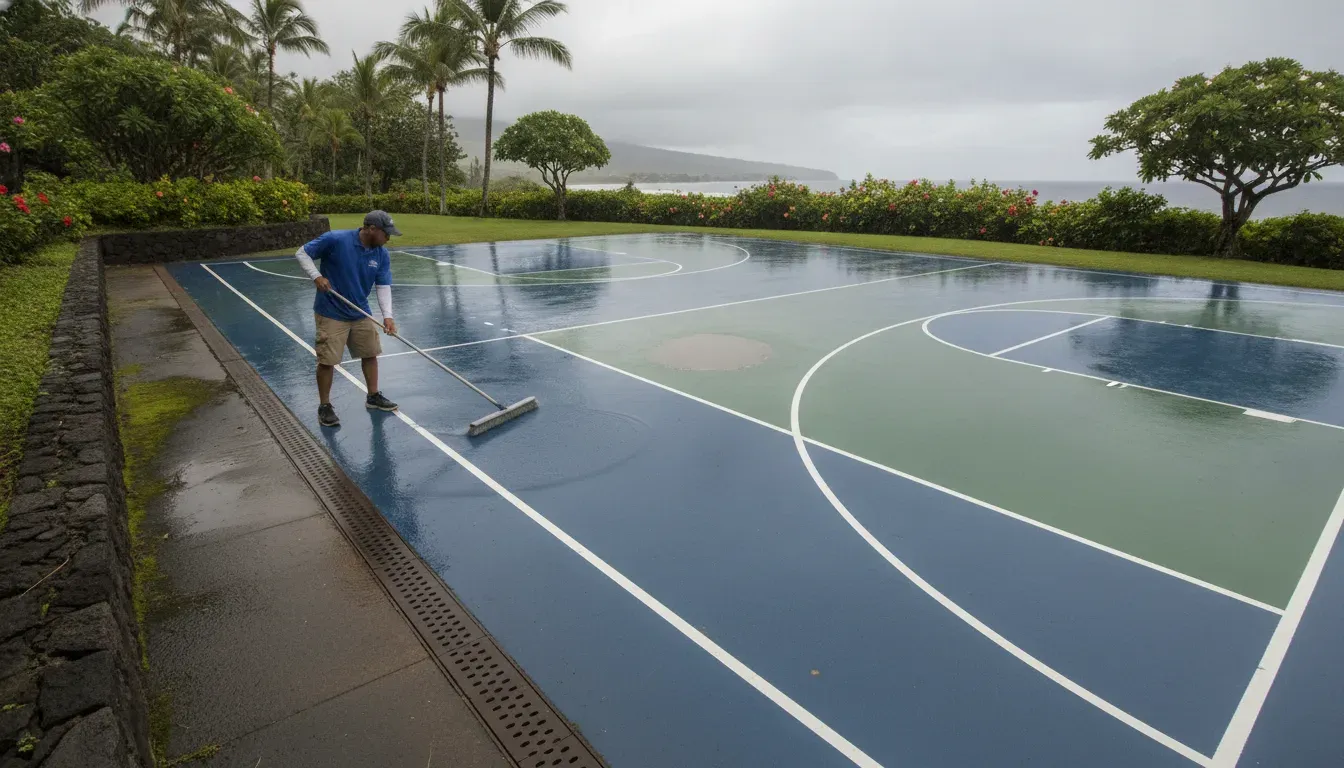
Sports court maintenance in Hawaii calls for a schedule that reflects local conditions, not a mainland calendar. Humidity, rainfall, intense UV exposure, salt air, and island-specific ground conditions can all affect how a court looks and performs. A simple routine helps owners catch debris, standing water, algae, and early surface changes before they become safety concerns. This checklist is for homeowners, HOAs, resorts, schools, and property managers. For the bigger picture on local ground movement and cracking, see our court repair and maintenance services.
Why Hawaii Courts Need a Different Maintenance Schedule Than Mainland Courts
There is no single maintenance calendar that fits every Hawaiian court. A court exposed to salt air near the coast may need more frequent rinsing and inspection than a sheltered inland court. A shaded surface that stays damp can collect organic debris and develop slippery growth sooner than a sunny, well-drained court. Rainfall patterns also vary by island and by location, so property managers should use the condition of their own facility as the guide.
Think in terms of wet and drier periods rather than assuming four sharply defined seasons. During wetter stretches, check more often for puddles, blocked drainage, leaves, and slick areas. During sunnier periods, pay closer attention to fading, surface wear, and loose debris. After a major storm or a period of heavy use, inspect the court even if it is not on your usual calendar.
Regular care is not a substitute for repairing a failing surface. It is a way to notice changes early and keep the playing area clear. For tennis, basketball, pickleball, volleyball, and multi-sport courts, the appropriate coating, layout, and equipment can differ. Hawaii Court Resurfacing provides court construction, resurfacing, repair, and maintenance services across the islands.
Build the schedule around the court’s exposure rather than applying the same interval everywhere. For example, a court under trees may need debris removed several times a week during periods of leaf or seed drop, while an open court may need sweeping less often but more checks for windblown sand. A coastal facility can make a brief rinse part of its routine when the surface system and local water-use rules allow it. A shaded court that remains damp into the afternoon may need more frequent checks for slickness than a court that dries quickly.
Also consider who uses and manages the facility. A private court may need a short owner walk-through, while an HOA, school, or resort benefits from an assigned staff member and a written process for reporting hazards. Put the responsible person’s name, inspection date, and any follow-up action in one shared log. That way, a wet patch noticed by one staff shift is not overlooked by the next.
Monthly Court Maintenance Tasks for Hawaii’s Humid Climate
A short monthly walk-through is a useful baseline for most facilities. Increase the frequency if the court is shaded, near the ocean, surrounded by trees, heavily used, or exposed to frequent rain. Put the inspection on a calendar and record what you see, so small changes are easier to compare over time.
- Clear the surface. Sweep or use a soft-bristle broom to remove leaves, sand, seed pods, and other loose debris. Pay attention to corners and fence lines, where material tends to collect.
- Check drainage. Look for blocked drains, channels, or outlets and clear debris that you can safely reach. Note where water remains after rainfall rather than assuming every low spot is a surface defect.
- Look for slick areas. Check shaded and damp sections for algae, mildew, or other buildup. If an area feels slippery, keep people off it until it has been cleaned and is fully dry.
- Inspect visible cracks and joints. Note the location, approximate length, and whether a crack appears to have changed. Photographing the same area from a consistent angle can help track change.
- Check lines, coating, and edges. Watch for peeling, worn-through coating, fading, or edges that appear to be lifting. Do not scrape or patch a coated playing surface with an unapproved product.
- Inspect equipment and access points. Look over nets, posts, hoops, fencing, gates, and windscreens for visible looseness or damage. Follow the equipment maker’s guidance for adjustments or repairs.
- Record use and weather observations. Note heavy use, storms, persistent puddles, or areas that remain damp. Those details help a contractor assess a problem if the condition worsens.
Keep the checklist practical: a dated note and a few photos are more useful than a complicated form nobody completes. For larger facilities, assign one person to do the monthly inspection and another to review any maintenance requests. If resurfacing or a larger repair may be needed, you can compare the current condition with examples in the court project portfolio.
Make the walk-through systematic so that the whole site gets attention. Start at the entrance and follow the perimeter once, checking the fence line, corners, and drains. Then walk the playing area in parallel passes, looking for changes in coating, traction, lines, and cracks. Finish with equipment and access points. A consistent route reduces the chance that a familiar problem draws attention away from a new one elsewhere.
For an HOA or school, keep the inspection record useful to the next person. Write down the exact court and area, not just “crack by the net.” Note whether the issue was present before or after rain, whether play was affected, and what action was taken. If a concern is closed off, include who was notified and when the area can be checked again. These simple details help the manager decide whether routine cleaning is enough or a professional evaluation is appropriate.
How to Inspect for Early Signs of Cracking and Surface Wear
Inspect the court when the surface is dry and, where possible, in good light. Walk the entire playing area and perimeter rather than checking only the most visible section. Look across the surface from a low angle as well as straight down; changes in texture or level can be easier to see when light falls across them.
Use a simple record for each concern: its location, what it looks like, when you first noticed it, whether it changes after rain, and whether it affects play. Take a photo with a nearby fixed reference, such as a line intersection or fence post. Avoid marking the court with paint or tape unless the surface system permits it.
Pay attention to these signs:
- Cracks that lengthen, widen, or branch. A recurring or changing crack deserves professional assessment, especially if there is visible displacement or a difference in level across it.
- Repeated puddling or slow drainage. Water that remains in the same area may point to a drainage or slope concern. Record where it forms and how long the area stays wet.
- Blisters, peeling, or loose coating. These can create uneven or unsafe play and should not be pulled or scraped away by hand.
- Areas that look or feel different. A rough patch, exposed base, unusual soft spot, or abrupt change in traction can signal that routine cleaning alone will not address the issue.
- Persistent stains or growth. If a stain or slick area returns soon after cleaning, identify the source of moisture or debris rather than repeatedly applying stronger chemicals.
Routine inspection does not diagnose what is happening below a court surface. Hawaii’s volcanic and coral soils, root impacts, and site-specific movement can make crack assessment more complex than a cosmetic patch. Hawaii Court Resurfacing uses a proprietary crack filling and leveling system designed for conditions in Hawaii; a site evaluation can help determine whether a concern calls for a repair or a broader scope. Read the related overview of the court evaluation and project process for a sense of what information helps with an assessment.
It helps to separate an observation from a conclusion. A photo of a crack or a puddle is evidence of what you see, but it does not establish why it occurred or which repair is suitable. When comparing photos over time, use the same viewing angle and include the same fixed reference. If the affected area changes, send the dated images with a short note describing rainfall, cleaning, or heavy use around that time. This context is more useful than guessing at a cause or applying a surface patch based only on appearance.
Keep a short “watch list” for conditions that are not an immediate hazard but need another look. For instance, record the location of a small crack, take a baseline photo, and set a reminder to check it on the next monthly walk-through. If it lengthens, branches, creates a level difference, or recurs after a previous repair, move it from watch list to professional review. For a slick area or trip hazard, do not wait for the next scheduled inspection; restrict access and report it promptly.
Cleaning Protocols to Prevent Algae, Mold, and Mineral Buildup
Remove loose material first. Sweep leaves, sand, and dirt off the court so that scrubbing does not grind grit into the coating. For ordinary dirt, use water and a soft brush or other gentle cleaning method that is compatible with the court’s surface system. Follow any product or facility guidance supplied for the installed coating.
For a persistent mark or growth, begin with a small, inconspicuous area and a gentle approach. Avoid aggressive scrubbing, abrasive pads, solvents, and harsh chemicals unless the coating manufacturer or a qualified court professional confirms they are suitable. An unsuitable cleaner can damage the surface or affect its texture. Do not mix cleaning products, and follow the product label and applicable safety directions.
Pressure washing is not automatically the right solution. High pressure or an incorrect nozzle and distance may damage coatings, lines, or vulnerable edges. Confirm that the surface system allows it and use the recommended method. If you are unsure what was applied to the court, ask a professional before using pressure equipment or a chemical treatment.
Rinse cleaned areas as appropriate, then allow the surface to dry fully before reopening it. Do not let players use a wet or slick court. If algae or mildew repeatedly returns, check for overhanging vegetation, blocked drainage, and places that stay shaded or damp. Trimming vegetation or improving routine debris removal may help, but significant drainage or surface problems need an assessment.
Salt and mineral residue can be more noticeable on courts exposed to coastal air or hard water. Use a gentle rinse when suitable for the site, and avoid leaving sediment to accumulate in corners. Follow local water-use restrictions and the court system’s care instructions. If discoloration remains or the coating appears to have changed, document the area rather than escalating to a stronger cleaner without advice.
Choose a cleaning window that allows the surface to dry completely before scheduled play. If the court is used by a team, class, or resort guests, post a temporary closure notice and let the person responsible for reopening know that the surface must be dry and safe. Do not rely only on a set drying time, since shade, humidity, airflow, and rain can change how quickly a particular area dries. Check the entire playing surface, including the shaded edge and areas near drains, before allowing use to resume.
Avoid moving soil and organic debris back onto a clean court. After sweeping, check nearby vegetation and the fence perimeter for branches or leaves that are likely to fall again. Keep drain grates and accessible channels clear, but do not remove covers or enter drainage structures unless trained and authorized to do so. If water repeatedly carries sand or dirt onto the surface, note where it enters and ask a qualified professional to assess the site rather than trying to alter grading yourself.
What Should You Do During Wet and Drier Periods?
Instead of treating seasonal maintenance as four identical quarterly jobs, adjust the checklist to local weather. The table below gives a practical starting point. A court’s exposure, material, use, and drainage can change what makes sense.
| Period or condition | Maintenance focus | What to check |
|---|---|---|
| Wetter, rainy stretches | Keep drainage clear and reduce slippery buildup | Leaves in drains, persistent puddles, shaded damp areas, algae, and loose debris after storms |
| Sunny, drier stretches | Watch for wear and protect the surface from avoidable damage | Fading, worn coating, cracks, line condition, dry debris, and exposed edges |
| After a major storm | Inspect before returning to normal use | Standing water, windblown branches, sand, damaged fencing or equipment, and new surface changes |
| After heavy use or an event | Restore a clean, safe playing area | Trash, scuffs, debris, equipment condition, and any new slick or damaged areas |
| Year-round monthly check | Document gradual changes | Crack locations, coating, drainage, access, equipment, and photos for comparison |
For sites with several courts, create separate notes for each surface. A shaded pickleball court and an open basketball court at the same property can have different cleaning and drying needs. If your facility is considering a change in sport or layout, review the relevant pickleball court resurfacing or basketball court resurfacing information before assuming the maintenance plan will be identical.
After a storm, first make the area safe to inspect. Keep players off the court if water, branches, sand, or damaged equipment could create a hazard. From outside the affected area, look for obvious debris and visible damage. Remove loose material only when it is safe to do so, then check drains and outlets that are accessible without special tools. Once the surface is dry, complete the usual walk-through and compare new concerns with the prior month’s photographs.
For properties with a court calendar, use a brief post-event reset as well as the monthly inspection. Remove trash and loose debris, check that gates and equipment are in normal condition, and note any new scuffs or slick areas. If an event involved temporary equipment, confirm that nothing was dragged across the coating or left to trap moisture. This practical reset helps separate ordinary wear from changes that need follow-up.
When to Call a Professional vs. Handle Maintenance Yourself
Owners and facility staff can generally manage routine observation and light cleaning when they understand the surface care instructions and can do the work safely. Sweeping debris, keeping drains clear, documenting changes, and reporting an unsafe area are practical maintenance tasks. Keep people off a court that is visibly slippery or has a trip hazard until the issue is addressed.
Call a court professional when the issue goes beyond ordinary cleaning or when you are unsure whether a repair method is compatible with the surface. That includes cracks that grow or return, standing water that persists, delamination or peeling, exposed base material, recurring slippery growth, significant fading or wear, or any uneven area that affects play. Avoid filling a crack or applying paint or coating based on appearance alone. The visible surface may not reveal the underlying cause, and an incompatible patch can complicate later work.
It also makes sense to request an assessment before planning a larger project. Share the court type, approximate age if known, island and site conditions, the maintenance history, and clear photos of the affected areas. Note how many courts are involved and whether the property needs tennis, pickleball, basketball, volleyball, or multi-sport use. Hawaii Court Resurfacing serves Oahu, Maui, the Big Island, Kauai, Molokai, and Lanai, and its project process explains the steps from discovery through final walkthrough.
For a broader introduction to the company and its Hawaii-specific approach, visit the Hawaii Court Resurfacing team page. A maintenance note does not commit you to resurfacing; it gives a professional useful context to assess what the court needs.
Before contacting a contractor, gather the details that affect the next step: court type and approximate dimensions if known, island and whether the site is coastal or shaded, the main concern, when it first appeared, whether it changes after rain, and photos from more than one angle. For multiple courts, label each image with the court and location so the condition is easy to identify. Include any known history of cleaning or repair products. Avoid making a repair attempt just to improve the photos; an altered area can make the original condition harder to evaluate.
At the site, the assessment may distinguish a maintenance issue from a surface or drainage concern. Ask what is included in the recommended scope, what information remains uncertain, and whether the proposed repair is appropriate for the installed court system and local ground conditions. If resurfacing is being considered, explain how the court is used and whether its sport or layout may change. Owners planning a new project can also explore court design options before discussing layout and colors.
Frequently Asked Questions
How often should a sports court in Hawaii be cleaned?
Use a monthly walk-through as a baseline, then sweep as needed to prevent leaves, sand, and other debris from building up. Check more often if the court is shaded, near the coast, surrounded by trees, used heavily, or exposed to frequent rain.
Can I use bleach or a pressure washer on an acrylic court?
Do not assume either is safe for your particular surface. Check the coating manufacturer’s care directions or ask a court professional before using chemicals or pressure washing. Use gentle methods for routine cleaning and avoid abrasive tools or unapproved products.
What should I do if a crack appears?
Record its location, take a photo, and monitor whether it changes. Do not apply a generic filler or paint over it without confirming the correct repair method. Contact a professional if it widens, returns after repair, has uneven edges, or affects play.
Does every court need the same seasonal checklist?
No. Sun exposure, shade, salt air, rainfall, drainage, vegetation, court use, and the surface system all matter. Use the schedule as a starting point and adjust it based on what your own inspections show.
Contact us to discuss your court
Consistent observation, gentle cleaning, and timely professional advice can help you keep a Hawaii sports court safer and make better-informed decisions about its care.