
Converting a tennis court to pickleball in Hawaii can create more ways to use an existing recreation area without automatically starting from bare ground. The right plan begins with the court’s base, drainage, surface condition, available space, intended sports, and the needs of the people who will use it.
Ready to explore a conversion? Request a free estimate from Hawaii Court Resurfacing.
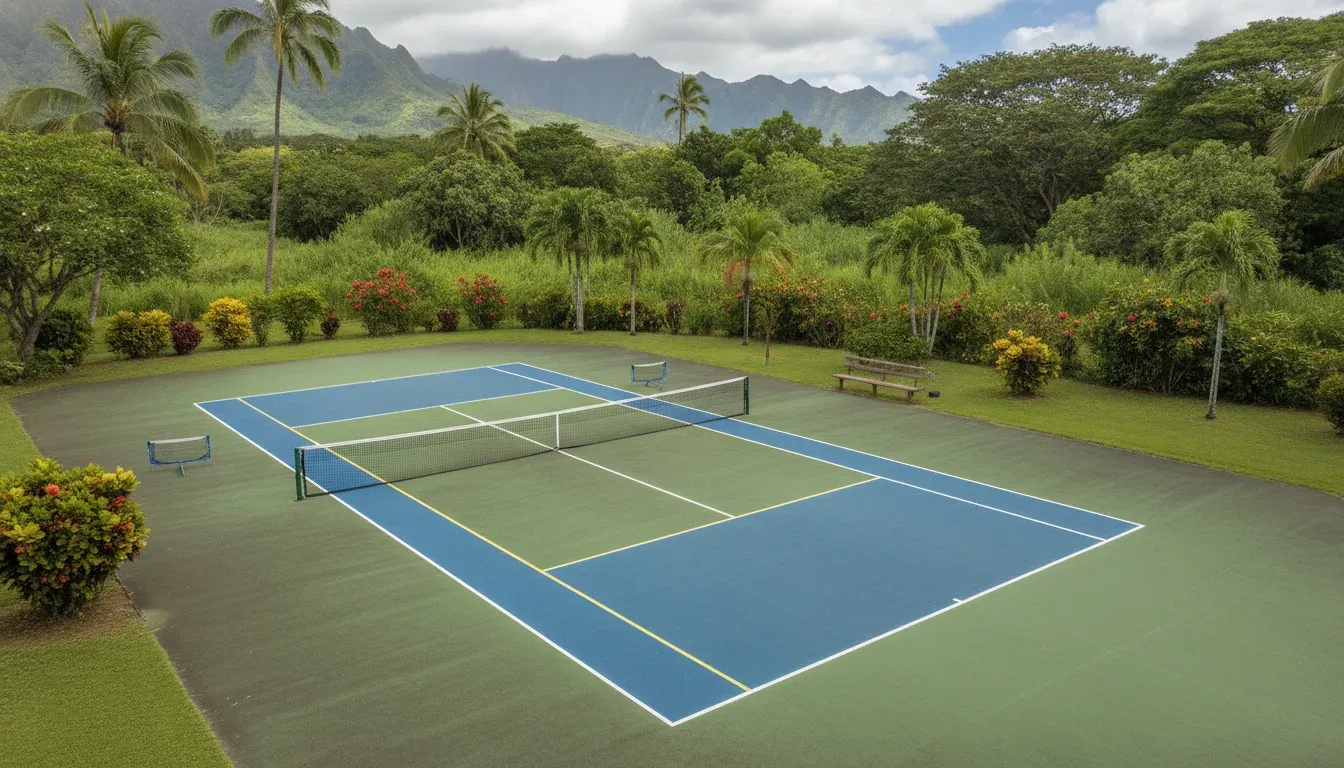
This guide explains how a tennis-to-pickleball conversion works, how many pickleball courts may fit, which site conditions matter in Hawaii, and when a new build may be the better option. It is practical planning guidance, not a substitute for a site evaluation or project-specific proposal.
Can You Convert a Tennis Court to Pickleball in Hawaii?
Yes, many existing tennis courts can be evaluated for pickleball conversion, provided the structure, surface, drainage, access, and surrounding space support the intended layout. Conversion may involve adding pickleball lines, changing or refreshing the surface, installing pickleball nets and posts, adjusting fencing, or creating a shared-use design that keeps tennis playable.
The word can matters. A tennis court that looks usable from a distance may have cracks, low spots, ponding, root damage, peeling coatings, or structural movement that needs attention before new lines are added. Hawaii’s volcanic and coral soils, roots, rainfall, humidity, UV exposure, and salt air also make local evaluation important. New striping cannot correct a moving base or standing water.
Hawaii Court Resurfacing provides pickleball conversions, line striping, resurfacing, crack repair, leveling, fencing, windscreens, and equipment installation across Oahu, Maui, the Big Island, Kauai, Molokai, and Lanai. Review the pickleball court services page for the broader service scope, then use an evaluation to determine what your court actually needs.
What Does a Pickleball Court Conversion Involve? Step-by-Step
A conversion is more than painting a smaller rectangle inside a tennis court. The scope should match the current court condition and the way the property plans to use the space.
- Define the use: Decide whether the goal is dedicated pickleball, tennis and pickleball sharing, recreational flexibility, or a multi-court facility. Include the users, hours, access rules, and future plans.
- Document the existing court: Gather photos and video of the surface, cracks, low areas, drainage paths, fences, gates, equipment, landscaping, and access routes.
- Evaluate the structure and surface: Review the base, coating condition, levelness, cracks, root pressure, drainage, and any areas that may need repair or leveling before coating or striping.
- Plan the layout: Confirm court positions, safety runoff, net locations, shared tennis lines, fencing, gates, and circulation. The layout should be drawn for the actual property, not copied from a generic diagram.
- Choose the surface scope: Depending on condition, the project may need cleaning, repairs, leveling, resurfacing, color coating, or only a limited line conversion. The appropriate choice follows the evaluation.
- Install lines and equipment: Apply accurate pickleball markings, coordinate any retained tennis lines, and install the selected net posts, nets, dividers, fencing, windscreens, or other accessories.
- Inspect and hand off: Complete a final walkthrough, clarify care requirements, and confirm that the finished layout matches the approved scope.
Hawaii Court Resurfacing describes a nine-step process from discovery through final walkthrough. Its court construction and resurfacing process can help homeowners, HOAs, resorts, schools, clubs, and property managers prepare the right questions before requesting a proposal.
How Many Pickleball Courts Fit on a Standard Tennis Court?
A regulation pickleball playing area is 20 feet wide by 44 feet long. USA Pickleball also recommends planning a larger overall playing surface, about 30 by 60 feet for a basic layout and 34 by 64 feet as a preferred size, so players have more room beyond the marked court. See the USA Pickleball court construction guidance for the dimensions and planning considerations.
Many tennis courts can be evaluated for more than one pickleball court, and a layout may sometimes accommodate up to four. That number is not a promise. The usable count depends on the tennis court dimensions, required runoff, court orientation, fencing, gates, access paths, lighting, nearby structures, and whether the tennis layout must remain functional.
For a shared-use design, the goal is not to fit the maximum number of lines. The goal is to create a layout that is safe, legible, maintainable, and appropriate for the users. A resort may prioritize guest flow and appearance. An HOA may need a simple layout that works for different skill levels. A school or park may need durable access routes, supervision sightlines, and clear separation from other activities.
| Planning question | Why it matters | What to confirm |
|---|---|---|
| How many courts are needed? | More lines can increase capacity but may reduce space for movement and circulation. | Desired capacity, users, and whether tennis remains playable. |
| What needs to stay? | Existing tennis lines, net systems, fencing, and gates may affect the conversion. | Shared-use goals and any equipment to retain or replace. |
| What surrounds the court? | Buildings, trees, slopes, roads, and landscaping can limit safe runoff and access. | Setbacks, gates, maintenance paths, and drainage. |
Which Parts of a Tennis Court Should Be Evaluated First?
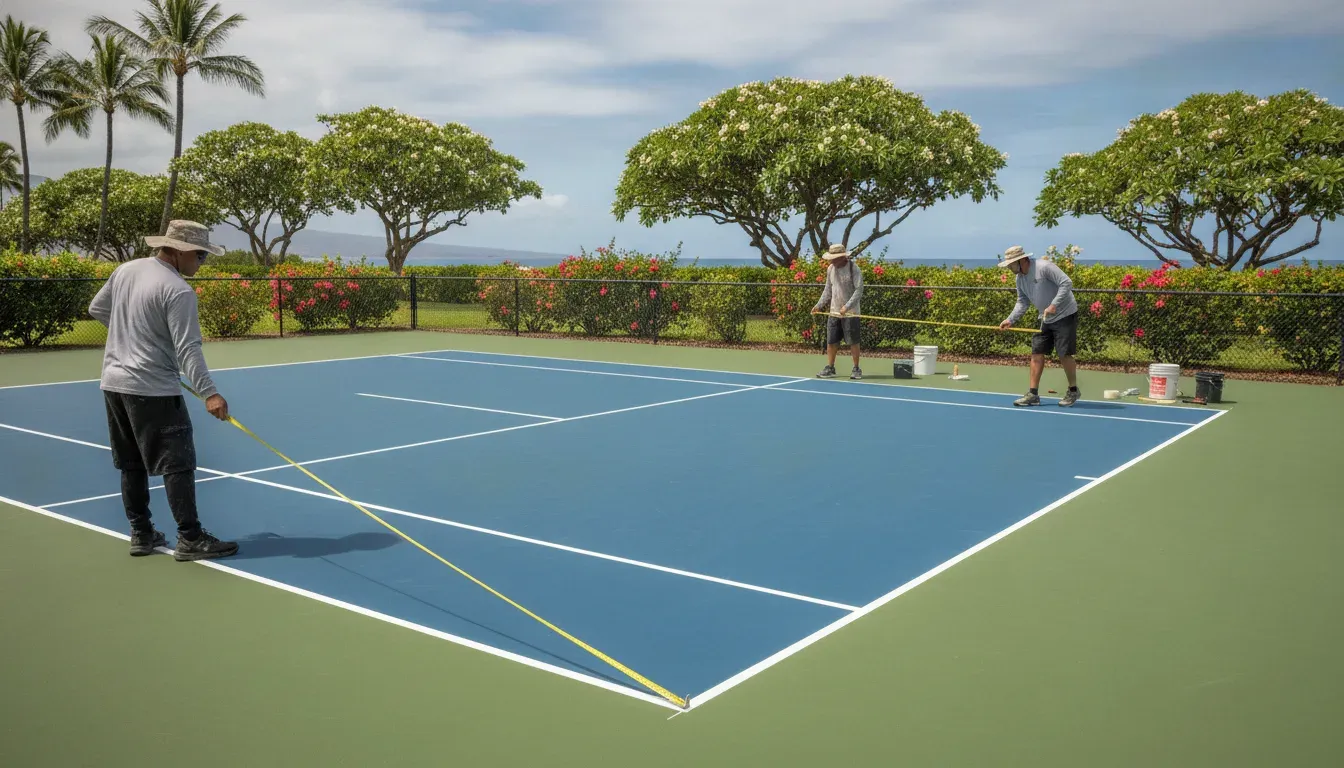
The existing court should be evaluated from the ground up before the conversion scope is chosen.
Surface condition and cracks
Look for visible cracks, peeling or bubbling coatings, faded areas, slippery areas, and patches that may affect ball response. Minor surface wear may call for a different scope from widespread cracking or structural movement. New lines should be applied only after the surface is suitable for the intended use.
Drainage and low spots
Rainwater should move away from the playing surface rather than collect in low areas. Ponding can shorten the useful life of coatings and make the court less comfortable to use. A site review should consider grades, drains, runoff routes, and whether nearby landscaping directs water toward the court.
Soil, roots, and movement
Expansive soils and root damage can affect pavement and create cracks or uneven areas. Hawaii Court Resurfacing uses a proprietary crack filling and leveling system designed for Hawaii’s expansive volcanic and coral soils and root damage. The system is not a guarantee against future movement, so the recommended repair or resurfacing scope should be based on observed conditions.
Access, fencing, and equipment
Materials and equipment need a practical path to the court. Fences, gates, windscreens, divider nets, net posts, lighting, seating, and maintenance access can all affect the layout. Identify these items before striping so the final design works as a complete facility rather than only as a set of lines.
Converting vs. Building New: Which Is Right for Your Property?
Conversion is often worth evaluating when the existing court has a sound base, workable dimensions, appropriate access, and a layout that serves the property’s goals. It may reduce the amount of new site work compared with starting over, but the final recommendation depends on the court’s condition and the desired number of courts.
New construction may be more appropriate when the existing court has major structural problems, poor drainage, inadequate space, difficult circulation, or a layout that cannot support safe use. A new build also makes sense when the owner wants a different court location, a larger facility, new base work, or infrastructure that the existing court cannot accommodate.
| Conversion may fit when… | New construction may fit when… |
|---|---|
| The existing base and drainage are serviceable after evaluation. | The base, grade, drainage, or structural condition requires extensive rebuilding. |
| The property can support the desired layout and safe runoff. | The current footprint cannot provide the needed capacity or access. |
| The owner wants a shared tennis and pickleball facility. | The owner wants a new location or a dedicated multi-court facility. |
| Repair, resurfacing, striping, and equipment can meet the goal. | New grading, base, utilities, fencing, or other infrastructure is needed. |
For broader planning context, read the Hawaii tennis court construction guide. That pillar covers new-build decisions, site planning, process, budget factors, and contractor questions. This conversion article focuses on the separate decision of adapting an existing court and should not replace a site-specific review.
How Much Does a Tennis-to-Pickleball Conversion Cost in Hawaii?
There is no responsible one-size-fits-all conversion price. The investment depends on the existing surface, repairs, crack and leveling requirements, drainage, number of courts, striping, resurfacing, color changes, nets, posts, fencing, windscreens, access, island logistics, and other site conditions.
For planning only, smaller projects generally fall around $8,000-$15,000, medium resurfacing or reconstruction projects around $20,000-$50,000+, and full construction or large facilities at $50,000+. A multi-court conversion can land in a different range from a simple line conversion. These figures are planning guidance, not a quote or guarantee.
A useful proposal should separate the current-court evaluation, repairs, surface preparation, coating or resurfacing, line striping, equipment, fencing, cleanup, and final walkthrough. It should also explain assumptions about access, drainage, weather, and the number of playing areas. If payment terms apply, Hawaii Court Resurfacing states that a 50% deposit secures scheduling and material ordering, with the remaining 50% due after completion and customer approval. Confirm current terms in the project proposal.
Frequently Asked Questions
Can any tennis court be converted to pickleball?
No. Many tennis courts can be evaluated for conversion, but the existing base, surface, drainage, dimensions, access, and surrounding space must support the proposed layout. A site review is needed before deciding whether to add lines, resurface, repair, rebuild, or start with new construction.
Can tennis and pickleball lines share one court?
Yes, a shared-use layout may be possible when the court has enough space for clear lines, safe movement, and practical net placement. The design should consider visual clarity, player circulation, fencing, lighting, and whether the owner wants tennis to remain a primary use.
Will adding pickleball lines fix cracks or drainage problems?
No. Striping changes the markings, not the structure beneath them. Cracks, low spots, ponding, root damage, or unstable areas should be assessed and addressed through the appropriate repair, leveling, resurfacing, reconstruction, or new-build scope.
How many pickleball courts can fit on one tennis court?
Some tennis courts can accommodate multiple pickleball courts, sometimes up to four, but the safe number is site-dependent. Court dimensions, runoff, fencing, access, equipment, shared tennis use, and local site conditions all affect the final layout.
Does Hawaii Court Resurfacing serve every island?
Hawaii Court Resurfacing serves Oahu, Maui, the Big Island, Kauai, Molokai, and Lanai. The company uses trained full-time in-house crews and evaluates the property, access, condition, and project goals before recommending a conversion scope.
Plan Your Hawaii Pickleball Court Conversion
A tennis-to-pickleball conversion should be designed around the existing court and the way the property will use it. Evaluating the base, drainage, cracks, roots, surface, access, layout, equipment, and future maintenance helps prevent a line-only solution from overlooking the conditions that determine long-term performance.
Hawaii Court Resurfacing can help homeowners, HOAs, resorts, schools, clubs, property managers, and public facilities compare conversion, resurfacing, repair, reconstruction, and new-construction options. Request a free estimate and share your island, court photos, approximate dimensions, current problems, desired number of pickleball courts, and whether tennis should remain in the layout. Inquiries are typically answered within 24 hours.