
Choosing court fencing and windscreens in Hawaii takes more than selecting a color. Trade winds, salt air, sun exposure, rain, court use, and the surrounding property all affect what may work well. This guide explains the main options and planning decisions for owners and managers of tennis, pickleball, basketball, and multi-sport courts.
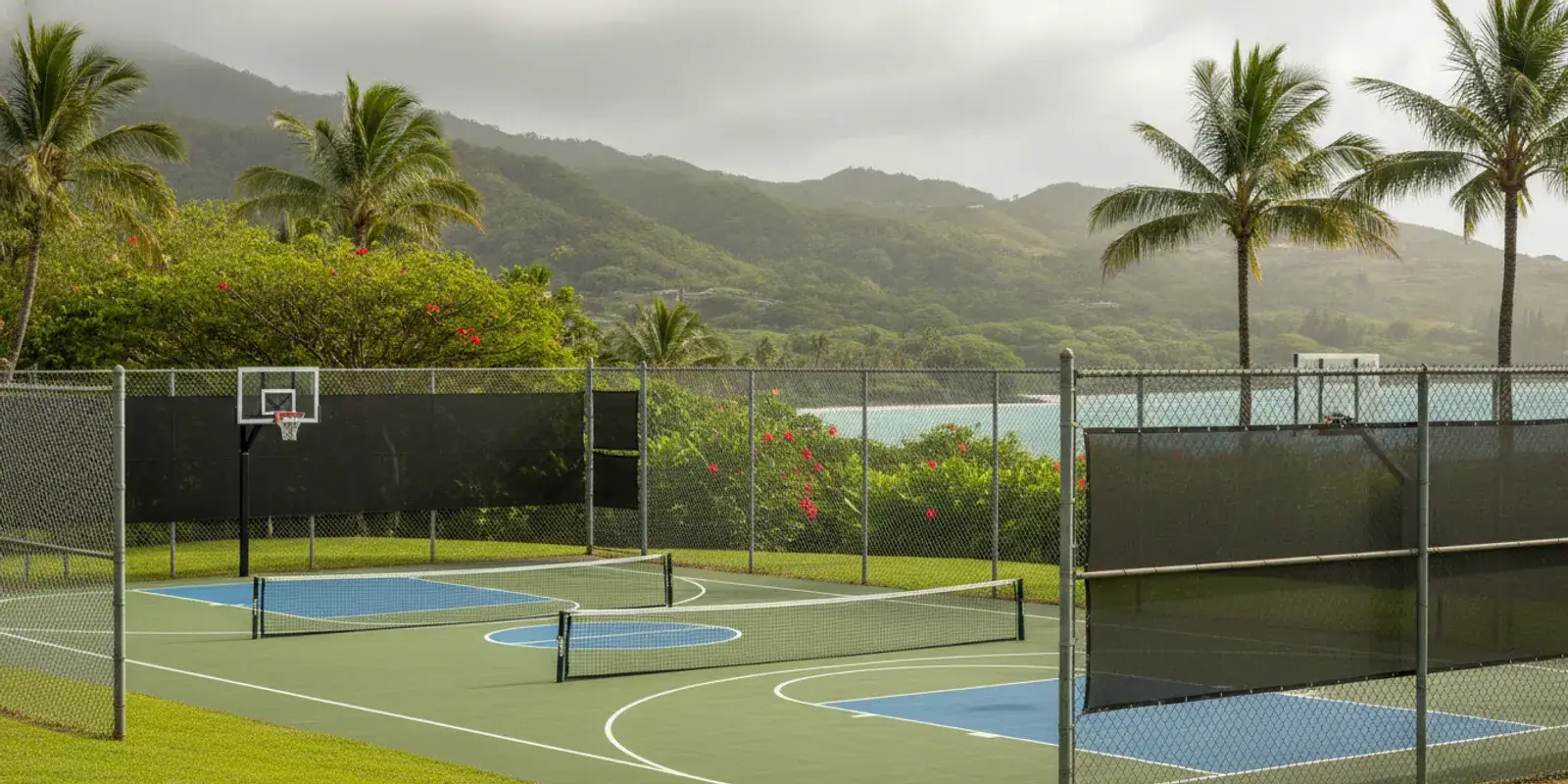
Why Court Fencing and Windscreens Matter in Hawaii’s Trade-Wind Climate
Fencing defines the playing area and helps keep balls within the court, while windscreens can provide visual screening, reduce distractions, and create a more finished appearance. On a busy property, a well-planned perimeter can also help separate active play from walkways, parking, landscaping, and other shared spaces.
Hawaii’s outdoor courts face conditions that deserve attention during planning. Salt carried through coastal air can contribute to corrosion on exposed metal. Strong sun and humidity can wear on some finishes and fabrics over time. Trade winds can put pressure on a screen and its attachments, especially when a large, relatively solid surface is exposed. Rain, drainage, nearby vegetation, and the court’s orientation matter too.
These factors do not point to one universally best fence or screen. The right choice depends on the site, the structure, how much screening is wanted, maintenance capacity, and the facility’s budget. A court beside the ocean may need a different maintenance plan from a sheltered neighborhood court. A resort with several courts may also have different privacy, appearance, and access needs than a private backyard.
Before selecting materials, walk the site and note the prevailing wind direction, salt exposure, slopes, access gates, nearby buildings, and places where wind may funnel between structures. Consider how the fence and screen will affect drainage, sight lines, and access for maintenance. If wind exposure varies along the perimeter, it may be worth evaluating screening by side rather than assuming every fence run should be covered in the same way.
A simple site checklist can make that walk more useful. Photograph each side of the court, including gate locations, existing posts, nearby trees, walls, and areas where water collects. Note which directions feel most exposed, when the court is most used, and where balls most often leave the playing area. This gives the project team concrete information to discuss instead of relying on a general description such as “windy” or “needs privacy.” For more context on how Hawaii’s conditions affect court surfaces and repair decisions, see the company’s information about court services and how a court project works. Fence decisions can be discussed early when surface work is part of the project.
Current local weather and climate information can help facility managers understand conditions at a particular site. The National Oceanic and Atmospheric Administration provides general weather and climate resources at NOAA; site-specific design and installation decisions still require an evaluation of the actual property.
Chain Link vs. Vinyl-Coated Fencing for Hawaii Sports Courts
Chain-link fencing is a common court perimeter because it allows visibility and airflow while forming a clear boundary. A vinyl-coated finish adds a colored coating over the metal and can create a more finished look. The coating does not remove the need to consider the underlying metal, installation details, exposure, or ongoing inspection. In a salt-air setting, owners should ask what materials and finish are proposed and how they should be cared for.
Plain galvanized chain link and vinyl-coated chain link are not simply a choice between low and high quality. They can differ in appearance, initial cost, and maintenance expectations, while the specific product and site conditions influence long-term performance. Gate frames, posts, fittings, fasteners, and connection points deserve attention alongside the mesh. These components have different shapes and exposure, and small areas of damage can be easier to miss if inspections focus only on the fence fabric.
| Option | What it offers | Planning considerations |
|---|---|---|
| Galvanized chain link | Open visibility and airflow with a practical court boundary. | Ask about material specifications, salt-air exposure, finish care, and inspection of posts, gates, and fittings. |
| Vinyl-coated chain link | A coated appearance with color choices that may coordinate with a facility. | Confirm what the coating covers, how to address damage, and what maintenance is recommended for the selected product. |
| Chain link with windscreen | Combines a permeable fence structure with added visual screening. | Screen coverage changes wind exposure. Consider the site’s wind, attachment method, fence structure, and whether partial coverage is more appropriate. |
Use this comparison as a starting point rather than a product specification. Request details about the proposed mesh, coating, posts, fittings, and gates. Ask how the installer accounts for the site’s exposure and what regular checks the owner should make. A written proposal should clarify the scope so the selected materials and any screening coverage are clear.
When assessing a coating, ask what happens if it is cut, scraped, or worn at a connection point. Find out whether the manufacturer provides care instructions and what repair method it recommends. Also look at the whole assembly: mesh connected to posts, hinges and latches at the gates, and hardware where the screen attaches. A durable-looking panel does not by itself tell you how the entire perimeter will perform or be maintained.
Also think about how a fence will function day to day. Gate placement can affect player circulation, maintenance access, and emergency access requirements. Fence height and openings should be considered in relation to the sport, ball containment, adjacent uses, and applicable project requirements. Confirm those requirements with the relevant project professionals and authorities rather than relying on a generic rule of thumb.
For facility owners comparing surface work with perimeter improvements, the tennis court resurfacing page offers information about one type of court project. Basketball and pickleball courts have their own play and layout considerations; see information on basketball court resurfacing and pickleball court resurfacing.
Windscreen Materials That Hold Up Against Salt Air and UV Exposure
Windscreens are available in different fabrics, weights, colors, and levels of openness. Their purpose and construction matter as much as the label on the material. Some screens are selected mainly for visual privacy; others are chosen to provide a degree of wind diffusion while preserving airflow. No fabric makes a court immune to wind, sun, moisture, or salt exposure.
When comparing a screen, ask the supplier or installer for product information covering intended use, fabric construction, UV-related guidance, cleaning, attachment hardware, and replacement considerations. Ask whether the screen is designed for the expected exposure and how it should be tensioned and secured. Confirm the specific warranty, if any, in writing. Warranty terms depend on the product and project conditions, so avoid assuming that every screen or installation has the same coverage.
Screen coverage is an important design choice. More coverage can provide more visual screening, but it also presents more surface to the wind. A fully covered perimeter may not be appropriate at every exposed site. Depending on the layout and goals, the owner may consider screening selected sides, using a more open material, or leaving portions of the fence uncovered. The right balance requires evaluating the fence structure and local conditions rather than treating privacy as the only measure.
It helps to define the screen’s main job before comparing samples. If the concern is visual distraction from a road or neighboring activity, a screen on the relevant side may answer the need without enclosing every fence run. If privacy is important around a pool, patio, or guest area, consider whether the court’s use and sight lines call for more coverage. If wind is the concern, do not assume that a screen will act as a wind shield; ask how the proposed openness and installation affect airflow and loading on the fence.
Color and finish also influence the facility’s appearance. A dark screen may reduce visual distractions for some players, while a lighter or brighter color may align with the property’s design. Consider how the screen will look from nearby residences, guest areas, and public spaces, and whether it will make routine visual inspection of the fence more difficult. The screen should complement the court without obscuring signs or access points that need to remain visible.
Maintenance planning can be straightforward. Establish a regular visual check for loose edges, damaged fabric, worn ties, corrosion, bent sections, and gate problems. Inspect after unusually strong winds or storms, and address defects before they grow. Follow the product maker’s cleaning guidance rather than using harsh cleaners that could damage a coating or fabric. Keep vegetation trimmed back where it traps moisture or interferes with the fence, while respecting the site’s landscaping plan.
For a useful inspection, walk both sides of the perimeter rather than checking only from the court. Look for ties that have loosened, edges that flap, small tears around attachment points, and places where fabric rubs against metal. Check whether gates swing and latch as intended and whether vegetation, debris, or standing water is affecting access. Record the date and any repair needs, then compare observations over time. A consistent log can help distinguish an isolated issue from a recurring area that needs a revised maintenance approach.
Fencing Options for Resort, HOA, and Private Court Applications
Different facilities place different demands on a court perimeter. An HOA or condominium association may prioritize a durable, consistent appearance and clear separation from shared walkways. A hotel or resort may want screening that supports guest privacy and fits the broader property design. A school, government facility, park, or club may focus on access control, visibility, safety, and long-term maintenance. A private owner may be balancing cost, appearance, and neighborhood context.
- HOAs and condominium communities: Identify who approves the scope, how residents and contractors will access the work area, and which neighboring areas need protection. Share material and color selections with the appropriate decision-makers before ordering.
- Hotels and resorts: Consider guest sight lines, quiet areas, adjacent amenities, and the visual standards of the property. Plan work to coordinate with operations, without assuming a construction schedule until it has been assessed.
- Schools, parks, and public facilities: Review access needs, gate use, supervision, and applicable purchasing or project requirements. Make sure the intended users and facility operators can comment on the layout.
- Private courts and clubs: Match the perimeter to the sports played, the property’s boundaries, and the amount of privacy desired. Keep future maintenance access in mind when locating gates and screen sections.
For all facility types, clarify which party is responsible for decisions about property lines, permits, utility locations, access rules, and any required reviews. These items can vary by site and project. Do not assume that a fence can be moved or installed in a particular location without checking the relevant property documents and requirements.
In a shared facility, map the people and activities next to each court side. For example, an HOA might want to keep a gate convenient for players while directing pedestrian traffic away from the court entrance. A resort may need to coordinate the fence appearance with nearby guest spaces while preserving clear maintenance access. A school or park may need staff input on supervision and access. These are planning questions, not universal prescriptions; the site owner should identify who needs to review the layout before materials are selected.
Budget discussions should compare complete scopes rather than just fence fabric. A proposal might cover some combination of new fence runs, repairs, gate adjustments, screen panels, attachment hardware, and work around the existing court. Ask which items are included, which existing components will remain, and what conditions could change the scope. That makes it easier for a board, manager, or owner to compare alternatives and explain the decision to other stakeholders without mistaking a partial quote for a complete project plan.
Hawaii Court Resurfacing provides court construction and maintenance services across Oahu, Maui, the Big Island, Kauai, Molokai, and Lanai. For project context, see the company’s background and experience and examples in its project gallery. A site discussion can help identify how fencing or screening fits the court’s use and condition; it is not a substitute for approvals or requirements that apply to the property.
How Fencing and Windscreens Are Installed Alongside Resurfacing
Coordinating fence work with resurfacing can reduce conflicts between trades and help protect a newly finished playing surface. The best sequence depends on the court, fence design, the work required, and site access. Some projects may need fence repairs or post work before surfacing; others may be planned so that perimeter work follows surface preparation. Avoid assuming that one sequence fits every court.
- Review the court and perimeter. Identify cracks or uneven areas, loose fence sections, damaged coating, gate issues, drainage concerns, and obstacles that affect access. Share photographs or video if requested to support an initial discussion.
- Define the intended use. Confirm sports, play patterns, screening goals, gate locations, and any areas where visibility should be maintained. Note whether the court serves residents, guests, students, the public, or multiple user groups.
- Evaluate the site and scope. Review wind exposure, salt exposure, slopes, existing posts, access, and nearby features. Determine whether the scope involves new fencing, repairs, replacement, windscreens, resurfacing, or a combination.
- Agree on materials and responsibilities. Document the fence and screen selections, coverage, hardware, gate details, access needs, and maintenance expectations. Confirm who handles any approvals, property checks, or utility coordination.
- Set a coordinated work plan. Plan material delivery, site access, protection of nearby surfaces, and the order of work with the project team. Timing depends on the specific scope and conditions, so confirm the project schedule rather than relying on a general estimate.
- Inspect completed work. Walk the perimeter and court with the responsible project representative. Check gates, connections, screen tension, surface edges, and the agreed scope. Record any items needing attention before regular use resumes.
Resurfacing work can involve crack repair, leveling, color coating, and line striping depending on the court and project plan. Hawaii Court Resurfacing describes its process as moving from discovery and information gathering through evaluation, quote, design choices, scheduling, construction, and a final walkthrough. Learn more about the project process and use the court design tool if you are exploring court layout or color choices.
Fence installation and resurfacing should be scoped as related but distinct work. A surface contractor should not be assumed to perform every type of fence engineering or specialty installation. Confirm exactly which work is included, who performs it, and how responsibilities are divided. If existing fence posts are being retained, discuss their condition and how work around them may affect the project.
Before work begins, confirm how the court will be accessed, where materials may be staged, and how the playing surface and surrounding landscape will be protected. If the project includes post replacement or repairs near the court edge, clarify how that work relates to surface preparation and finishing. For a multi-court property, agree on which courts or gates will be unavailable at each stage if access needs to be managed. The project team can set a sequence based on actual conditions; a generic schedule cannot account for every site.
What Should You Ask Before Choosing a Fence or Windscreen?
Clear questions make proposals easier to compare. Ask each prospective provider to explain the proposed materials in plain language and relate them to your court’s site conditions. Request a written scope that separates fence, gate, screen, and court-surface work so you can see what is included and what is not.
- What fence mesh, coating, posts, fittings, gates, and screen fabric are included?
- How does the proposed screen coverage account for this property’s wind exposure?
- What routine inspections and cleaning does the product maker recommend?
- How will access, drainage, nearby landscaping, and the existing surface be protected during work?
- Will resurfacing and perimeter work be coordinated, and who is responsible for each part?
- What project-specific warranty terms apply to the materials and installation?
- Which approvals, property checks, or other project requirements should the owner confirm?
Compare proposals by scope and suitability, not just by a single material name or a headline price. A lower-cost option may leave out screen coverage, gate changes, site preparation, or other work you expected. Conversely, adding full screening everywhere may not be necessary for a court whose main need is ball containment. The objective is a fit-for-purpose solution that matches court use, exposure, maintenance capacity, and budget.
For an efficient review, make a short decision sheet with the court’s main purpose, desired screening, the most exposed sides, known access constraints, and the components that need repair or replacement. Share the same information with each provider, then compare how each scope answers those priorities. If an option is excluded, ask whether it is unnecessary for the stated goals or simply outside the quoted work. This makes trade-offs visible and helps decision-makers avoid choosing on a single headline number.
Discuss your court fencing and resurfacing project
For a project-specific recommendation, gather a few current photos, note the court’s location and main uses, and describe what you want the fence or windscreen to accomplish. Hawaii Court Resurfacing typically responds to inquiries within 24 hours, and a site evaluation may be needed to define the right scope.