
Learning pickleball rules makes the game easier to follow, whether you are picking up a paddle for the first time or managing a court used by a community. The basic rules cover serving, scoring, the two-bounce requirement, the non-volley zone, faults, and how singles play differs from doubles. This guide explains those rules in plain language and adds practical notes for owners responsible for a safe, clearly marked court.
What are the basic pickleball rules?
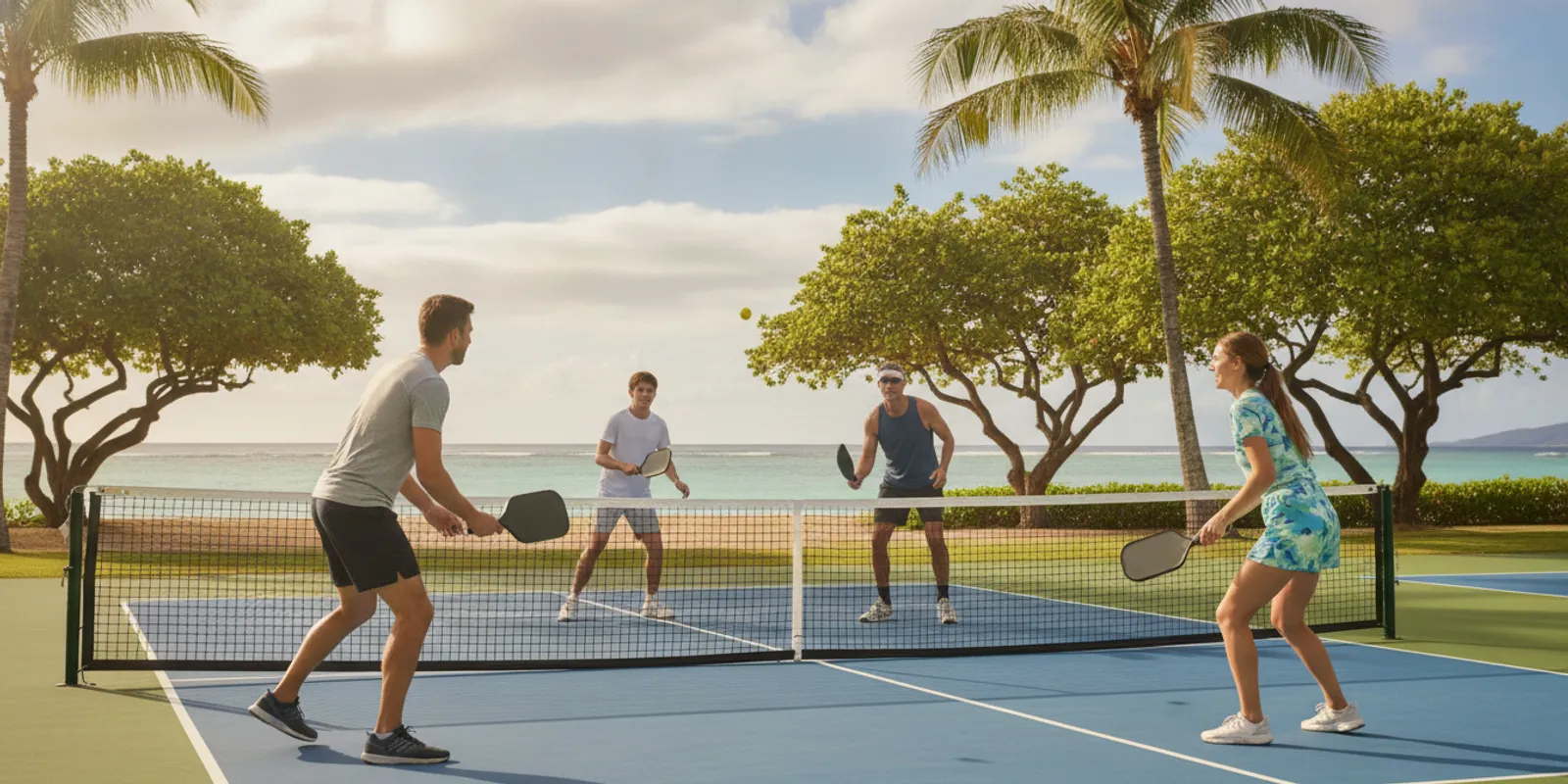
Pickleball is played on a court divided by a net. Players use solid paddles to hit a perforated plastic ball over the net. A rally begins with a serve and continues until one side commits a fault. The side that wins the rally may score, depending on the scoring format being used.
For a quick reference, the main rules are:
- The serve starts each rally and is made diagonally into the opponent’s service area.
- The ball must bounce once on each side before either side may hit a volley.
- The non-volley zone, often called the kitchen, restricts volleys close to the net.
- A ball landing outside the correct boundaries is a fault.
- A player or team must follow the scoring method agreed upon before play begins.
- In doubles, both players generally serve before the opposing team receives the serve, with an exception at the start of the game.
Rules can be presented in a short summary, but players understand them best when the court layout and line markings match the rules. The USA Pickleball rules summary is a useful external reference for checking common rules before play.
How does serving work in pickleball?
The serve begins behind the baseline. It is hit diagonally across the net and must land in the opponent’s service court. The serve must clear the non-volley zone. A serve that lands in the kitchen, on the kitchen line, or outside the correct service court is a fault.
Traditional pickleball serving uses an underhand motion. The ball is contacted below the waist, and the server’s arm moves upward. The server must also keep both feet behind the baseline when making contact. Players should establish the serving method being used before a recreational game, especially if a group follows a newer rule set or local house rules.
A serve is not returned from inside the non-volley zone. The receiver lets the serve bounce before returning it. After that return bounces, the serving side must also let the ball bounce before hitting it. This is the two-bounce rule.
What is the two-bounce rule?
The two-bounce rule requires the served ball to bounce once on the receiving side and the return to bounce once on the serving side. Only after those two bounces may either side hit the ball out of the air. This rule reduces the advantage of standing close to the net immediately after serving.
After the required bounces, a player may choose to volley or let the ball bounce. The two-bounce requirement applies at the start of each rally, not to every shot that follows. A ball may bounce repeatedly during a rally, but a player does not have to wait for another bounce once the opening sequence is complete.
New players often make one of two mistakes: rushing forward before the return has bounced, or assuming every shot must bounce. Practicing the opening serve, return, and third shot as a sequence can make the rule easier to remember.
What is the non-volley zone, or kitchen?
The non-volley zone is the area next to the net on both sides of the court. It is commonly called the kitchen. A player may enter this area to play a ball after it bounces, but may not volley while standing in the zone.
A fault can also occur when a player volleys outside the zone and then steps into the zone because of momentum. The player must regain balance without touching the zone or its boundary line during the volley action. The non-volley zone line is part of the zone, so a volley that contacts that line is not legal.
The kitchen does not prevent all net play. Players may hit a ball after it bounces, even if they are standing in the non-volley zone. They may also stand in the zone when they are not volleying. The rule is about the volley and the player’s position during that action.
How is pickleball scored?
In the commonly used traditional scoring system, only the serving side can score a point. A serving team continues serving while it wins rallies. When the serving side loses a rally, the serve changes according to whether the game is singles or doubles.
Games are commonly played to 11 points and must be won by 2. However, groups and facilities may use another agreed format for a league, event, lesson, or time-limited session. Players should confirm the target score and scoring method before the first serve.
In doubles, the score is usually called using three numbers: the serving team’s score, the receiving team’s score, and the server number. For example, a call such as 4-3-2 communicates the two scores and identifies which server is serving. The exact announcement can be confusing at first, so players should call the score clearly before each serve.
Some formats use rally scoring, where the winner of every rally receives a point. That is a format choice, not something players should assume in every recreational game. Agreeing on the system avoids disputes and keeps the focus on play.
What is the difference between singles and doubles rules?
Singles uses one player on each side. The server serves diagonally, and the service side is determined by the server’s score. A common convention is serving from the right when the server’s score is even and from the left when the score is odd.
Doubles uses two players on each side. The team serves diagonally and players change positions as their team scores while serving. Both players generally have a service turn before the opposing team receives the serve, except at the beginning of the game, when the opening side’s second-server sequence is handled differently.
In both formats, the court’s outside sidelines differ. Singles uses narrower sidelines, while doubles uses the full width of the court. The non-volley zone and its lines remain important in either format. Players should avoid changing lines or cones during a rally because consistent boundaries help everyone make fair calls.
What counts as a fault?
A fault ends the rally. Common faults include:
- Serving into the net or outside the correct diagonal service court.
- Volleying before the two-bounce requirement has been completed.
- Volleying while touching the non-volley zone or its line.
- Hitting the ball out of bounds.
- Allowing the ball to bounce twice before returning it.
- Hitting the ball into the net.
- Touching the net or its support system while the ball is in play, where the applicable rules treat that contact as a fault.
- Serving from the wrong position or serving out of sequence.
Players should make calls promptly and explain them calmly when needed. If there is uncertainty in a casual game, replaying a point may be more useful than arguing. In organized play, players should follow the rule set for that event.
How do line calls and boundaries work?
A ball that touches a boundary line is generally considered in when that line belongs to the area being targeted. The kitchen line is different for a serve because a serve landing on that line is in the non-volley zone and is a fault. Players should know which lines are active for the shot being played.
Good visibility matters. Faded lines, conflicting colors, or temporary tape can make it difficult to distinguish the service courts, sidelines, baseline, and non-volley zone. A court owner should review markings as part of routine court maintenance planning, especially when the surface has weathered or the court serves multiple sports.
What should a facility owner know about pickleball court markings?
A facility owner has a practical role in helping players apply pickleball rules. The court should show the net, baseline, sidelines, centerline, and non-volley zone clearly. If a shared court also supports tennis or another sport, the different lines should be distinguishable without making the surface visually confusing.
Before refreshing a court, review how it is used. A private court may need a simple, durable layout. An HOA, resort, school, club, or public facility may need markings that support frequent play, multiple skill levels, and more than one sport. A clear sign can explain whether the court uses traditional scoring, rally scoring, or local scheduling rules. Signs should supplement the court, not replace accurate lines.
Owners can also inspect the net area, surface texture, drainage, and surrounding clearance. Cracks, uneven areas, standing water, or poor visibility may affect play and may signal the need for an evaluation. Hawaii’s sun, humidity, rainfall, salt air, and soil movement make regular condition reviews particularly useful. An evaluation can determine whether the appropriate response is maintenance, crack repair and leveling, full resurfacing, or a larger construction project.
For examples of court layouts and finished work, owners can review the court projects portfolio and explore the court view experience. Those resources can help a facility team discuss its goals before requesting a proposal.
How can a court be prepared for reliable play?
A useful preparation process starts with the intended users and the existing court condition. Consider the following steps:
- Identify the use. Decide whether the court is for private play, an HOA, a resort, a school, a club, or a public facility.
- Confirm the sports. Note whether the surface will support pickleball alone or a combination of pickleball, tennis, basketball, volleyball, or other uses.
- Inspect the base and surface. Look for cracks, root damage, low areas, peeling, drainage concerns, and areas that receive unusual wear.
- Review dimensions and clearance. Confirm that the court can support the desired layout, net placement, access, and player circulation.
- Plan colors and lines. Select a readable color scheme and decide whether shared-sport markings are necessary.
- Set maintenance expectations. Establish how the facility will monitor line visibility, surface condition, leaves, water, and net hardware.
- Request a project-specific evaluation. Photos and a site review can help distinguish routine maintenance from resurfacing or reconstruction.
Hawaii Court Resurfacing uses a nine-step process that moves from discovery and photos or videos through site evaluation, a custom quote, design choices, scheduling, construction, and a final walkthrough. Read how the court process works to understand what information may be useful before an evaluation.
How should owners compare pickleball court project options?
The right scope depends on the condition of the existing court, the intended use, and the owner’s goals. A surface with minor wear may need a different response than a court with widespread cracking, movement, or drainage problems. The table below is a starting point, not a substitute for a site evaluation.
| Project situation | Typical focus | Owner questions |
|---|---|---|
| Clear lines and limited wear | Routine inspection and maintenance | How often should the surface and net area be checked? |
| Faded lines or worn coating | Line refresh or surface work | Will the selected colors remain easy to distinguish? |
| Cracks, root damage, or uneven areas | Repair, leveling, or resurfacing evaluation | What is causing the condition, and what limits should be expected? |
| New or substantially changed facility | Construction, layout, drainage, and equipment planning | How should the court serve users, circulation, and future maintenance? |
| Shared multi-sport court | Coordinated dimensions, colors, and line markings | Can players identify each sport’s boundaries quickly? |
Project costs vary with scope and site conditions. As general planning guidance, smaller projects may fall around $8,000 to $15,000, medium resurfacing or reconstruction projects around $20,000 to $50,000 or more, and full construction or larger facilities at $50,000 or more. A proposal should explain what is included rather than treating a broad range as a guaranteed price.
When reviewing a proposal, ask about preparation, repairs, coating system, colors, line striping, equipment, access, scheduling, and cleanup. Payment terms may also matter. Where applicable, Hawaii Court Resurfacing describes a 50% deposit for scheduling and material ordering, with the remaining 50% due after completion and customer approval. Warranty terms depend on the specific system, materials, installation conditions, and contract.
Frequently asked questions
Can you score a point when you are receiving?
Under traditional scoring, only the serving side scores. A receiving side can win the rally and gain the serve, but does not score a point from that rally. If a group uses rally scoring, every rally may produce a point, so confirm the format before play.
Can you stand in the kitchen?
Yes. A player may stand in the non-volley zone, but may not volley while touching the zone or its line. A player may hit a ball after it bounces while standing in the kitchen.
Does the kitchen line count as part of the kitchen?
Yes. The non-volley zone includes its boundary line. That is why a volley contacting the kitchen line is a fault. For a serve, a ball landing on the kitchen line is also a fault because the serve must land in the correct service court beyond the non-volley zone.
What score is a typical game played to?
A common traditional format is to 11 points, with a win by 2. Facilities and groups may choose another format for their activity, so players should agree on the target score and scoring method first.
What should I do if court lines are difficult to see?
Pause play and report the issue to the owner or facility manager. Faded or conflicting lines can cause repeated disputes and may reduce safe, confident play. A court professional can evaluate whether line work, resurfacing, or another repair is appropriate.
Clear pickleball rules and a well-maintained court work together: players know how to serve and score, while owners provide markings and surfaces that make those rules easier to follow.