
Pickleball Court Construction: Planning a Durable Hawaii Court
Planning a new pickleball court in Hawaii is about more than painting lines on a slab. The site, base, drainage, orientation, surface system, equipment, and maintenance plan all affect how the court performs after heavy rain, intense sun, humidity, salt air, and everyday play. A thoughtful plan helps homeowners, HOAs, resorts, schools, and property managers protect their investment from the ground up.
Get a Free Estimate for Your Hawaii Pickleball Court
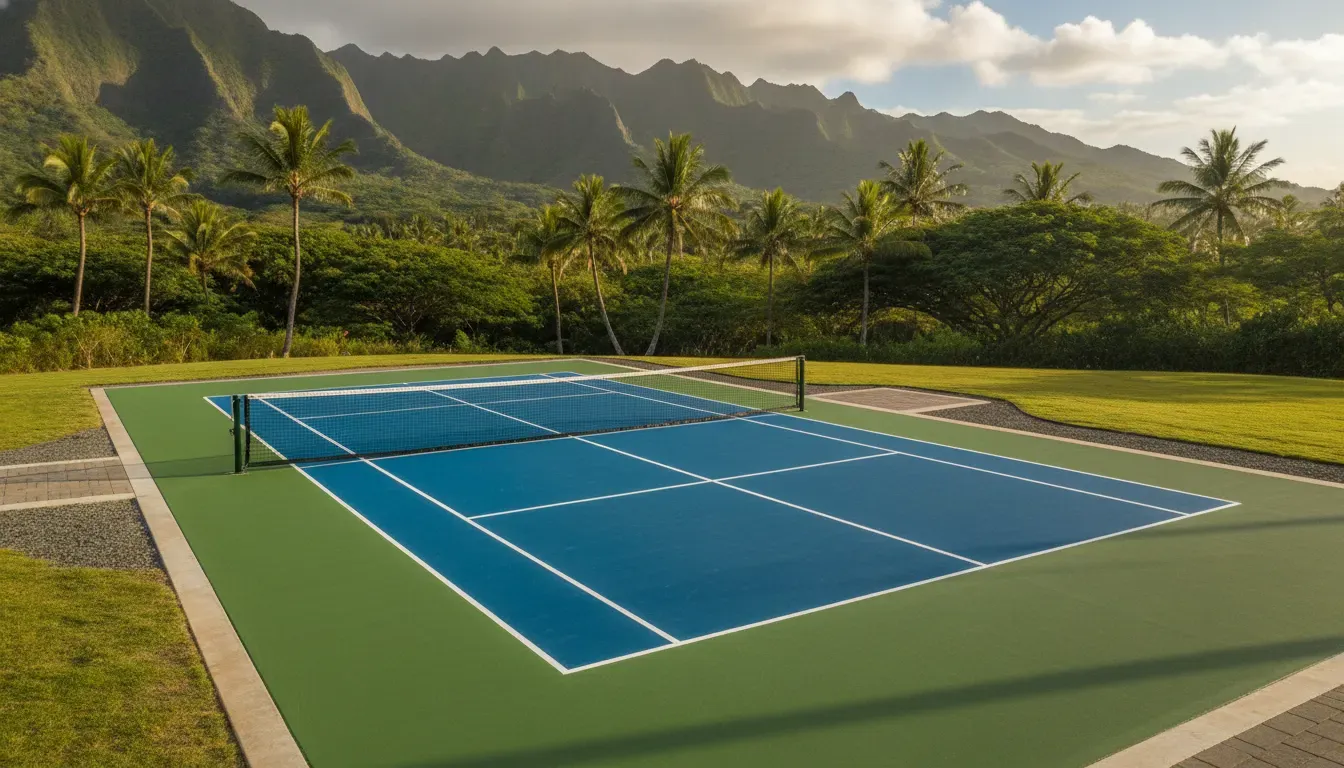
What does pickleball court construction include?
Pickleball court construction is the coordinated process of evaluating a property, preparing the site, building a stable base, managing water, installing a sport surface, striping the court, and adding equipment and site features. In Hawaii, the construction plan should also account for expansive volcanic or coral soils, roots, tropical rain, ultraviolet exposure, humidity, wind, and salt air.
A new court project commonly includes:
- Site evaluation, measurements, access planning, and layout design
- Clearing, grading, excavation, and preparation of the subgrade
- A properly designed asphalt or concrete base
- Drainage and slope planning so water does not remain on the playing surface
- Surface preparation, acrylic coatings, cushioning when appropriate, and color selection
- Accurate pickleball lines, net posts, net installation, and court accessories
- Optional fencing, windscreens, lighting coordination, seating, and landscaping
The scope depends on whether the court is a private backyard amenity, a shared HOA facility, a resort addition, a school improvement, or part of a larger multi-court site. It also depends on the existing ground conditions and the level of finish required.
Hawaii Court Resurfacing provides court construction and maintenance services for pickleball, tennis, basketball, volleyball, and multi-sport courts across Oahu, Maui, the Big Island, Kauai, Molokai, and Lanai.
How much space does a new pickleball court need?
A regulation pickleball court is 20 feet wide by 44 feet long, but the playing rectangle is not the full site requirement. USA Pickleball recommends an overall playing surface of about 30 by 60 feet for a basic layout and identifies 34 by 64 feet as a preferred total size. That additional space supports safer movement, fencing, maintenance access, drainage details, and a more comfortable player experience.
Use the official USA Pickleball construction guidance as a starting point, then have the complete property evaluated. A professional layout should consider:
- Runoff and clear space beyond the baselines and sidelines
- Safe gates and paths for players, guests, equipment, and maintenance crews
- Setbacks from homes, roads, property lines, pools, trees, and other structures
- Room for fencing, windscreens, lighting, seating, and future access
- How the court will fit into a backyard, resort, school, park, or shared community
Outdoor courts are generally oriented to reduce direct sun in players’ eyes during typical play. The best orientation depends on the property, slope, nearby buildings, trees, and time of day the court will be used. A site visit is more reliable than choosing a direction from a satellite image alone.
Why do base preparation and drainage matter in Hawaii?
The base is the structural platform below the sport surface. If the subgrade moves, settles, or holds water, the finished court can develop low spots, cracks, ponding, or premature surface problems. Drainage is not an accessory decision. It is part of protecting the base and keeping the court playable between Hawaii’s frequent rain cycles.
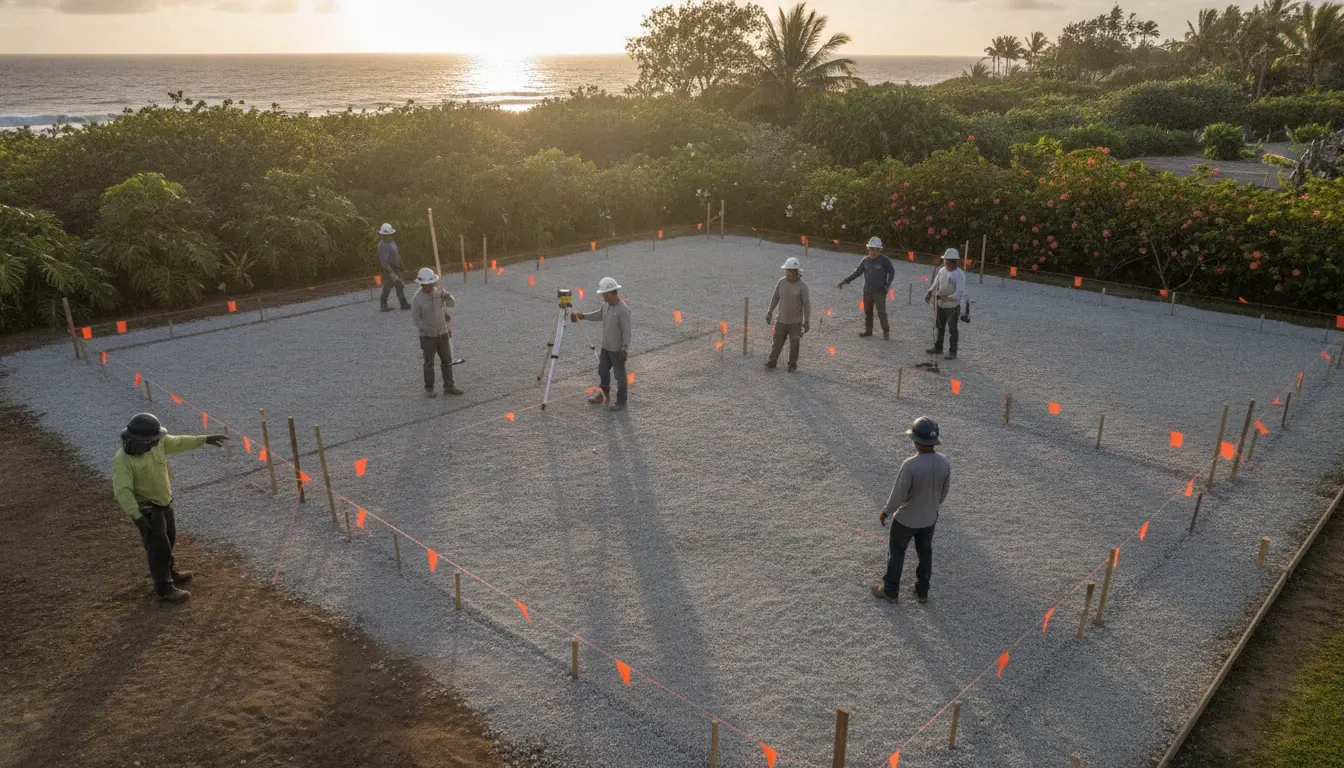
Before construction, the site team should look at:
- Soil and fill conditions: Identify areas that may compress, shift, or require additional preparation.
- Grade and water flow: Understand where water currently travels during heavy rain and where it needs to go after the court is installed.
- Roots and nearby vegetation: Plan around mature trees and root systems that may affect the subgrade or finished court.
- Access and staging: Confirm how materials, equipment, and concrete or asphalt deliveries can reach the site.
- Existing utilities: Locate relevant lines and structures before excavation or grading begins.
On a sloped property, the most economical court location is not always the best court location. Cutting, retaining, importing fill, or improving drainage can change the scope. A clear site assessment allows the owner or board to compare options before committing to a design.
Which surface is best for an outdoor Hawaii court?
For a permanent outdoor court, the surface should be selected as part of a complete system, not as a standalone color choice. Acrylic sport coatings can provide a consistent playing surface over a properly prepared asphalt or concrete base. The right system depends on the base, court use, climate exposure, desired pace, maintenance plan, and whether added cushioning is appropriate.
When comparing surface options, ask:
- How will the base be prepared and checked before coating?
- What repair or crack isolation approach is appropriate for the site?
- How will the system handle Hawaii’s UV exposure, humidity, rain, and salt air?
- Will the court need a standard hard surface or a cushion system?
- Which colors and line configurations fit the facility and surrounding property?
- What maintenance and warranty information will be provided in writing?
Hawaii Court Resurfacing is a SportMaster authorized installer and uses court surfacing methods selected for Hawaii conditions. Its proprietary crack filling and leveling system is designed to address expansive volcanic and coral soils and root-related movement. No coating can correct a base or drainage problem by itself, so surface specifications should follow the site assessment.
Talk with Hawaii Court Resurfacing about the right court surface for your site
What pickleball equipment and site features should be planned?
Equipment decisions are easiest when they are included before the base and fencing work begins. A court can be playable with a net and lines, but the right accessories improve safety, durability, access, and the experience for the people who will use it.
| Feature | Planning question | Why it matters |
|---|---|---|
| Net and posts | Will the court use a permanent, removable, or tournament-oriented system? | Post locations and sleeves must be coordinated with the base and court layout. |
| Fencing and gates | Where will balls, players, and service access move? | Perimeter design improves safety and makes the court easier to maintain. |
| Windscreens | How exposed is the court to trade winds or coastal conditions? | Windscreens can support privacy and a more controlled play environment when properly specified. |
| Lighting | When will the court be used, and where will fixtures be placed? | Early coordination helps avoid glare, shadows, conflicts with fencing, and costly rework. |
| Seating and shade | Where will players and spectators wait between games? | Shade, seating, and paths make a shared facility more usable. |
USA Pickleball’s construction and maintenance manual provides additional guidance on court planning, surfaces, lighting, and ongoing care. For a Hawaii property, that general guidance should be combined with a local review of wind, sun, rain, salt air, access, and the site’s specific ground conditions.
How long does pickleball court construction take?
The timeline is project-dependent. A straightforward private site with clear access and favorable ground conditions will move differently from a resort, HOA, school, or public facility that requires approvals, multiple stakeholders, complex grading, or several courts. Weather, material lead times, utility coordination, and the condition of the site can also affect the schedule.
A typical planning sequence looks like this:
- Discovery: Share the intended use, number of courts, property information, and target timing.
- Photos and site evaluation: Review access, grade, drainage, soil, trees, utilities, and surrounding uses.
- Design and scope: Confirm court dimensions, orientation, colors, fencing, equipment, and optional features.
- Proposal and scheduling: Compare scope, investment, warranty information, and the construction window.
- Site and base work: Complete preparation, grading, drainage work, and asphalt or concrete construction.
- Surfacing and installation: Apply the selected system, stripe lines, install equipment, and complete accessories.
- Final walkthrough: Review the finished court, care expectations, and next steps with the owner.
Hawaii Court Resurfacing describes a nine-step process from discovery through final walkthrough. Reviewing that court construction process early can help an HOA board, facilities team, or homeowner understand what information will be needed at each stage.
What should you budget for a new Hawaii pickleball court?
A useful budget starts with scope, not a generic per-court number. Site preparation, drainage, base construction, access, surfacing, fencing, equipment, lighting, permits, and the number of courts can change the total significantly. Hawaii inter-island logistics and property conditions should also be discussed before comparing proposals.
As general planning guidance from Hawaii Court Resurfacing:
- Smaller projects may generally fall around $8,000 to $15,000, depending on scope.
- Medium resurfacing or reconstruction projects may generally fall around $20,000 to $50,000 or more.
- Full new construction and large facilities commonly require an investment of $50,000 or more, depending on site work and features.
These are planning ranges, not a quote for a particular property. A reliable proposal should show what is included, what assumptions were made about the site, which features are optional, and how the construction schedule is secured. Hawaii Court Resurfacing states that a 50% deposit secures scheduling and material ordering, with the remaining 50% due after completion and customer approval when those payment terms apply to the project.
For examples of completed work and project types, review the Hawaii Court Resurfacing project portfolio and ask which parts of the scope are most relevant to your property.
How can an owner prepare for a court construction estimate?
The more complete the starting information, the more useful the first conversation will be. You do not need a finished design before requesting an estimate. You do need to explain how the court will be used and share enough site information to identify the right next step.
Before reaching out, gather:
- The property address and island
- Photos or video showing the proposed area from several directions
- Approximate available dimensions and any known grade changes
- The intended number of courts and sports
- Whether the facility is private, HOA, resort, school, government, park, or club owned
- Desired fencing, windscreens, lighting, shade, seating, and equipment
- Any target opening date, board meeting date, or procurement deadline
Hawaii Court Resurfacing serves homeowners, associations, resorts, hotels, schools, universities, government and military facilities, parks, clubs, and property managers throughout the major Hawaiian islands. The company uses trained full-time in-house crews, offers flat-rate pricing without hidden inter-island surcharges, and provides written proposals and warranties that vary by project and system.
Request your free estimate and start planning a durable Hawaii pickleball court
Frequently asked questions about pickleball court construction
What is the standard size of a pickleball court?
The regulation playing area is 20 feet wide by 44 feet long. The full recommended playing surface needs additional room for movement and safety. USA Pickleball identifies about 30 by 60 feet as a minimum recommended total playing surface and 34 by 64 feet as preferred.
Is concrete or asphalt better for a pickleball court?
Both can be used as a base for an outdoor court when properly designed and prepared. The better choice depends on soil, drainage, slope, access, local conditions, engineering requirements, and the selected surfacing system. The base should be evaluated with the complete site plan rather than chosen from material preference alone.
Can a backyard court be built on a sloped property?
It may be possible, but the project may require additional grading, retaining, fill, drainage, or access work. A site evaluation can compare the best court location with the amount of preparation needed and identify constraints before construction begins.
Does a new pickleball court need fencing?
Fencing is not required for every private court, but it can improve safety, ball containment, access control, privacy, and maintenance. The right height, gate placement, and windscreen plan depend on the property and how the court will be used.
How much does it cost to build a pickleball court in Hawaii?
Costs vary with site preparation, drainage, base construction, surfacing, equipment, fencing, access, and the number of courts. Hawaii Court Resurfacing uses project-dependent guidance, with full new construction and large facilities generally starting around $50,000 or more. A site-specific estimate is needed for an accurate investment plan.
How do I start planning a pickleball court?
Start with the intended use, available space, property photos, approximate dimensions, and a target timeline. Then request a site review and proposal that explains the base, drainage, surfacing, equipment, schedule, warranty, and investment assumptions.
Plan your Hawaii pickleball court with the right foundation
A durable court is the result of decisions made before the first coating is applied. Site assessment, water management, a stable base, climate-appropriate surfacing, accurate layout, and coordinated equipment all matter. With a clear scope and local construction partner, homeowners and facility managers can plan a court that is built for how their property will actually be used.
See why Hawaii Court Resurfacing is Hawaii’s #1 Court Specialist, explore the outdoor court designer, or get a free estimate for your new court.