
Planning a new tennis court in the islands involves more than choosing a surface color. Tennis court construction Hawaii property owners can rely on must account for site conditions, drainage. Soil movement, roots, intense sun, humidity, salt air, and rainfall before the first base material is installed. The right plan connects the playing surface to the land beneath it and the way the court will be used.
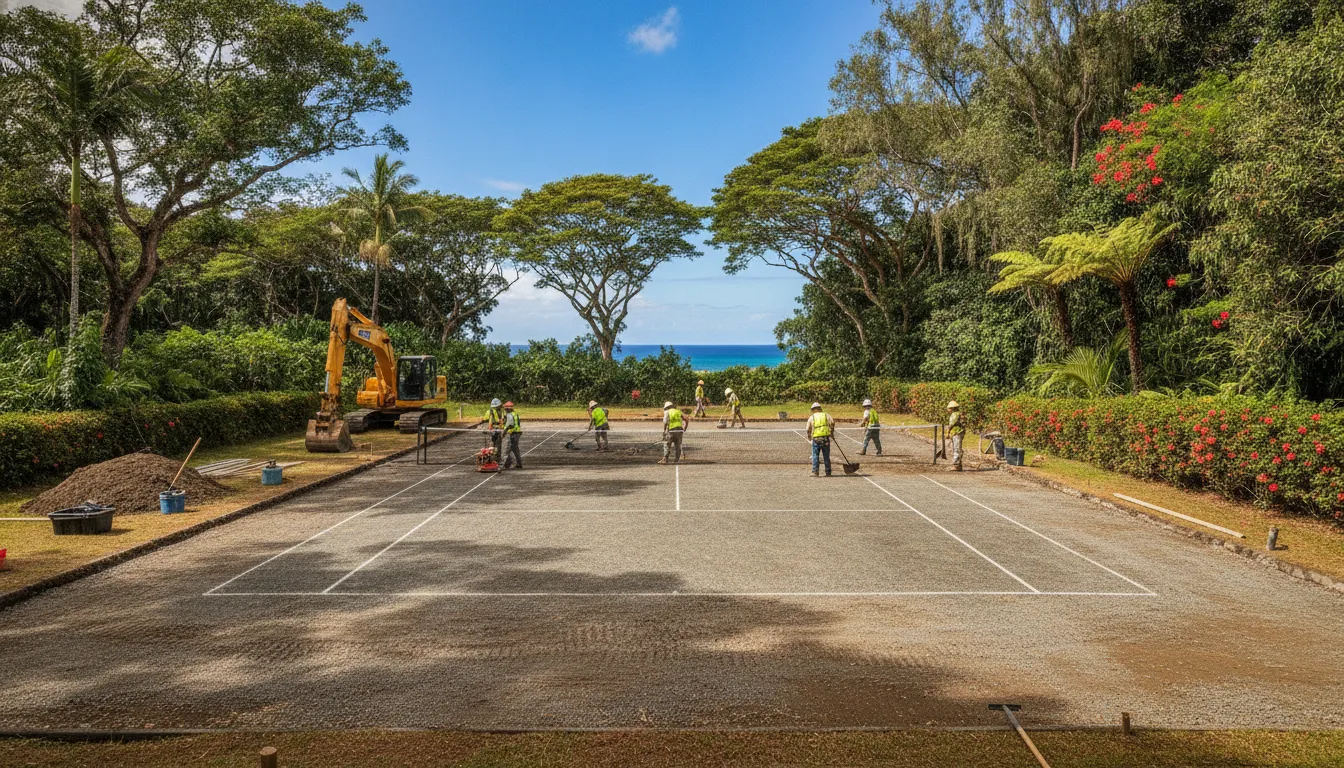
For a homeowner, HOA, resort, school, club, or public facility, a successful project starts with a clear scope. That scope may include site preparation, an asphalt or concrete base, acrylic surfacing, line striping, fencing, windscreens, equipment, and a maintenance plan. It should also explain which conditions were evaluated, what is included, and which choices can change the investment.
This guide walks through the Hawaii-specific considerations, construction components, planning decisions, project sequence, budget ranges, and contractor questions that matter before you request an estimate. The goal is not to promise one universal price or timeline. It is to help you ask better questions and choose a court specialist who can evaluate your site and build a practical plan.
Why Hawaii Conditions Matter in Tennis Court Construction
A tennis court is only as dependable as the surface and structure below it. In Hawaii, the site can introduce conditions that require careful evaluation. It is more than a simple surface installation. Volcanic and coral soils can move differently from one property to another. Tree roots can push into or beneath pavement. Heavy rainfall can expose grading and drainage weaknesses, while trade winds, salt air, humidity, and strong ultraviolet exposure affect how an outdoor court is used and maintained.
That does not mean every project needs the same solution. It means the construction plan should be based on the actual property. A contractor should look at access, existing grades, soil and root conditions, water flow. Nearby landscaping, exposure, and the intended use of the court before recommending a base or finish system. Skipping that evaluation can leave an owner addressing movement or drainage after the playing surface is complete.
- Ground movement: Soil conditions and roots can contribute to cracking, low spots, or uneven areas that need to be addressed in the design and preparation stages.
- Water management: Rainfall makes grading and drainage important to court performance, construction scheduling, and long-term maintenance.
- Coastal exposure: Salt air and humidity can influence material and accessory decisions, especially around fencing and windscreens.
- Sun and weather: UV exposure and tropical rainfall cycles make appropriate acrylic surfacing, color coating, and maintenance planning important.
Hawaii Court Resurfacing uses a proprietary crack filling and leveling system designed for expansive volcanic and coral soils and root damage. That system is one part of a broader site-specific approach. The contractor should still explain what was observed at the property, which preparation is recommended, and what the proposed scope is intended to solve.
For larger properties, the evaluation should also consider how people will reach the court. Where equipment and materials can be staged, and whether construction will affect residents, guests, students, members, or the public. A clear site plan helps align the base, surface, fencing, windscreens, and access details before construction begins.
What a New Tennis Court Build Includes
New court construction is a complete project rather than a coating job. The final playing surface matters, but it sits at the end of a sequence that begins with site preparation and base construction. A useful proposal separates the major components so an owner can compare scopes accurately and understand what is included.
Site preparation and base work
The project begins with the site. Depending on the property, preparation may involve access planning, grading, drainage considerations, and work to establish a suitable foundation. The base may be built with asphalt or concrete, selected in response to the site, intended use, and project design. Hawaii Court Resurfacing evaluates the conditions rather than treating every property as interchangeable.
Surfacing, color, and lines
Once the base is ready, the court receives its surfacing system. SportMaster acrylic coating systems, color coating, and precise tennis line striping are part of the company’s approved service scope. Surface colors can help define the court visually, but the more important question is how the complete system fits the base, drainage plan, climate exposure, and expected use.
Fencing, windscreens, and equipment
A court also needs practical features around the playing area. Fencing can define the court and help manage balls and circulation. Windscreens may support privacy and usability while addressing Hawaii trade wind conditions. Equipment installation, gates, and related amenities should be identified before the estimate is finalized rather than added as an afterthought.
One court or a broader recreation area
Some owners want a dedicated tennis court. Others are planning a shared recreation area or want flexibility for multiple sports. Custom colors and multi-sport line configurations can be included when appropriate. The intended users should guide the layout, accessories, and maintenance plan. A private residential court, a resort amenity, and a school or public facility may require different access, scheduling, and durability decisions.
Review the company’s tennis court construction services to see how a complete scope can be organized. During discovery, ask the contractor to identify base work, surfacing, striping, fencing, windscreens, equipment, cleanup, and final walkthrough responsibilities in writing.
How to Plan the Site and Design
Good court design starts with how the property will be used. A homeowner may prioritize a private playing experience and a clean view from the house. An HOA or condominium board may need to consider resident access, work hours, noise, and long-term maintenance. Resorts, clubs, schools, and public facilities may need a plan for multiple users, equipment, safety, procurement, and minimizing disruption.
Evaluate the site before choosing finishes
Before selecting colors or accessories, review access for people and construction equipment, the grade of the property, drainage paths, nearby trees, root exposure, and prevailing wind conditions. These observations can affect the court position, fencing, windscreens, base preparation, and the order of work. The site evaluation should also identify existing pavement or structures that need to be protected or removed.
Plan the playing environment
Think through who will use the court, how often it will be used, and what will surround it. Fencing, gates, windscreens, benches, equipment, and lighting or electrical work, if applicable to the project, should be discussed early. Do not assume that an accessory is included simply because it appears in a concept image. Ask for each item to be shown in the scope and estimate.
Choose colors and layout with the whole property in mind
Color choices can help the court fit a home, resort, campus, or community setting. If the area may support more than tennis, discuss whether multi-sport lines are appropriate before striping begins. A clear plan avoids conflicts between the primary tennis layout and future uses.
Owners can review the outdoor tennis court design resource to organize preferences before discovery. The tool does not replace a site evaluation, but it can make the conversation more specific. Bring photos, approximate dimensions, access details, known drainage concerns, and the intended user group to the first discussion.
The Tennis Court Construction Process in Hawaii
A defined process gives the owner clear decision points before work begins. Hawaii Court Resurfacing describes a nine-step sequence from the first conversation through the final walkthrough. The exact scope is project-dependent, but the sequence below shows what each stage is meant to accomplish.
- Contact: Share the property location, court type, project goal, and the best way to reach you.
- Discovery: Discuss whether the project is a new court, a larger facility, a replacement, or part of a broader recreation plan. Identify users, priorities, and known site concerns.
- Photos and videos: Provide visual information that helps the team understand access, existing surfaces, grades, landscaping, and surrounding structures before the site evaluation.
- Site evaluation: Review the property conditions, drainage, soil movement, roots, access, wind exposure, and other factors that may affect preparation and construction.
- Custom quote: Receive a project-specific scope rather than relying on a generic price. The proposal should identify the work, materials, accessories, and assumptions.
- Design and colors: Confirm the court layout, surface colors, line configuration, fencing, windscreens, equipment, and other selected features.
- Schedule and deposit: Confirm the schedule and material ordering requirements. When the approved payment terms apply, a 50% deposit secures scheduling and material ordering.
- Construction: The crew completes the agreed preparation, base, surfacing, striping, accessories, and site work. Weather and site conditions can affect the sequence.
- Final walkthrough: Review the completed court, clarify care and maintenance expectations, and confirm that the finished work matches the agreed scope.
Read more about how the court construction process works before your first call. A prepared owner can make the project more efficient by gathering property photos, access information, approximate dimensions, desired sports, and questions about the proposal.
How Much Does Tennis Court Construction Hawaii Cost?
The honest answer is that tennis court construction in Hawaii is project-dependent. The investment changes with the property, access, grading, drainage, base preparation, court size, surfacing system, fencing, windscreens, equipment, and the number of courts or sports included. A contractor should evaluate the site and provide a custom scope rather than promise one universal price.
As planning guidance, full construction or large facility projects typically represent a $50,000+ investment. Premium facilities may exceed $100,000 when the project includes substantial site work, higher-end features, multiple courts, or complex infrastructure. These ranges are not a quote for a particular property. They are a starting point for deciding whether a new-build conversation fits the project budget.
It is also useful to distinguish construction from resurfacing. A larger resurfacing or reconstruction project may fall around $20,000-$50,000+, depending on the court’s size and condition. Resurfacing an existing court can be a different scope from building a new court, especially when the existing base, drainage, cracking, or grade needs attention. Compare proposals by the work included, not just the top-line number.
Typical planning ranges
The table below is planning guidance, not a quote.
| Type. | Range. | Factors. |
|---|---|---|
| Full construction or large facility. | $50,000+. | Site work, base, surfacing, accessories. |
| Premium facility. | May exceed $100,000. | Infrastructure, multiple courts, features. |
| Larger resurfacing. | $20,000-$50,000+. | Size, condition, repairs, drainage. |
What can change the investment?
- Site preparation: Grading, access, drainage, removal, soil movement, and root-related work can affect the preparation scope.
- Base and surface: Asphalt or concrete, the surfacing system, color choices, and line configuration should be identified clearly.
- Site features: Fencing, gates, windscreens, equipment, amenities, and multi-sport lines add scope when selected.
- Project scale: A backyard court, HOA amenity, resort facility, school, or public complex may have different logistics and requirements.
Ask whether the estimate includes mobilization, preparation, materials, striping, accessories, cleanup, and the final walkthrough. If payment terms apply, Hawaii Court Resurfacing states that a 50% deposit secures scheduling and material ordering, with the remaining 50% due after completion and customer approval. Confirm the current terms in the proposal.
For an existing court, reviewing tennis court resurfacing can help clarify whether resurfacing or new construction is the more appropriate conversation.
How to Choose a Hawaii Court Construction Contractor
The best contractor is not simply the one who offers the lowest initial number. Look for a specialist who can explain the site conditions, separate preparation from finish work, and communicate what happens from discovery through the final walkthrough. Court construction has its own requirements, and a general paving conversation may not address surfacing, striping, fencing, windscreens, or playability.
Questions to ask before signing
- Do you have a Hawaii contractor license and relevant court-construction experience?
- Who will perform the work, and are the crews employees or subcontractors?
- How will you evaluate drainage, soil movement, roots, access, and wind exposure?
- Which base, coating system, colors, lines, fencing, windscreens, and equipment are included?
- What written warranty terms apply to this system and project scope?
- What maintenance and care should the owner plan for after completion?
Hawaii Court Resurfacing is positioned as Hawaii’s #1 Court Specialist, holds C-3B contractor license C-39570, uses trained full-time in-house crews, and is a SportMaster authorized installer. Its service area covers Oahu, Maui, the Big Island, Kauai, Molokai, and Lanai. Those credentials do not replace a project-specific evaluation, but they give an owner useful points to verify when comparing proposals.
Ask for a written scope that reflects the property and intended use. It should make clear what is included, what is excluded, how changes are handled, and what the final walkthrough covers. If the site has cracking or uneven areas, review the company’s court crack repair and leveling information and ask how those conditions affect the new-build or renovation plan.
Finally, discuss care before the court is finished. A clear handoff helps homeowners, boards, facility managers, and maintenance teams protect the investment and recognize concerns early.
Frequently Asked Questions
How much does it cost to build a tennis court in Hawaii?
Full construction or large facility projects typically represent a $50,000+ investment, while premium facilities may exceed $100,000. The actual scope depends on site preparation, base work, drainage, surfacing, fencing, windscreens, equipment, access, and project scale. A site evaluation and custom quote are needed for an accurate project budget.
How long does tennis court construction take?
Project duration depends on the site condition, preparation scope, weather, materials, access, and selected features. A contractor should provide scheduling information after discovery and site evaluation rather than promise one timeline for every Hawaii property.
What types of courts can a specialist build?
Hawaii Court Resurfacing’s portfolio includes tennis, pickleball, basketball, volleyball, and multi-sport court construction. A project can also include surfacing, color coating, line striping, fencing, windscreens, equipment installation, and custom court design when those items fit the plan.
Can an existing tennis court be resurfaced instead of rebuilt?
Possibly. Resurfacing may be appropriate when the existing base and site conditions support it, but cracking, low spots, drainage, root damage, or major deterioration can change the recommended scope. A contractor should inspect the court before advising whether resurfacing, repair, reconstruction, or new construction makes sense.
What should I prepare before requesting an estimate?
Gather the property location, photos and videos, approximate court dimensions, access information, known drainage or root concerns. Desired court type, intended users, and preferences for colors, fencing, windscreens, or other features. This gives the contractor a better starting point for discovery and site evaluation.
Plan Your Hawaii Tennis Court Project
A new tennis court deserves a plan built around the property, the climate, and the people who will use it. Hawaii Court Resurfacing can evaluate your site, discuss the construction scope, and help you understand the decisions that affect the finished court and investment.
To begin, request a free estimate or call (808) 476-3235. Share your island, project type, photos, access details, and goals. Inquiries are typically answered within 24 hours.