
Building a tennis court in Hawaii is not a one-size-fits-all project. The schedule depends on the site evaluation, ground preparation, drainage, access, selected court features, material availability, crew scheduling, and weather. A straightforward site may move differently from a property that needs substantial leveling, root mitigation, or base work.
Planning a court project? Get a Free Estimate from Hawaii Court Resurfacing before you set a target completion date.
There is no universal completion date for building a tennis court in Hawaii. A 50% deposit secures scheduling and material ordering, but the start and completion dates depend on weather, material availability, site conditions, and the approved scope. Your contractor should confirm a site-specific schedule before work begins.
Owners and property managers can plan more confidently by separating the project into clear phases, from discovery and site evaluation through construction and the final walkthrough. Understanding what happens at each stage helps you make timely decisions, coordinate access, and account for Hawaii’s soil and weather conditions before work begins.
How Long Does It Take to Build a Tennis Court in Hawaii?
Short answer: Hawaii Court Resurfacing does not publish a fixed total completion time for a new tennis court. The schedule is established for each property after reviewing the scope, site conditions, materials, crew availability, and weather. A 50% deposit secures scheduling and material ordering, but it does not establish a universal start or completion date.
The first schedule variable is the work required. A straightforward court and a complex facility do not move through the same sequence. Full construction can include site preparation, an asphalt or concrete base, surfacing systems, drainage-related work, and other infrastructure. Existing grade, access, and the selected court design also influence how much preparation is needed before surfacing begins.
What can change the construction timeline?
- Assessment findings: The site evaluation reviews dimensions, structural conditions, drainage, and equipment access. Unexpected conditions may require additional preparation or adjustments to the proposed scope.
- Soil and drainage: Hawaii properties can have varied volcanic or coral soils, roots, and water-management needs. These conditions should be evaluated rather than assumed to be uniform.
- Materials and crew scheduling: The deposit helps secure crew scheduling and material ordering, but availability can still affect the start and sequence of work.
- Weather: Rain, trade winds, and other local conditions can affect outdoor preparation, coating, and curing windows. Hawaii Court Resurfacing provides progress updates and communicates weather-related delays.
- Project scope: Crack repair, surface preparation, primer, multiple acrylic coats, line striping, fencing, or equipment installation may add distinct work stages.
For a reliable project plan, ask for a scope-specific schedule after the site evaluation. That gives you a more useful completion expectation than applying a generic number of weeks to every tennis court project in Hawaii.
| Project phase | What it covers | What can affect timing |
|---|---|---|
| Planning | Discovery, site evaluation, proposal, design, and approvals. | Scope decisions, access, soil, drainage, and stakeholder response time. |
| Preparation | Layout, grading, drainage, and asphalt or concrete base work. | Ground conditions, roots, rainfall, and equipment access. |
| Surfacing | Surface preparation, primer, acrylic coats, and curing. | Rain, wind, humidity, and suitable application conditions. |
| Closeout | Line striping, equipment, inspection, and final walkthrough. | Approved scope, material availability, and final owner decisions. |
What Are the Phases of Tennis Court Construction in Hawaii?
A new tennis court is planned in stages so decisions about the site, design, materials, and schedule are made before construction begins. This phase-by-phase view complements the broader guide to tennis court construction in Hawaii by focusing on how the work progresses and what can affect the timeline.
- Discovery and initial consultation. The project begins with a conversation about the intended court use, desired improvements, budget, access, and target timeline. This helps clarify whether the project calls for a new build, reconstruction, or a different scope of work.
- Photos, videos, and site information. Photos or videos can give the contractor useful early context about the property, existing surfaces, access routes, surrounding structures, and visible drainage or ground concerns. They help prepare for a more focused evaluation.
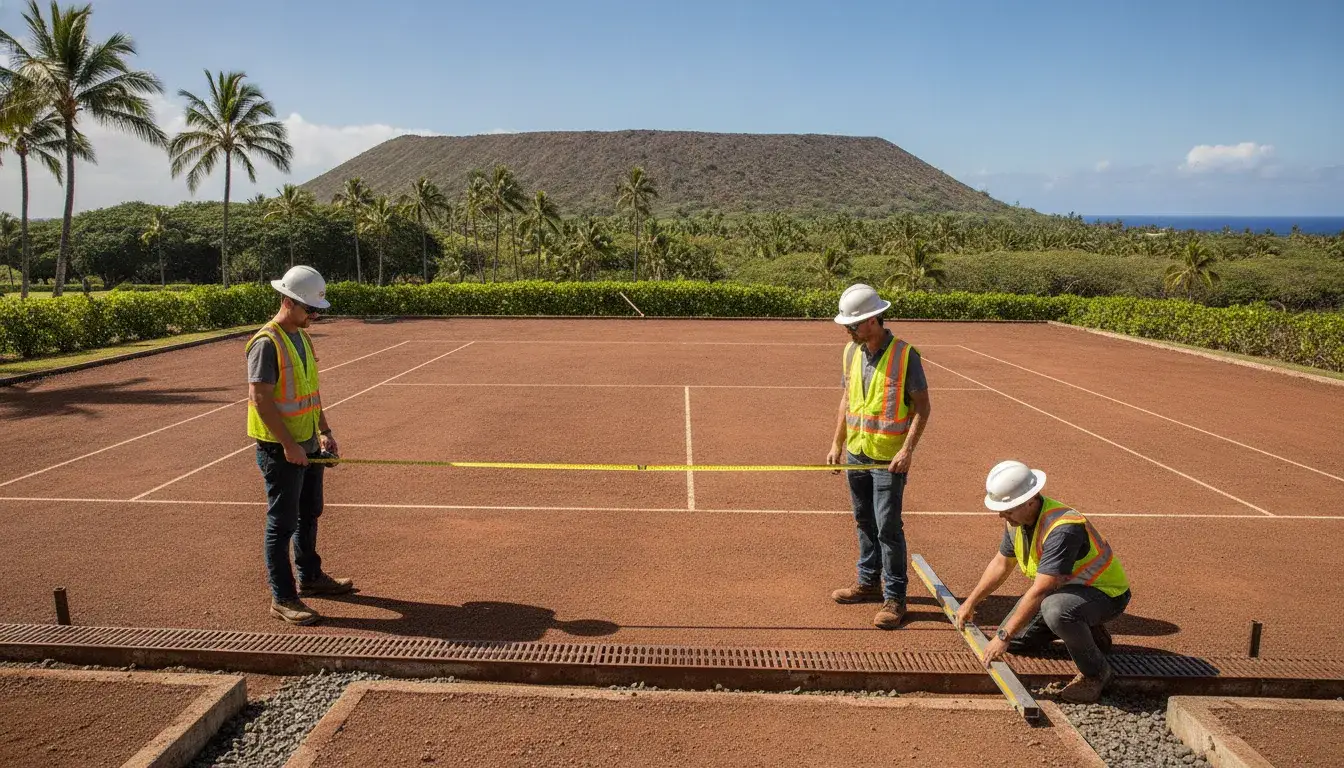
- Site evaluation. A site visit examines dimensions, structural conditions, drainage, soil and root issues, existing coatings where applicable, and equipment access. Hawaii’s volcanic and coral soils are not uniform, so the findings help determine the preparation and leveling work the court needs.
- Custom proposal and design decisions. The proposal can define the recommended construction or repair system, preparation, coating options, scope, timeline, and warranty. Owners then select court colors and other design details that fit the property and its intended use.
- Deposit, scheduling, and material ordering. A 50% deposit secures crew scheduling and material ordering. The contractor can then confirm the project sequence and site-specific schedule based on the approved scope, material availability, and expected working conditions.
- Construction and finishing work. Depending on the approved scope, construction may include site preparation, an asphalt or concrete base, related infrastructure, crack repair, surface preparation, primer, multiple acrylic coats, line striping, and equipment installation. The sequence can change when site conditions or weather require additional preparation.
- Final walkthrough. After the work is complete, the team reviews the finished court with the owner, checks the agreed scope, and addresses final questions. For a facility managed by an HOA, school, resort, or other organization, this is also an opportunity to confirm handoff details with the relevant stakeholders.
How Weather and Soil Conditions Affect Your Construction Timeline
Hawaii’s weather can change from one part of an island to another, so a tennis court schedule cannot be based on a statewide calendar alone. The National Weather Service describes persistent northeasterly trade winds and significant rainfall differences over short distances. Typical summer conditions run from May through October, while winter conditions generally run from October through April. Those patterns influence when crews can prepare the site, place materials, and allow coatings or other surfaces to cure. The NWS climate summary provides useful context, but it does not establish a construction duration for your property.
Rain is especially important during grading, drainage work, base preparation, and coating. A brief shower may have a different effect from saturated ground or repeated rainfall that prevents the team from achieving a clean, dry surface. Trade winds can also affect application and cure windows. On properties exposed to winter swells, coastal access, wind, or changing site conditions may require additional coordination. A responsible schedule includes communication about weather-related delays rather than treating every planned workday as guaranteed.
Why the ground must be assessed before scheduling
Hawaii’s volcanic and coral soils are not uniform. Drainage, roots, existing fill, slope, access for equipment, and the site’s structural condition can all change the preparation required before a court base or surface is installed. University of Hawaii research on tropical oxidic and volcanic ash soils shows why soil behavior should be evaluated carefully: clay content relates to properties such as water retention, and measurements can be affected by factors including oxides, pumice, organic matter, and surface charge. The study is useful background on soil variability, not a formula for predicting how long a court build will take.
For that reason, the site evaluation should examine drainage, dimensions, access, roots, and the condition of the ground before a completion expectation is set. A project with stable access and straightforward preparation may move differently from one needing leveling, root-related repairs, or drainage improvements. The answer to how long to build a tennis court in Hawaii becomes more reliable after those conditions are observed, documented, and included in the scope.
How to Plan Around Hawaii’s Rainy and Trade-Wind Seasons
There is no single best season for every tennis court project in Hawaii. Conditions can vary significantly by island, elevation, coastline, and the specific property. The National Weather Service notes that Hawaii has persistent northeasterly trade winds and meaningful rainfall differences over short distances, with a May-to-October summer pattern and an October-to-April winter pattern for most of the state. Local climate patterns matter when planning outdoor construction.
Build weather flexibility into the schedule
Ask your contractor how much contingency time is appropriate for the site, scope, and season. Rain can affect excavation, grading, drainage work, coating application, and the time needed for surfaces to cure. Trade winds can also influence access, material handling, and the application of finish systems. Winter swells may add logistical considerations for coastal properties or projects that depend on inter-island transportation.
Rather than selecting a calendar date and expecting uninterrupted work, plan around decision points. Confirm when the site must be accessible, when residents or guests need advance notice, and which activities can continue if weather changes. HOAs, resorts, schools, and public facilities may also need to coordinate parking, noise, closures, deliveries, and stakeholder approvals before crews arrive.
Coordinate materials, access, and updates
Material delivery and crew scheduling should be discussed before the deposit is made. Hawaii Court Resurfacing states that a 50% deposit secures scheduling and material ordering. The contractor can then confirm a site-specific start sequence and completion expectation based on weather, material availability, and the approved scope.
Keep a clear communication plan throughout the work. The contractor should provide progress updates and explain any weather-related delay, along with the next workable step. Local conditions may differ even between nearby properties, so a site-specific schedule is more useful than a generic seasonal promise. Ask what access the crew needs, how deliveries will be staged, and how rain or wind will change the sequence before approving the construction plan.
What Happens During Each Week of Construction?
A week-by-week outline can make a new tennis court project easier to coordinate, but it should be treated as a planning sequence rather than a fixed promise. Actual timing depends on the approved scope, site conditions, material availability, crew scheduling, and weather. Rain, trade winds, and other conditions can change when certain work is practical.
Early work: layout, preparation, base, and drainage
Early construction focuses on turning the approved design into a properly prepared site. The crew confirms layout and access, prepares the work area, and addresses grading, drainage, and the court base. Depending on the project, this may involve asphalt or concrete base installation and related infrastructure. Soil behavior, roots, and existing site conditions can affect the preparation required, so this stage should not be rushed to meet an arbitrary calendar.
Middle work: repairs, surface preparation, and coatings
Once the base and supporting work are ready, construction may move through crack repair or leveling, surface preparation, primer, and multiple acrylic coating applications. Each layer needs suitable conditions before the next phase can proceed. The crew may adjust the sequence around rainfall, humidity, wind, or other conditions that affect application and curing. Materials and methods are selected with Hawaii’s UV exposure, salt air, humidity, and frequent rain cycles in mind.
Final work: lines, equipment, inspection, and walkthrough
Near the end of the project, the team completes court line striping and installs agreed equipment, which may include net and pole components. The final stage also includes inspection, cleanup, and a walkthrough with the owner or project representative. This is the opportunity to review the finished court, confirm that the agreed scope is complete, and discuss care or warranty information. Regular progress updates help owners coordinate access and keep stakeholders informed when conditions affect the sequence.
How to Keep Your Project on Schedule with a Hawaii Contractor
A well-organized owner can reduce avoidable schedule changes, even when weather and site conditions remain outside anyone’s control. Start by documenting the scope: ground-up construction is not the same as resurfacing an existing court. A new build may involve site preparation, a concrete or asphalt base, surfacing, drainage work, fencing, lighting, and equipment. Resurfacing follows a different sequence and should not be assigned the same planning assumptions.
Use this owner checklist
- Confirm the site. Ask what the evaluation will cover, including access for equipment, drainage, slopes, roots, existing structures, and soil conditions. Hawaii sites are not uniform, so early site information helps prevent surprises during preparation.
- Lock design decisions early. Confirm court dimensions, surface and color choices, fencing, windscreens, lighting, and equipment before scheduling materials and crews. If an HOA, resort, school, or government facility is involved, identify who has final approval.
- Understand the deposit and ordering step. The company states that a 50% deposit secures crew scheduling and material ordering. Ask the contractor to confirm the expected sequence and completion window for your property after the scope and site conditions are documented.
- Coordinate access and operations. Confirm gate access, staging areas, parking, quiet-hour restrictions, resident or guest notices, and any days when the property cannot accommodate construction activity.
- Ask about weather updates. Agree on how rainfall, trade winds, or winter swells will affect the plan and how delays will be communicated. Do not treat a weather adjustment as a failed schedule when the work requires suitable conditions.
- Define closeout. Before work begins, ask what the final walkthrough includes, how punch-list items are handled, and what written warranty information you will receive.
Request a written scope that separates construction, preparation, surfacing, and closeout. That document gives every stakeholder the same schedule assumptions and makes it easier to ask precise questions as the project moves forward.
Ready to plan your project? Call 808-476-3235 for a free estimate and get a schedule tailored to your Hawaii property.
Frequently Asked Questions
How long does it take to build a tennis court in Hawaii?
There is no universal completion timeline for a new court. The schedule depends on site preparation, soil and drainage conditions, access, selected materials, crew availability, and weather. A 50% deposit secures scheduling and material ordering, but your contractor should confirm the start sequence and completion expectation for the specific property.
Do I need a permit to build a tennis court?
Permit and approval requirements can vary by island, county, property type, site work, drainage, structures, fencing, and other project details. Confirm the site-specific requirements with the appropriate local authority and your contractor before scheduling construction. A thorough site evaluation helps identify questions that may affect the plan and timeline.
How much land do I need to build a tennis court?
The required footprint is larger than the playing lines because the design may need room for run-off areas, fencing, gates, drainage, access, and equipment. The usable dimensions and site layout should be evaluated together, especially on sloped or constrained property. A contractor can review the available land, access, and grading needs before finalizing the design.
How does weather affect tennis court construction?
Rain, trade winds, and winter swells can affect site work, coating application, drying, and scheduling. Acrylic layers and related materials need suitable conditions before the next step can proceed. Hawaii Court Resurfacing monitors conditions, provides progress updates, and communicates weather-related delays rather than promising a fixed finish date.
Ready to Plan Your Hawaii Tennis Court?
A clear site review and project plan can help you understand the construction phases, scheduling considerations, and site conditions that may affect your timeline. Get practical guidance tailored to your property and goals. Call 808-476-3235 to get a free estimate for your Hawaii tennis court construction project.