
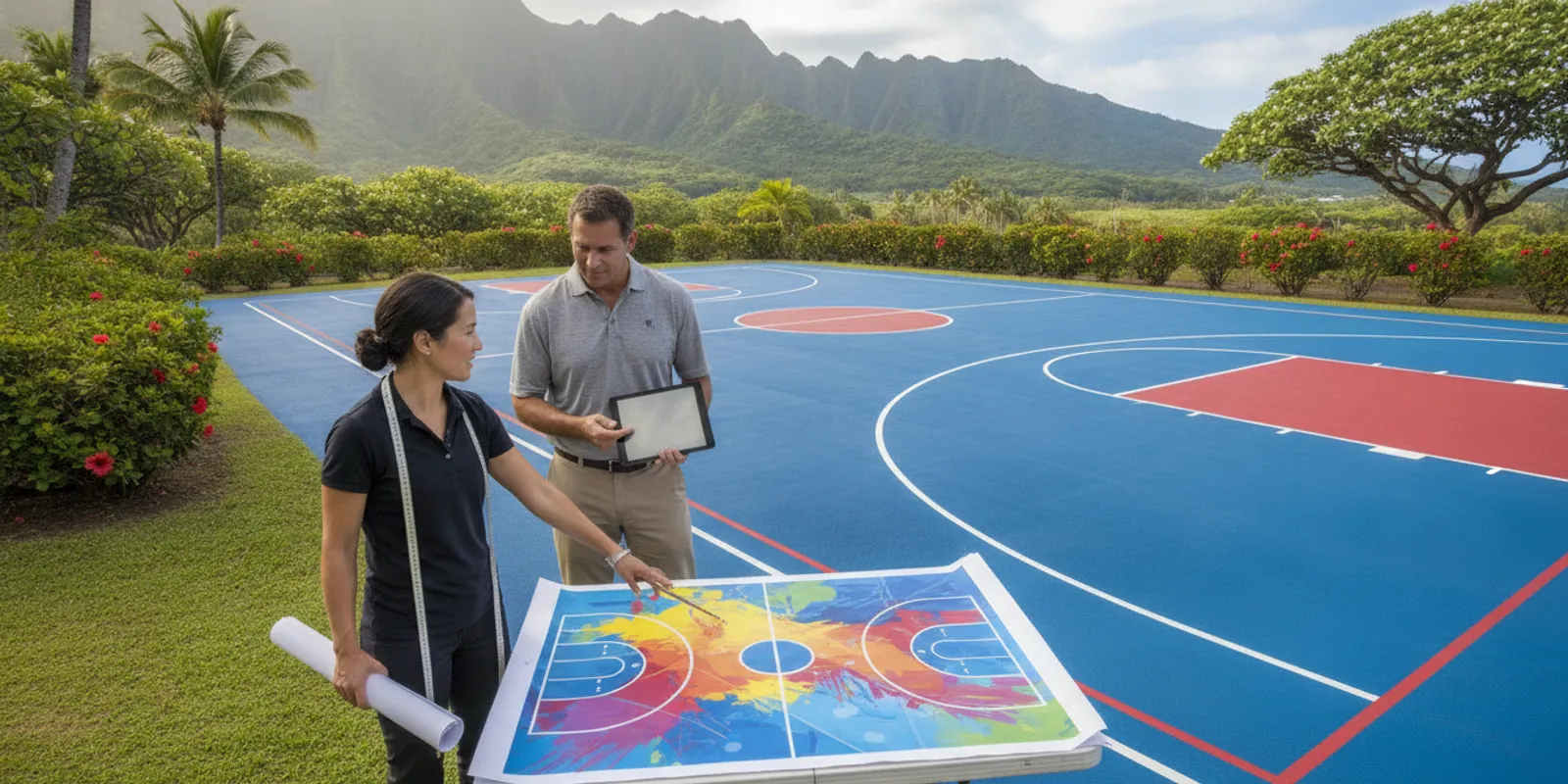
When should a court owner work with a sport court designer? In most projects, the answer is before major choices are locked in: when defining the court’s purpose, reviewing the site, comparing layouts, or planning construction and upgrades. Early design input can help owners and managers identify constraints and align the court with its intended users. For Hawaii properties, that means considering local site conditions and the demands of sun, rain, humidity, and salt air.
Request a court project estimate
When should a court owner work with a sport court designer?
Bring a designer or qualified court professional into the conversation as soon as the project involves decisions that are difficult or costly to change later. That may be during early planning for a new court, before converting a court to another sport, or when the current layout, surface, drainage, or equipment no longer fits how people use the facility.
Design work is not only about choosing colors or drawing boundary lines. It can help organize questions about the site, intended activities, circulation, safety clearances, accessories, and construction scope. The right timing depends on what is being changed and how much uncertainty remains. A simple refresh may need fewer planning steps than a new multi-sport facility or a conversion with shared use.
For a project involving surface work rather than a new layout, start by identifying whether the court needs maintenance, repairs, or full resurfacing. Hawaii Court Resurfacing describes its court construction and maintenance services and its project process as separate resources to review while defining the scope.
Which project decisions benefit from early design input?
Involve a sport court designer early when a project includes several of these decisions:
- New construction: The owner must shape the court’s purpose, position, dimensions, access, and supporting features before construction is planned.
- Multi-sport use: More than one activity may need to share the surface, markings, equipment, or schedule.
- Conversion: The existing court may need a different layout, surface approach, equipment, or circulation pattern.
- Site uncertainty: Slope, drainage, tree roots, soil movement, access, or existing damage could affect the work.
- Multiple stakeholders: Residents, students, guests, staff, boards, or facility operators have different needs that must be reconciled.
- Complex supporting work: Fencing, windscreens, lighting, equipment, or access improvements are part of the scope.
- Investment decisions: The owner needs to compare options and understand what is included before requesting approval or funding.
Not every court needs a separate designer. A resurfacing project that keeps the existing configuration may be straightforward, but an on-site evaluation can still be useful if the surface has significant cracks, standing water, or other visible concerns. Design and condition assessment are related but not identical: the owner should clarify whether the immediate need is a new layout, a construction plan, a repair recommendation, or a combination.
What should owners define before discussing a design?
Write down what the court must do before comparing layouts. A short project brief helps the designer understand priorities and prevents early conversations from focusing only on appearance.
- Name the users and activities. Identify whether the facility is for tennis, pickleball, basketball, volleyball, or more than one sport. Note who will use it and whether the court is for residents, students, guests, organized programs, or general recreation.
- Describe the current problem or opportunity. Explain what is not working, what prompted the project, and whether the work is new construction, a conversion, repairs, or a surface upgrade.
- Separate essential needs from preferences. For example, access and usable play space may be essential, while a particular color scheme may be a preference.
- Identify operational constraints. Consider site access, operating hours, nearby activities, and any periods when the facility cannot be closed.
- Establish a planning budget. A project-dependent range helps determine which options merit further review. The scope and site conditions need evaluation before anyone can provide a project-specific proposal.
- List decision-makers. Determine who can approve the layout, scope, funding, and schedule, and what information they need to make a decision.
For an association, school, resort, or public facility, gather feedback from the people who maintain and manage the court as well as its players. Operators may flag access, storage, or maintenance concerns that users do not see. Conversely, user feedback may reveal that the current court configuration does not support the activities people want to play.
How do site conditions shape a court design?
A design that looks clear on paper still has to fit the actual property. Before settling on a layout, owners should understand the usable area, access routes, slope, drainage, nearby structures, and any existing surface or base concerns. The exact checks depend on the site and the type of work.
Hawaii’s conditions deserve specific attention. UV exposure, humidity, rainfall, salt air, expansive volcanic and coral soils, and root movement can all be relevant to court planning and maintenance. These factors do not point to one automatic solution. They are reasons to evaluate the particular location and specify materials and methods with the site and intended use in mind.
Share clear photos or video of the full court and its surroundings. Include views of edges, transitions, cracks, drainage paths, fencing, and access points. If the property has site plans or records of prior work, have them available. Visual information can help prepare for an evaluation, but it does not replace one where conditions need to be inspected in person.
Owners planning new work can review the company’s court design configurator as a way to explore design choices. It is a planning aid, not a substitute for confirming site conditions and project requirements.
How should owners compare court project options?
Ask for a clear comparison of what each option includes and what it does not address. A proposal should be understood in the context of site conditions, intended activities, project scope, and budget. The following table is a starting point for organizing a conversation, not a price quote or a substitute for evaluation.
| Project situation | Planning focus | Questions to resolve |
|---|---|---|
| New court construction | Site, intended sports, layout, access, supporting features | What site review and preparation are needed? Which features are essential now? |
| Existing court resurfacing | Surface condition, cracks, drainage, retained layout | Is the existing configuration suitable? Which underlying concerns need evaluation? |
| Pickleball or multi-sport conversion | Shared use, markings, equipment, circulation | How will activities coexist? What tradeoffs come with the selected configuration? |
| Facility upgrade | Fencing, windscreens, equipment, access, operations | Which improvements are part of this phase, and what needs coordination? |
Hawaii Court Resurfacing’s general investment guidance is project-dependent: smaller projects generally fall around $8,000 to $15,000, medium resurfacing or reconstruction projects around $20,000 to $50,000 or more, and full construction or large facilities at $50,000 or more. These broad ranges are not a quote. Actual scope and site conditions must be assessed for a project-specific proposal.
When reviewing options, ask whether they solve the actual problem or simply add features. If the budget is limited, discuss which work is essential, what could be phased, and whether deferring an item would create a coordination issue later. The goal is a functional, appropriate plan, not the most elaborate design.
What is a practical sequence for design and construction planning?
A structured process helps owners keep choices in the right order. Hawaii Court Resurfacing describes a sequence from initial contact and discovery through photos or videos, site evaluation, a custom quote, design and colors, scheduling, construction, and a final walkthrough. Each project can require different levels of detail, but these stages offer a useful planning framework.
- Discuss the goals. Explain the facility, intended users, sports, current condition, and desired outcome.
- Provide available information. Share photos, video, plans, and notes about known site or operating constraints.
- Evaluate the site and court. Confirm relevant physical conditions and clarify what work the project requires.
- Compare scope and options. Review what is included, the choices available, and any limits or assumptions.
- Confirm design details. Resolve layout, colors, markings, and supporting features before finalizing the project scope.
- Plan approval and scheduling. Confirm who authorizes the work and what needs to happen before materials and crews are scheduled.
- Review completed work. Use the final walkthrough to discuss the finished project and any applicable care guidance.
For a board or facilities team, share the same project brief with all reviewers. Ask for written feedback by topic, such as layout, access, cost, and operations, rather than collecting disconnected opinions. This makes it easier to identify a genuine conflict and decide who has authority to resolve it.
Who should be involved in the design conversation?
The owner or authorized representative should lead the conversation and clarify how decisions will be approved. Depending on the project, useful participants may include:
- A facility or property manager who understands daily operations and maintenance.
- Representatives of the primary users, such as residents, coaches, students, or resort staff.
- A board member, school administrator, or public agency representative responsible for funding and approval.
- A court construction professional who can connect the desired use with site conditions and project scope.
- Other site or project professionals when access, drainage, utilities, or adjacent improvements require coordination.
Set a simple decision process before the meeting: which choices are open, who recommends an option, who approves it, and when the decision is needed. This reduces the chance that a layout is treated as final before the people responsible for operations or funding have reviewed it.
What should owners ask a sport court designer?
Good questions help expose assumptions and tradeoffs. Consider asking:
- What information do you need to understand the site and the intended use?
- Which parts of the project are confirmed, and which still depend on evaluation?
- How does the proposed layout support the sports and users we identified?
- What site or surface conditions could affect scope?
- Which items are included in the proposal, and which are excluded or optional?
- What are the limitations of the recommended approach?
- How will the project address Hawaii’s exposure to sun, rain, humidity, and salt air?
- What decisions must be made before scheduling, and what can remain open?
- What warranty terms apply to this specific system and contract?
Ask for answers in plain language. If a term is unfamiliar, request an explanation of what it means for the court, the work, and future care. Warranty coverage is project-specific and depends on the system, materials, installation conditions, and contract, so it should not be assumed from a general statement.
What mistakes can early design planning help prevent?
Early coordination can reduce avoidable confusion, though it cannot remove every site uncertainty or guarantee a particular outcome. Common planning gaps include:
- Starting with colors instead of use. Define activities and users first, then consider appearance.
- Assuming every surface problem is cosmetic. Visible damage may need evaluation to understand the appropriate scope.
- Leaving equipment or access until late. Supporting features can affect layout and coordination.
- Overlooking operating needs. Consider how a closure, work area, or revised configuration affects the facility.
- Comparing proposals with different scopes. Line up inclusions, exclusions, assumptions, and optional items before comparing costs.
- Expecting a generic answer to fit every island or property. Site conditions and project requirements vary, so recommendations should be specific to the location.
For owners considering an existing-court project, the tennis court resurfacing overview and pickleball court resurfacing overview can help frame sport-specific questions. The appropriate scope still depends on the court’s condition and intended use.
Frequently asked questions
Does every court project need a dedicated designer?
No. The level of design support should match the project. A straightforward surface renewal that retains the existing layout may need less planning than new construction, a multi-sport facility, or a conversion. Owners should clarify which decisions require professional input.
When should a designer visit the site?
Arrange site evaluation before finalizing choices that depend on existing conditions. This is especially important when the project involves new construction, drainage concerns, major surface damage, access constraints, or changes to the court layout.
Can a court be planned for more than one sport?
Often, owners can explore multi-sport use, but the layout and equipment must suit the activities and users. Discuss how markings, shared space, and the way people use the facility may affect one another before settling on a plan.
What should I send before requesting an estimate?
Share the property location, sport or sports, basic project goal, photos or video of the court and surroundings, and any known timing or operational constraints. Hawaii Court Resurfacing says inquiries are typically answered within 24 hours.
Plan the right conversation before committing to a layout
A sport court designer is most useful when important choices are still open and the project has enough complexity to benefit from coordination. Define the intended use, gather site information, involve the right decision-makers, and compare clear scopes before committing. For a project in Hawaii, make sure the discussion accounts for the particular court, location, climate exposure, and budget.
Review the court project process
With a clear brief and a realistic understanding of the site, owners can have a more focused conversation about the court their facility needs.