
Sports court construction does not end when the coating dries or the final line is painted. For a school, resort, HOA, park, club, or government facility, the project is complete only when the people responsible for the court can operate it, maintain it, and respond to problems with confidence. A planned turnover gives your team the information and access it needs before the first regular users return.
Request a free project estimate
In Hawaii, turnover planning deserves special attention. Rainfall, intense UV exposure, humidity, salt air, roots, and movement in volcanic or coral soils can all affect an outdoor court over time. The right handoff does not promise that a court will never crack or need care. Instead, it explains what was built, how it should be used, what to watch for, and when to request an evaluation.
What should sports court construction turnover accomplish?
Turnover is the structured handoff from the construction team to the facility owner or manager. It should answer practical questions, not simply confirm that a crew has left the site. A useful handoff helps your team understand:
- What work was included in the approved scope.
- Which surfaces, colors, coatings, lines, equipment, fencing, and accessories were installed.
- What areas need protection while materials complete their curing or setting process.
- How the court should be opened, cleaned, inspected, and maintained.
- Which records, warranties, product information, and project contacts belong in the facility file.
- What conditions should trigger a call for professional review.
The process also creates a shared baseline. Photos and notes taken at turnover can help distinguish normal wear from a new concern later. This is especially useful for a busy multi-court facility where several staff members, vendors, or user groups may share responsibility.
When should a facility manager begin turnover planning?
Start during project planning, not on the day of the final walkthrough. The proposal and project conversations should identify who will receive the court, who can approve changes, who will control access, and what information the owner expects at completion. Early questions can prevent a common problem: a technically finished court that the operating team is not ready to open.
Ask the contractor to explain the expected sequence from final surface work through inspection and opening. The exact timing depends on the system, weather, site conditions, and completed work. Avoid relying on a generic calendar promise. Your facility should receive a project-specific recommendation for when routine play, cleaning, equipment use, and vehicle access are appropriate.
For larger facilities, include the people who will actually manage the property. That may include a general manager, school administrator, parks supervisor, HOA representative, maintenance lead, athletic director, security team, and scheduling coordinator. Each person may need different information. The maintenance lead needs care instructions. The scheduler needs opening restrictions. The decision-maker needs closeout documents and unresolved-item status.
Which turnover details belong in the project record?
A complete project file should be easy to find and easy to understand. It does not need to be complicated, but it should bring together the information that may otherwise be scattered across emails, invoices, drawings, and conversations.
Scope and as-completed information
Keep the approved scope, change orders, final colors, court layout, line plan, and equipment selections together. If the project involved a conversion, such as changing an existing area into pickleball use, record the final layout and any features that remain from the original court. For multi-sport areas, note which lines serve each sport and which equipment is removable or adjustable.
Product and maintenance information
Record the coating system, relevant product information, cleaning recommendations, and any restrictions supplied for the installed system. A facility should not assume that every court surface responds the same way to pressure washing, chemicals, abrasive tools, or mechanical equipment. Written guidance is more reliable than a memory passed from one employee to another.
Condition photos and outstanding work
Take clear photos of the completed surface, lines, edges, drains, fencing, posts, hoops, nets, gates, and adjacent areas. Label the date and location. If any punch-list item remains, describe it, identify the responsible party, and record the expected next step. Do not treat an unresolved item as complete simply because the court is usable.
Warranty and contract information
Place the contract and warranty documents in the same file. Warranty coverage depends on the specific system, materials, installation conditions, and contract. It should never be summarized as a blanket promise. Note what the owner must do to preserve the applicable terms and how to report a concern.
What should the final sports court construction walkthrough cover?
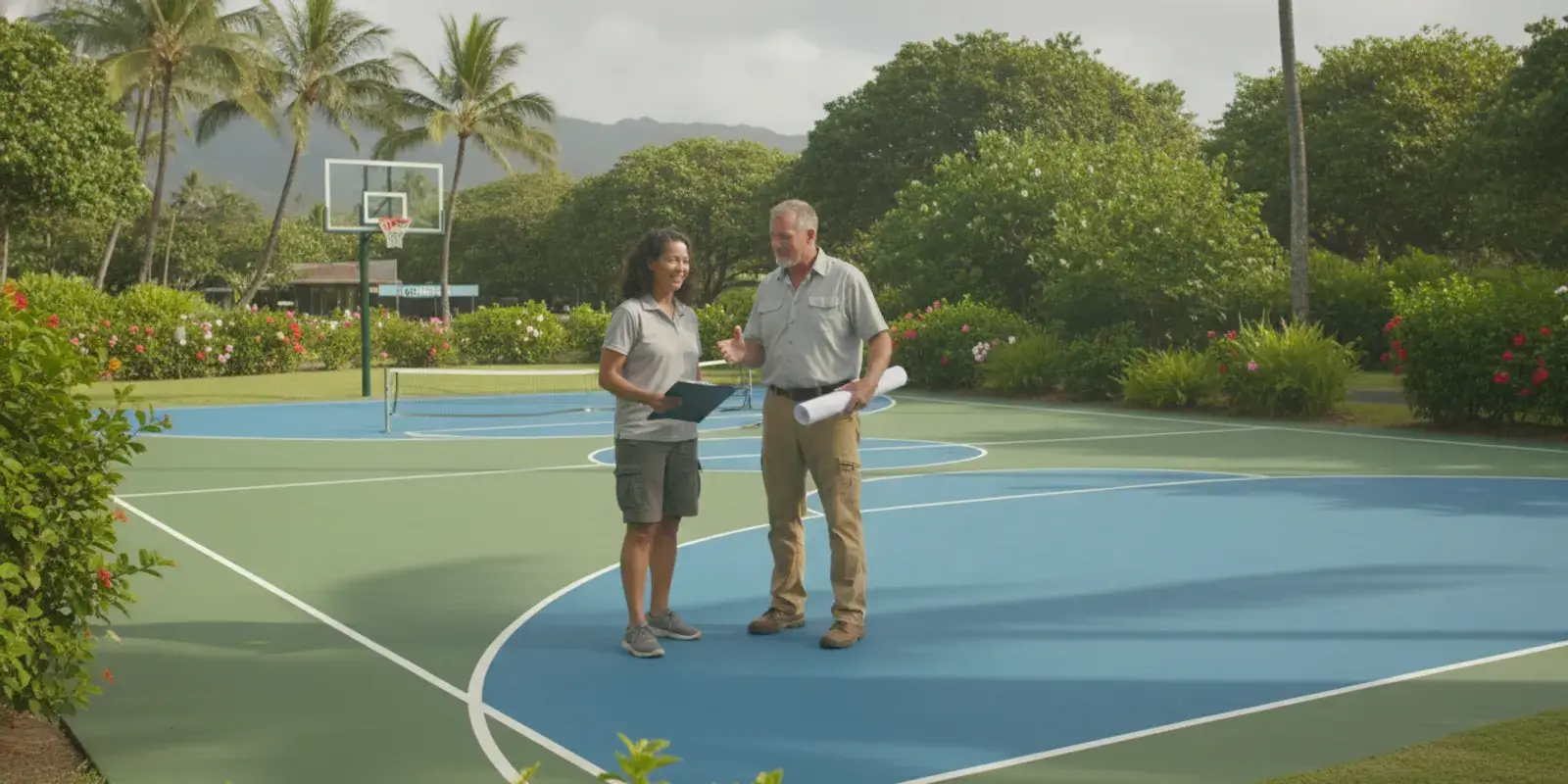
The final walkthrough should be a conversation and inspection, not a quick tour. Use a written checklist so the owner and contractor are looking at the same items. The exact list will vary by project, but these categories are a practical starting point:
- Surface: Review the playing area for visible defects, incomplete coating, unusual ponding, debris, or damage. Discuss any condition that needs monitoring.
- Lines and layout: Confirm that lines are in the agreed locations, colors are correct, and the intended sport layout is clear. Check that lines do not conflict with the facility’s operating plan.
- Edges and transitions: Inspect borders, aprons, thresholds, drains, curb interfaces, and transitions to walkways. These areas affect accessibility, cleaning, and water movement.
- Equipment: Review posts, nets, hoops, sleeves, anchors, padding, and other installed components. Confirm which items are permanent and which require removal or adjustment.
- Fencing and gates: Operate gates and latches. Look for sharp points, loose hardware, trip hazards, and access problems. Record keys or access instructions where relevant.
- Site cleanup: Confirm removal of construction materials and protection of nearby landscaping or structures. Make sure the facility understands who is responsible for any remaining cleanup.
- Documents: Collect closeout records, care instructions, product details, photos, and the contact path for questions or warranty concerns.
- Opening plan: Agree on the conditions for opening the court and the person authorized to make that decision.
For court security and facility operations, the walkthrough should also consider controlled access, lighting, visibility, emergency contact information, and how staff will respond if a surface or piece of equipment becomes unsafe. A Hawaii legislative discussion of facility-level court security needs illustrates why operational planning belongs alongside the physical facility, rather than being left until after opening: review the Hawaii facility security discussion.
How can managers prepare staff before the court opens?
Give staff a short, role-based orientation. A maintenance employee does not need the same briefing as a tournament coordinator, but both should know the basic boundaries. The orientation can cover:
- Who controls keys, gates, equipment, and reservations.
- Which activities are allowed on the surface and which are not.
- How to remove ordinary debris without damaging the coating.
- How to report standing water, unusual cracking, surface separation, damaged lines, loose equipment, or unsafe access.
- Where the project records and emergency contacts are stored.
- How to close the court temporarily and notify users.
Use plain language and show the team the actual court. If the facility has several shifts, repeat the briefing or create a simple handoff sheet. A court may be well built yet poorly protected if one shift knows the opening restrictions and another does not.
It is also useful to establish a condition-reporting routine. Staff can record the date, location, weather context, visible symptom, and photographs. This is not a substitute for a professional evaluation. It simply gives the owner better information when deciding whether a concern is isolated, recurring, or changing.
What maintenance plan should follow turnover?
Turnover should lead directly into routine care. The plan should identify daily, weekly, seasonal, and event-related tasks. The correct frequency depends on use, surrounding vegetation, weather, drainage, and the installed system.
| Turnover or maintenance item | What the facility should confirm | Why it matters |
|---|---|---|
| Opening inspection | Surface, lines, gates, equipment, debris, and visible hazards | Problems can be identified before users enter the court |
| Routine cleaning | Approved tools and methods for dust, leaves, sand, and organic material | Improper cleaning can damage the playing surface or move debris into drains |
| Water and drainage review | Areas where water collects or flows toward the court | Persistent moisture can affect playability and may point to a site or drainage concern |
| Equipment check | Posts, nets, hoops, anchors, padding, fasteners, and gates | Loose or damaged components can create safety and scheduling problems |
| Seasonal review | Vegetation, roots, rainfall effects, salt exposure, and heavy-use wear | Hawaii conditions can reveal concerns that are not visible immediately after completion |
| Annual planning | Condition photos, repair priorities, and future resurfacing or improvement needs | A documented plan supports budgeting and avoids rushed decisions |
Managers should also clarify what not to do. Do not apply an unapproved chemical, drag heavy equipment across the surface, cut into the court, or attempt to fill a structural crack without understanding its cause. A crack may relate to surface wear, underlying movement, roots, drainage, or another condition. Crack isolation, leveling, fiberglass, or cushion approaches can be appropriate in some situations, but none can guarantee that future movement or cracking will never occur.
How should owners plan the budget for turnover and closeout?
Turnover is often included within a broader construction, resurfacing, repair, or improvement project, but owners should still ask what closeout work is included. Confirm whether the proposal covers the final walkthrough, cleanup, photos, equipment adjustment, staff orientation, documents, punch-list completion, and follow-up evaluation.
Project investment depends on the existing court, site work, size, materials, access, equipment, drainage, and intended use. As general planning guidance, smaller projects may fall around $8,000 to $15,000. Medium resurfacing or reconstruction projects may be around $20,000 to $50,000 or more. Full construction and large facilities may exceed $50,000. These are not guaranteed prices or quotes. A site evaluation and defined scope are needed for a realistic proposal.
For an HOA, school, resort, or public facility, compare proposals by deliverables rather than by a single total. Ask whether each proposal explains the surface system, site preparation, drainage assumptions, line layout, equipment, access, closeout records, warranty terms, and owner responsibilities. A lower initial number may not represent the same scope as a more detailed proposal.
Which Hawaii conditions should facility managers monitor?
Hawaii courts operate in a demanding outdoor environment. UV exposure can affect color and surface materials. Humidity and rainfall can complicate cleaning and drying. Salt air can affect exposed metal components. Roots and movement in volcanic or coral soils can contribute to changes beneath or around the court. These conditions do not make a project unsuitable, but they make site-specific planning and consistent observation important.
When a concern appears, document it before attempting a repair. Note whether it is near a drain, edge, tree, joint, gate, or high-traffic area. Photograph the condition from a distance and close up. Then request an evaluation from a qualified court professional. The appropriate response may be routine maintenance, localized repair, crack filling and leveling, resurfacing, reconstruction, or a different solution based on the cause.
Hawaii Court Resurfacing serves Oahu, Maui, the Big Island, Kauai, Molokai, and Lanai. Its services include court construction, full resurfacing, maintenance, crack repair and leveling, color coating, line striping, fencing, windscreens, equipment installation, and custom court design. Learn more about the available court construction and maintenance services, or review how the project process works before preparing your request.
How can a facility compare a turnover-ready proposal?
Before approving sports court construction, ask each provider to answer the same questions. This makes a side-by-side review more useful:
- What existing conditions were observed, and what remains unknown until work begins?
- What preparation, drainage, repair, coating, striping, and equipment work is included?
- What materials and installation methods are proposed for the court’s use and Hawaii setting?
- What is the expected sequence from construction through inspection and opening?
- What documents, photos, maintenance guidance, and staff orientation are included at turnover?
- How will punch-list items be recorded and completed?
- What warranty terms apply to this specific system and contract?
- Who should the facility contact if a condition changes after opening?
Photos, measurements, court use, access restrictions, and the desired opening date can help a contractor understand the project. A clear request also helps identify whether the facility needs a new court, full resurfacing, a conversion, targeted repairs, or a phased improvement plan.
For examples of completed work, review the court project portfolio. Owners planning a multi-sport layout can also use the court design tool to organize early preferences before a detailed evaluation.
Frequently asked questions
Is turnover the same as a final inspection?
No. A final inspection checks the completed work against the project scope. Turnover includes that review plus the operational handoff: documents, care guidance, access, staff orientation, equipment information, and the plan for unresolved items.
Can a facility open immediately after the last construction task?
Not necessarily. Opening depends on the installed system, weather, site conditions, equipment, and the contractor’s project-specific guidance. The owner should receive a clear recommendation before scheduling regular play or a public event.
What should we do if a crack appears after turnover?
Document the location, size, surrounding conditions, and photographs. Avoid applying an unapproved repair product. Request an evaluation so the response can account for surface condition, underlying movement, roots, drainage, and the specific system.
Should a school or resort create a separate court manual?
A simple court manual or one-page operating sheet can be helpful, especially when several employees or user groups share the facility. It should identify opening checks, cleaning methods, equipment rules, reporting steps, and the location of project records.
How can we begin planning a Hawaii court project?
Gather current photos, approximate dimensions, court use, access information, known drainage or cracking concerns, and the goals for the project. Then request a site-specific conversation and proposal rather than relying on a generic price.
Talk with a Hawaii court specialist
A well-planned turnover gives facility managers a practical starting point for safe use, consistent maintenance, and informed decisions as the court ages.