
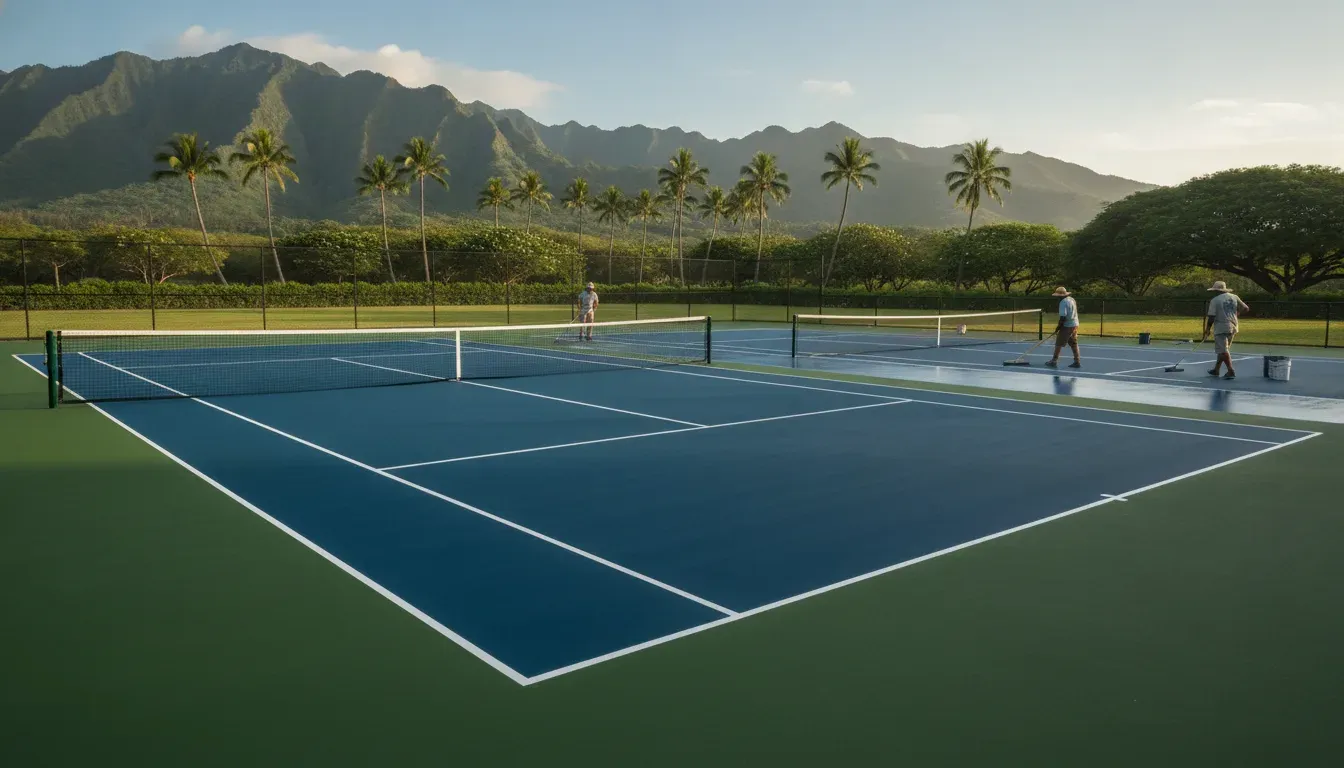
 If your court is faded, cracking, uneven, slippery, or collecting water after rain, a new color coat alone may not solve the problem. Court resurfacing in Hawaii starts with an honest assessment of the surface, the base below it, drainage, access, and the conditions that affect the court year-round. The right plan can restore playability, improve safety, and give a tennis, pickleball, basketball, volleyball, or multi-sport court a durable new finish.
Get a Free Estimate and share photos, videos, the court type, and the island where the project is located. Hawaii Court Resurfacing typically responds within 24 hours.
What is court resurfacing?
Court resurfacing is the process of preparing an existing athletic surface, correcting appropriate defects, applying a compatible surfacing system, and restoring the game lines. It is different from simply painting over a worn court. A professional resurfacing project may include cleaning, crack repair, leveling low areas, correcting surface problems, applying acrylic base and color coats, and installing precise striping.
Resurfacing is usually considered when the underlying court can still support a new surface. If the base has major structural movement, severe drainage failure, extensive settlement, or damage beyond practical repair, reconstruction may be the better path. That decision should follow a site evaluation rather than a guess based only on color fading.
Why Hawaii courts need a Hawaii-specific plan
Outdoor courts in Hawaii face a combination of intense sun, humidity, salt air, tropical rain, heavy use, and ground movement. Conditions vary from one property to another, and they also vary from Oahu to Maui, the Big Island, Kauai, Molokai, and Lanai. A court near the coast may experience different exposure than one in an inland neighborhood. A court surrounded by mature trees may have different cracking and drainage concerns than a court in an open resort complex.
Hawaii Court Resurfacing selects materials and methods with Hawaii’s environment in mind, including UV exposure, humidity, salt air, and rainfall. The company also uses a proprietary crack filling and leveling system designed for expansive volcanic and coral soils and root damage. That focus matters because a new coating cannot permanently hide movement below the surface.
For owners planning a long-term project, the NOAA climate normals resource is a useful neutral reference for understanding how long-term weather patterns are evaluated. Your contractor still needs to assess the actual court, because climate data cannot show a court’s cracks, slope, drainage, coatings, or access conditions.
Signs your Hawaii court may need resurfacing
Some wear is cosmetic. Other symptoms indicate that water, movement, or failing materials are already affecting the court. Look for these conditions:
- Faded or chalky color: The surface looks tired, uneven, or less visible in bright light.
- Cracks: Hairline cracks, wider fissures, recurring cracks, or cracks that follow roots may require different repair approaches.
- Low spots and birdbaths: Water remains on the court after surrounding areas have dried.
- Peeling, bubbling, or delamination: Coatings are lifting, separating, or losing adhesion.
- Slippery areas: Surface wear, algae, contamination, or drainage can affect traction.
- Worn or confusing lines: Game markings are difficult to see, inaccurate, or no longer match the way the court is used.
- Drainage and edge problems: Water flows onto the court, collects along the fence, or reaches the surface from a failing edge.
- Movement around trees or roots: Roots and soil movement are pushing against the slab or pavement.
Do not assume every crack requires full reconstruction, and do not assume every crack can be sealed with a quick patch. A qualified assessment should identify whether the issue is in the coating, the repair layer, the base, the surrounding drainage, or the supporting ground.
Can an existing court be resurfaced?
Often, yes, but the answer depends on the court’s condition. A resurfacing contractor should evaluate the existing surface before recommending a system. The review commonly considers:
- Current court type and dimensions
- Asphalt or concrete condition
- Crack size, pattern, and movement
- Low areas, slope, and drainage
- Existing coating layers and adhesion
- Water, roots, vegetation, and edge conditions
- Fence, windscreen, net, hoop, and other equipment conditions
- Material access and staging space
- Desired sport layout, colors, and line configuration
A surface with manageable wear and repairable defects may be a strong resurfacing candidate. A court with substantial base failure or movement may need reconstruction or a more extensive repair plan. A professional should explain the distinction and show which portions of the recommendation address the cause rather than only the symptom.
What does the Hawaii court resurfacing process include?
A well-managed project should be clear before work begins. Hawaii Court Resurfacing uses a nine-step process that moves from discovery to a final walkthrough. The exact scope depends on the court, but the sequence generally looks like this.
1. Contact and project discovery
The first conversation establishes the court type, property location, current concerns, desired result, timeline, and any access limitations. Homeowners, HOAs, resorts, schools, government facilities, clubs, and property managers may have different approval and scheduling requirements.
2. Photos and videos
Photos and short videos can help identify obvious cracks, faded areas, standing water, fence conditions, access points, and surrounding roots. Good images do not replace a site evaluation when the project is complex, but they help the contractor understand the starting point and prepare useful questions.
3. Site evaluation
The site review looks beyond the color of the court. It may include the surface, cracks, drainage, slope, dimensions, existing coatings, fencing, equipment, and the route for materials and equipment. Outer-island projects may require additional coordination, so accurate information early in the process is valuable.
4. Custom quote and scope
The proposal should explain the recommended repair system, surface preparation, coating system, color options, striping, estimated timeline, warranty information, and optional additions. If there are multiple reasonable approaches, the owner should be able to understand what changes between the options and why.
5. Design and colors
Resurfacing is an opportunity to improve the court’s appearance and usability. Owners can select court colors, multi-sport layouts, logos, line striping, fence colors, windscreens, and equipment finishes. When a court supports more than one sport, line placement should be planned before the coating and striping work begins.
6. Scheduling and deposit
Once the scope is approved, scheduling and material ordering are coordinated. Hawaii Court Resurfacing states that a 50% deposit secures scheduling and material ordering, with the remaining 50% due after completion and customer approval. Confirm the payment terms and project schedule in the written proposal for your specific project.
7. Surface preparation and repairs
Preparation is the foundation of a good resurfacing result. Depending on the court, work may include cleaning, removing loose material, filling cracks, leveling low areas, addressing drainage-related concerns, and preparing the existing surface for the coating system. Repair materials and methods should match the condition and movement of the court.
8. Coating, striping, and installation
After the repair and preparation stages, the crew applies the specified surfacing system and color coats, then lays out the lines. The scope may also include fencing, windscreens, nets, posts, hoops, divider nets, or other equipment. Weather and curing conditions are considered as the work progresses.
9. Final walkthrough
The project ends with a walkthrough to review the completed surface, markings, equipment, touch-ups, care recommendations, and warranty information. This is the right time to confirm that the finished court matches the approved scope and that the owner knows how to protect the new surface.
Learn more about the sequence in the Hawaii Court Resurfacing process guide.
Which court types can be resurfaced in Hawaii?
Resurfacing should reflect the sport, the existing dimensions, the intended users, and the property’s long-term goals. Hawaii Court Resurfacing works with several court types and can also plan multi-sport layouts.
Tennis courts
Tennis resurfacing typically combines surface preparation, crack repair where appropriate, acrylic coating, and precise tennis striping. Owners may also need to review net posts, fencing, windscreens, drainage, and color contrast. See the tennis court resurfacing service for sport-specific considerations.
Pickleball courts
Pickleball projects may involve resurfacing an existing pickleball court, adding lines to a shared court, or converting another court type. Line layout, spacing, net placement, and the relationship between pickleball and other sport lines should be agreed upon before striping. For a new facility rather than a resurfacing project, review the pickleball court construction planning guide.
Basketball courts
Basketball resurfacing may include crack repair, leveling, acrylic coating, color design, basketball striping, and equipment installation. Hoops, backboards, anchors, and surrounding fencing should be reviewed as part of the project so that the finished court works as a complete facility. Explore the basketball court resurfacing service.
Volleyball and multi-sport courts
Volleyball and multi-sport courts require extra coordination because the surfacing, markings, equipment, and shared use must work together. A multi-sport plan can combine tennis, pickleball, basketball, and volleyball lines on one surface, but the layout should prioritize legibility and safe movement rather than adding every possible line without a plan. Hawaii Court Resurfacing also provides volleyball court resurfacing and custom court design.
How much does court resurfacing in Hawaii cost?
There is no responsible single price for every court. Investment depends on court size, existing condition, crack and leveling requirements, drainage or structural work, coating system, number of courts, sport layout, access, equipment, fencing, island logistics, and the selected options.
As project-dependent guidance, smaller projects generally fall around $8,000 to $15,000. Medium resurfacing or reconstruction projects commonly fall around $20,000 to $50,000 or more. Full construction and large facilities may be $50,000 or more. These are planning ranges, not a guaranteed quote, and the written scope for the specific property should control.
Ask whether the proposal includes preparation, crack repair, leveling, coatings, striping, equipment, fencing, windscreens, mobilization, warranty information, and cleanup. A lower initial number may exclude work that the court needs to perform well. A useful proposal makes those inclusions and exclusions easy to compare.
Request a project-specific estimate after documenting the court’s condition. A few clear photos and a description of the desired result can help the contractor prepare for the first conversation.
What materials and repairs matter most?
The correct system depends on the court, but several parts of the work deserve close attention.
Crack repair and isolation
Cracks can result from coating failure, normal movement, root pressure, or movement in the supporting surface. The repair approach should reflect the pattern and severity of the cracking. Hawaii Court Resurfacing’s proprietary crack filling and leveling system is designed for expansive volcanic and coral soils and root damage, which are important local considerations.
Leveling and drainage
Low spots and standing water can shorten the usefulness of a new surface and make play less predictable. Leveling work should be discussed alongside drainage, slope, edges, and nearby water flow. Filling a low area without understanding why water collects there may not solve the complete problem.
Acrylic surfacing and color coating
Acrylic systems provide the finished playing surface, color, texture, and line foundation. Hawaii Court Resurfacing is a SportMaster authorized installer and uses materials selected for Hawaii’s climate. The proposal should identify the system and preparation steps rather than describing the work only as paint.
Lines, equipment, and edges
Sharp lines are part of the court’s function, not just its appearance. Confirm the sport dimensions, shared-line priorities, color contrast, net or hoop placement, fencing, windscreens, and edge details before work starts. If the fence or equipment is failing, repairing the surface alone may leave the facility incomplete.
How should owners plan a resurfacing project?
Good planning reduces surprises and helps each decision support the court’s actual use.
- Identify the users: Decide whether the court primarily serves a home, HOA, resort, school, club, public facility, or multiple groups.
- Document the condition: Photograph cracks, standing water, peeling areas, roots, damaged edges, fences, and equipment.
- Clarify the sports: Choose one sport or define the priorities for a multi-sport layout.
- Set the project constraints: Discuss access, quiet hours, events, school calendars, resident notices, and weather-sensitive dates.
- Request a written scope: Make sure the proposal covers preparation, repairs, coatings, lines, equipment, cleanup, and warranty terms.
- Compare solutions, not just totals: Ask what each option fixes, what it leaves in place, and how it supports the intended use.
- Plan maintenance: Ask how to clean the court, manage water, protect the surface, and report new cracks or coating problems.
For visual planning, the outdoor court designer can help owners think through sport type, colors, lines, and features before finalizing the scope.
Questions to ask a Hawaii court resurfacing contractor
Before signing a proposal, ask:
- Are you licensed for the work, and what is the contractor license number?
- Will the existing court be evaluated for cracks, movement, drainage, and low areas?
- Which repair system is recommended for this court, and why?
- What preparation is included before coating?
- Which materials and surfacing system will be used?
- How will the proposal address roots, water flow, or recurring cracks?
- Who will perform the work, and will the crew be in-house or subcontracted?
- What are the expected work phases and weather-related scheduling limits?
- What is included for striping, equipment, fencing, windscreens, and cleanup?
- What written warranty applies to this system and project scope?
- What payment terms, deposit requirements, and approval steps apply?
- What maintenance should the owner follow after completion?
Hawaii Court Resurfacing is a licensed C-3B contractor, license C-39570, a SportMaster authorized installer, and serves all six major Hawaiian islands with trained full-time in-house crews. Confirm the current scope, warranty, and schedule in the written proposal for your project.
How to protect a resurfaced court after completion
A new surface still needs sensible care. Keep drainage paths clear, address standing water promptly, follow the contractor’s cleaning recommendations, and avoid dragging equipment across the playing surface. Inspect fences, windscreens, nets, posts, hoops, and nearby vegetation regularly. Document new cracks or coating changes early so they can be evaluated before a small issue becomes a larger repair.
Maintenance needs also depend on use. A private court, an HOA court, a resort court, and a school facility may have different traffic, cleaning, equipment, and scheduling demands. Ask for a maintenance plan that reflects how your court will actually be used in Hawaii’s weather.
Why choose an all-island court specialist?
Island logistics, weather, material coordination, and access can shape the project as much as the court surface itself. A specialist serving Oahu, Maui, the Big Island, Kauai, Molokai, and Lanai can plan around those realities from the beginning. Hawaii Court Resurfacing offers flat-rate pricing without hidden inter-island surcharges, trained full-time in-house crews rather than subcontractors, written warranties, and a process that runs from discovery through final walkthrough.
The right contractor should be able to explain what the court needs, why the recommended system fits the conditions, and which decisions are optional. That kind of communication is especially important for HOAs, resorts, schools, and public facilities where multiple people need to understand and approve the work.
Start your Hawaii court resurfacing project
A successful resurfacing project begins before the first coating is applied. Identify the symptoms, document the court, clarify the sports and users, and request a written evaluation that addresses the surface, repairs, drainage, materials, markings, schedule, and warranty. The goal is not simply a brighter court. It is a safer, clearer, more usable court with a plan that reflects Hawaii’s environment and the property’s real needs.
Get My Free Quote from Hawaii Court Resurfacing. Share your island, court type, current concerns, photos, and goals, and the team will help determine the next step. You can also call (808) 476-3235.
Common questions about court resurfacing in Hawaii
Is resurfacing the same as rebuilding a court?
No. Resurfacing renews an existing court when the supporting surface is a suitable candidate for repair and new coatings. Rebuilding or reconstruction addresses more extensive base, structural, settlement, or drainage problems. A site evaluation should determine which path fits the court.
Can one court support multiple sports?
Yes, a court can be designed or resurfaced for multiple sports, but the line layout, spacing, colors, equipment, and priorities should be planned together. A clear design is more useful than adding lines without considering how people will play.
Does a new coating fix recurring cracks?
Not by itself. Recurring cracks may relate to movement, roots, soil, drainage, or the underlying surface. The repair system should address the observed condition before the final coating is applied.
Does Hawaii Court Resurfacing serve every major island?
Yes. The company serves Oahu, Maui, the Big Island, Kauai, Molokai, and Lanai. Contact the team with the property location so the project can be evaluated and scheduled appropriately.
How do I get started?
Contact Hawaii Court Resurfacing through the free estimate page or call (808) 476-3235. Include the island, court type, photos, visible problems, desired improvements, and any timing requirements.