
Tennis rules are easier to follow when you understand the basic rhythm of a point, game, and set. This court-side reference explains how to serve, score, make line calls, and handle common situations in singles and doubles, with practical notes for players and court managers. For an overview of surface work, see our tennis court resurfacing service page.
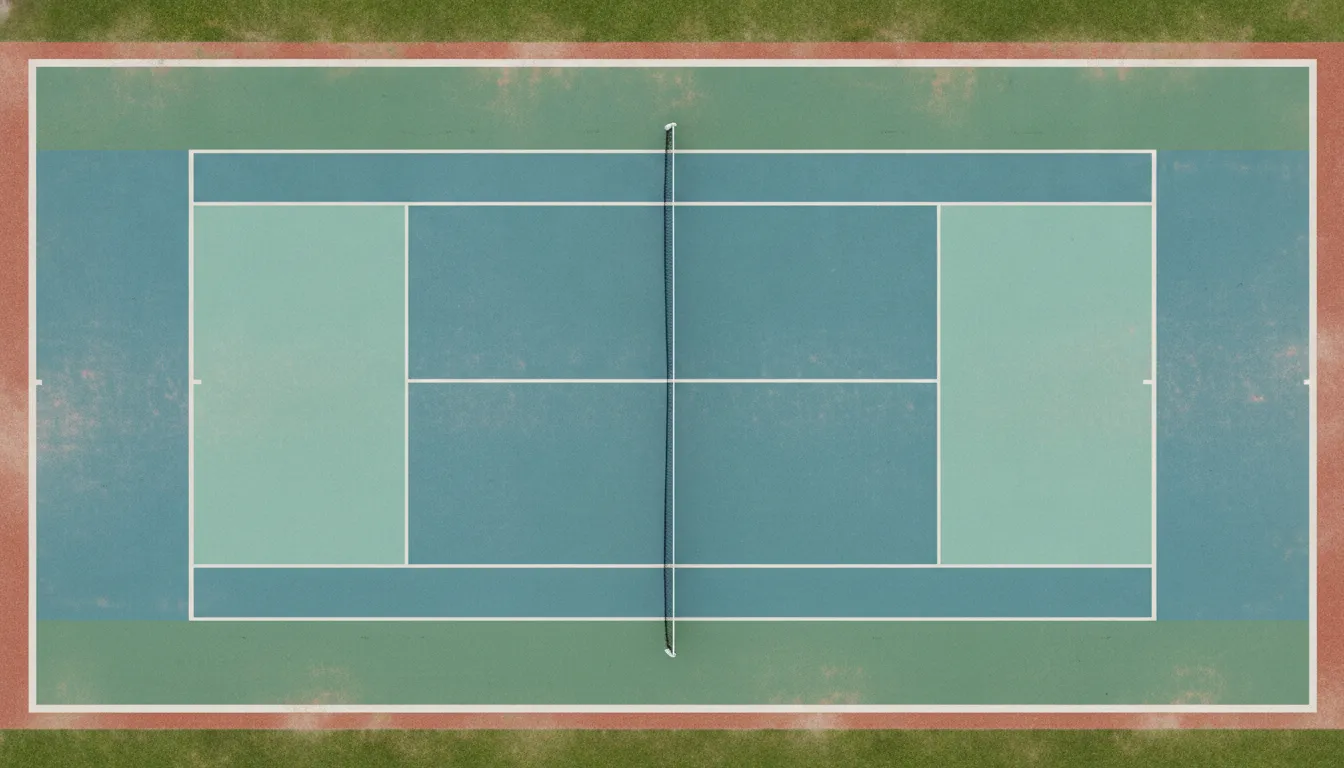
Tennis rules: how does scoring work?
A tennis match is divided into points, games, and sets. Players win points to win games, games to win sets, and enough sets to win the match. The match format depends on the event. Many recreational matches are best of three sets, while some professional events use different formats.
Within a standard game, the score progresses from love (zero) to 15, 30, and 40. The first player or team to win four points wins the game, but must lead by at least two points. If both sides reach 40, the score is called deuce. From deuce, a player must win two points in a row to take the game.
- At deuce, the next point gives the server or receiver advantage, depending on who wins it.
- If the player with advantage wins the next point, that player wins the game.
- If the other side wins the next point, the score returns to deuce.
Some recreational leagues use no-ad scoring to shorten matches. In that format, the point after deuce decides the game. The receiving side usually chooses which service court receives that deciding point, though a league may set its own procedure. Confirm the format before play rather than assuming every match follows the same scoring system.
What are the basic steps in a tennis point?
- Start with the correct server. The server stands behind the baseline, between the center mark and the singles sideline for the court half being used.
- Serve diagonally. The ball must land in the service box opposite the server. The first point of each game starts from the right-hand side; the server alternates sides after each point.
- Return the serve. The receiver must let the serve bounce in the correct service box before hitting it. After the return, players can hit the ball before or after one bounce, but must return it before it bounces twice.
- Keep the rally going. Players alternate hits across the net. A ball that touches a boundary line is in. A point ends when a player fails to return the ball legally, hits it out, lets it bounce twice, or commits another point-ending fault.
- Call the score and move on. The server announces the score before serving, saying their own score first. Players then take the next point from the required service side.
A player may hit a ball before it lands if it appears headed out, but once it lands outside the lines, the point is over. Players should make calls promptly and clearly, especially on courts without an umpire.
Tennis rules for a legal serve
A serve begins each point. The server must stand behind the baseline and within the imaginary extensions of the center mark and sideline. The server may not touch the baseline or the court inside it with either foot before striking the ball. Doing so is a foot fault.
The server releases the ball by hand and strikes it with the racket before it hits the ground. The ball must cross the net and land in the diagonally opposite service box. A serve that misses the box is a fault. A server gets two attempts on each point. If both attempts are faults, the receiver wins the point on a double fault.
Common service faults include:
- The ball lands outside the correct service box or does not cross the net.
- The server steps on or over the baseline before contact.
- The server hits the ball after it has bounced on the court.
- The server serves from the wrong side or in the wrong order and the error is identified under the match procedure.
If a serve clips the net and then lands in the correct service box, it is normally a let and is replayed. A let serve does not count as a fault, so the server keeps the same number of attempts. If the ball clips the net and lands outside the correct box, it is a fault. Some formats use a no-let rule, so players should check event rules before beginning.
For the formal wording and rules used in organized play, consult the International Tennis Federation, the sport’s international governing body. Local leagues and facilities may publish additional procedures for their competitions.
How should players keep track of the score?
Scorekeeping is easier when the server says the score before every point and both sides listen. Within a game, announce the server’s score first. For example, if the server has won two points and the receiver has won one, the score is 30-15. At 40-30, the server needs one more point to win the game; the receiver needs the next point to bring the score to deuce.
After each game, record the game score in the set as well as the point score in the new game. A match score might be described as one set all, with the current set at 3-2. If the players lose track, pause between points and reconstruct the score together from the last point both remember. Do not guess in a way that gives one side an advantage. In a match with an official, ask the official to confirm the score.
Service order matters too. The same player serves every point in a game, alternating right and left service courts. After a game ends, the other player serves the next game. In doubles, the four players rotate through the serving order for the set. At a changeover, players can use the short break to confirm the score, hydrate, and get ready for the next game. The particular timing and changeover procedures can vary by competition.
How do singles and doubles rules differ?
Singles is one player against one player. Doubles is two players against two. The scoring sequence is generally the same, but the court boundaries, service order, and receiving positions differ.
| Situation | Singles | Doubles |
|---|---|---|
| Side boundaries during a rally | The singles sidelines mark the width of the playable court. | The doubles sidelines make the playable court wider. |
| Serving | One player serves for the entire game, alternating service courts by point. | One partner serves for the entire game; partners take turns serving in a set. |
| Receiving | The receiver takes the serve from the service court opposite the server. | The receiving team decides which partner receives from each side at the start of a set; the assigned sides remain for that set. |
| Rally hits | The player must return the ball over the net and into the singles court. | Either partner may hit the ball, but the team gets only one hit before returning it. |
| Scoring | Standard point, game, set, and match scoring applies. | Standard scoring usually applies, though some doubles competitions use a match tiebreak or no-ad games. |
In doubles, teams decide who serves first and who receives on each side. Partners must preserve the service and receiving order established for the set. A team can change positions for a new set, but should not switch its receiving arrangement in the middle of a set except where the rules for a specific event allow it.
The doubles alleys are part of the court during a doubles point, including a doubles rally after the serve. They are not part of the singles court. The service boxes remain the same size in singles and doubles. Knowing which lines are active prevents confusion when a ball lands near a sideline.
How do sets and tiebreaks work?
A set is usually won by the first player or team to win six games with a margin of at least two. At 5-5, play continues until one side leads by two games, unless the event uses a tiebreak at 6-6. A set tiebreak is commonly played to seven points, and the winner must lead by two. Some events use a different target or a match tiebreak in place of a final set.
In a standard tiebreak, the player whose turn it is to serve starts with one point from the right-hand side. The opponent serves the next two points, starting from the left. Players then alternate two serves at a time. They change ends after every six points. The tiebreak continues until one side reaches the required score with a two-point lead.
After a set tiebreak, the player or team that received first in the tiebreak generally serves first in the next set. Players should check the event format, because match tiebreaks and shortened sets can change service order or the number of points required.
How should players make line calls?
On a court without an official, players are responsible for calling balls on their side. A ball is in if any part of it touches a boundary line. A ball completely outside the relevant line is out. When a player is unsure whether a ball landed out, the fair course is to call it in.
- Make the call promptly, in a voice the other player can hear.
- Call only balls that are clearly out on your side of the net.
- If partners disagree on a call, resolve it fairly rather than turning uncertainty into an advantage.
- Do not call a ball out simply because its bounce or spin was difficult to judge.
- When an official is present, follow that official’s decision and the competition’s review procedure.
Players should not stop a rally to dispute a close call unless the rules or a safety issue require it. A calm, consistent approach keeps recreational play enjoyable and helps organized matches proceed fairly.
Why do accurate court markings matter?
Court lines are part of how players apply the rules. The baseline helps define where a server must stand; the service lines and center service line divide the target boxes; and the singles or doubles sidelines determine whether a rally ball lands in bounds. Worn, faded, uneven, or confusing lines can make routine calls harder and affect how people use a facility.
Facility managers can make a basic court check by walking the playing area and looking for markings that are difficult to see, inconsistent, or interrupted by surface wear. Pay attention to the service boxes, center marks, baselines, and the sidelines for the sports the court supports. If a court is used for multiple sports, clear, distinct line colors can help users identify the correct boundaries. The best marking plan depends on the intended play, existing surface, and the condition of the court.
Markings are only one part of court condition. Cracks, surface irregularities, drainage concerns, and coating wear can also affect play and maintenance decisions. A visual check helps identify questions to investigate, but it does not replace an on-site evaluation when the surface needs repair or renewal. See the tennis court resurfacing service page for information about court surface work, or review available court services if you manage more than one type of facility.
Hawaii’s strong sun, humidity, rainfall, and salt air are practical considerations when a facility plans maintenance. Hawaii Court Resurfacing serves Oahu, Maui, the Big Island, Kauai, Molokai, and Lanai, and uses a proprietary crack-filling and leveling system designed for Hawaii’s expansive volcanic and coral soils and root damage. Learn more about the company’s approach in how the court project process works, and view completed work in the court project portfolio.
What basic tennis etiquette should players follow?
Etiquette helps keep play safe and respectful, especially when a court is shared. Follow the facility’s posted rules and agree on any informal procedures before the match. These habits are useful for casual and organized play:
- Wait until a point ends before walking behind or across another court.
- Return stray balls only when it is safe, and avoid sending them through an active point.
- Call the score clearly before serving and use a consistent pace between points.
- Give opponents room to play and avoid distracting movement or conversation during a point.
- Apologize if a ball rolls onto another court or an accidental interruption occurs.
- Leave the court promptly at the end of a reserved session so the next group can begin.
- Use appropriate footwear and follow facility guidance for equipment, weather, and court access.
Players should also pause when a ball from a neighboring court creates a safety risk. Good judgment matters more than keeping a rally going. On shared courts, facility managers can reduce confusion by posting clear rules for court use and explaining how tennis lines relate to other sports marked on the surface.
What should a beginner remember during a match?
A simple routine covers most situations: confirm the match format, identify the active court lines, establish who serves first, announce the score, and serve diagonally into the opposite box. During rallies, return the ball before it bounces twice and treat any ball touching the correct boundary line as in. For close calls, be prompt and fair. If players disagree about a special format such as no-ad scoring or a final-set tiebreak, check the event rules before the match starts.
For managers planning maintenance around the way a court is used, the company background and service coverage can help explain the team’s Hawaii-specific experience. The appropriate work depends on the court’s condition and intended use, so owners should seek a project-specific assessment rather than assume that one treatment suits every surface.
Frequently asked questions
Does the line count as in or out?
The line counts as part of the court. If any part of the ball touches the relevant line, the ball is in. It is out only when it lands completely beyond that line.
Can a player hit a serve after it bounces?
No. The server must strike the released ball before it hits the ground. A serve that bounces before the racket makes contact is a fault.
Does a serve that touches the net always get replayed?
No. Under the standard let procedure, a serve that touches the net and lands in the correct service box is replayed. If it lands outside the correct box, it is a fault. Some events use a no-let format, so check the rules for the match.
How many points are needed to win a tiebreak?
A common set tiebreak is played to at least seven points, with a two-point lead required. Some formats use a different target, especially for a match tiebreak, so the event format controls.
Why can tennis court lines seem different in doubles?
Doubles uses the wider doubles sidelines during rallies, while singles uses the narrower singles sidelines. The service boxes do not become wider for doubles. Players should identify the active lines before starting.
Clear rules, accurate calls, and visible markings make tennis easier to enjoy at every level. For facility owners, checking the court surface and its markings together is a practical first step toward keeping the space ready for play.