
For board members and property managers searching for hoa pickleball tennis court resurfacing hawaii, the important decision is not simply which coating to choose. It is how to assess court condition, verify a contractor’s documentation, plan work around residents, and compare proposals that may cover different scopes. Hawaii Court Resurfacing serves associations across the islands, with court construction, repair, and resurfacing for tennis, pickleball, basketball, and multi-sport facilities.
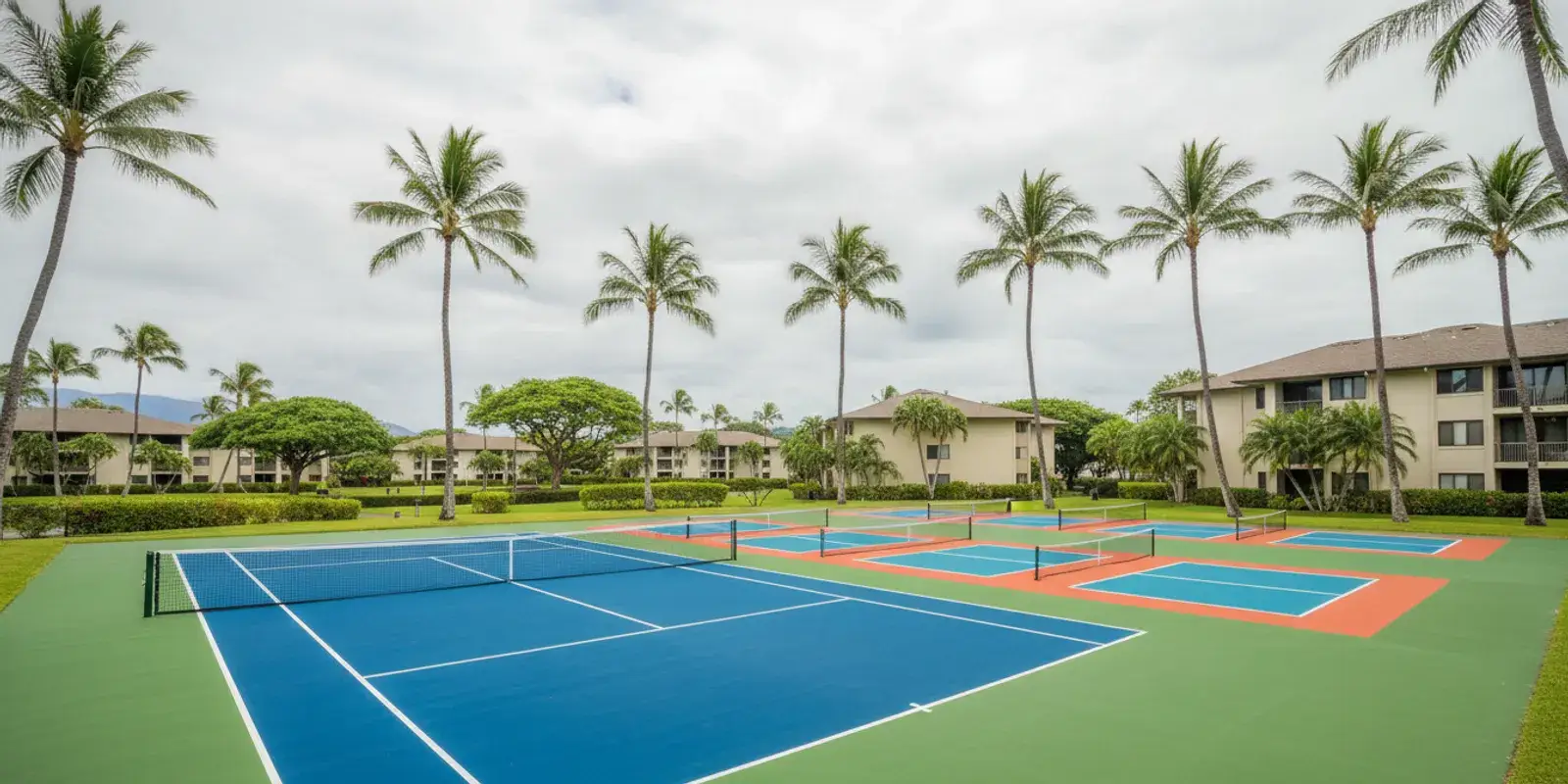
An HOA court is a shared asset. A sound plan starts with the surface and the conditions below it, then connects the technical scope to board approval, budgets, scheduling, and resident communication. This guide outlines the questions to ask before moving from initial review to a proposal. For an overview of services across the islands, see Hawaii court construction and resurfacing services.
What HOA Boards Need to Know Before Hiring a Court Contractor in Hawaii
Begin by defining what the association wants the court to do and what problems it needs to solve. A tennis court with surface wear may need a different scope from a pickleball court with recurring cracks, uneven areas, or lines that no longer fit how residents use the space. For a shared court, there may also be choices about sport layout, access, equipment, and how long the area can be closed.
Before requesting proposals, collect basic information that helps contractors evaluate the work:
- Identify each court and its use. Record whether it is used for tennis, pickleball, basketball, volleyball, or multiple activities. Note any planned conversion or additional striping.
- Describe visible conditions. Photograph cracks, low or uneven areas, coating wear, peeling, standing water, root impacts, and drainage concerns. Note where and when the issues appear.
- Gather site history. If available, assemble prior repair records, resurfacing dates, plans, and information about recurring movement or water issues. Do not assume a coating alone will correct an underlying problem.
- Set the board’s decision criteria. Agree on the intended use, desired scope, budget range, approval process, and any periods when residents need access to the courts.
- Ask how the site will be evaluated. Photographs can support an initial discussion, but a contractor may need a site review to assess the existing surface and conditions before defining a final scope.
Hawaii’s weather and ground conditions matter to the evaluation. UV exposure, humidity, salt air, rainfall, expansive volcanic or coral soils, and nearby roots can affect court surfaces and repairs. The right recommendation should address the particular site and its observed condition, rather than promise that one coating or repair method will stop all future movement or cracking.
Associations should also make sure proposals describe comparable work. One quote might include crack repair, leveling, color coating, and new lines; another might address only coating and striping. Ask each bidder to state what is included, what conditions could change the scope, what preparation is planned, and what is excluded. A clear process is useful too. Hawaii Court Resurfacing describes a sequence from discovery and site evaluation through quote, scheduling, construction, and final walkthrough in its court project process.
Use the first site discussion to establish what is known and what still needs inspection. For example, a board may have observed a crack near a tree and water that remains after rain. Those observations help a contractor focus the review, but they do not by themselves identify the cause or determine the right repair. Ask the contractor to distinguish visible symptoms from likely underlying conditions and explain what further evaluation is needed before finalizing the scope.
It is also useful to appoint one board or management contact for the project. That person can collect resident observations, provide access information, and distribute questions to the contractor rather than sending conflicting requests from several sources. Keep a dated record of photographs, meeting decisions, and proposal revisions. This gives the board a clear reference when it compares options or revisits a decision later.
C-3B License, Insurance, and Written Warranties: The Documentation Checklist
Before recommending a contractor, the board can request documentation and verify that it matches the project and the association’s procurement requirements. Keep the records with the proposal and meeting materials so decision-makers can review the same information.
| Item to review | What to ask for | Why it helps the board |
|---|---|---|
| Contractor license | License classification and number, plus a way to verify current status | Helps confirm the contractor’s stated credentials and suitability for the proposed work |
| Insurance | Current certificate of insurance and any project-specific requirements from the association | Lets the board and its management team review coverage documentation against their own requirements |
| Written scope | Preparation, repairs, coating system, colors, lines, equipment, exclusions, and change conditions | Makes competing proposals easier to compare and reduces ambiguity about deliverables |
| Warranty terms | Written terms for the proposed materials and installation, including exclusions and claim process | Sets expectations based on the selected system and project conditions |
| Schedule and access plan | Estimated work sequence, access restrictions, and coordination responsibilities | Supports resident notices and day-to-day property planning without assuming an unconfirmed start date |
| Closeout information | Final walkthrough, care guidance, and copies of applicable project documents | Gives the association a record to use for maintenance and future planning |
Hawaii Court Resurfacing lists C-3B contractor license C-39570. Associations should still verify licensing and confirm that any bidder meets the association’s own documentation and procurement standards. For insurance, request current documentation and have the property manager or association adviser check it against the project requirements; do not rely on verbal assurances.
Warranty language deserves the same careful review as the scope. Ask what the written warranty covers, how long the applicable coverage lasts, which conditions are excluded, and how a concern should be reported. Warranty terms depend on the specific system, materials, installation conditions, and contract. They should not be treated as a blanket promise that a surface will never crack, move, or need maintenance.
It can help to ask the contractor to explain how it handles site-specific cracks or uneven areas and what limitations remain after the proposed repair. Hawaii Court Resurfacing uses a proprietary crack-filling and leveling system designed for Hawaii’s expansive volcanic and coral soils and root damage. That description is a starting point for discussion, not a substitute for reviewing the court itself and the proposed scope. The board can also review company information and experience as part of its due diligence.
During review, compare the warranty document with the work description instead of treating it as a separate promise. If the scope lists multiple work areas or surface systems, ask whether the same terms apply to each. Clarify who receives a warranty document at closeout, how to submit a concern, and what records or photographs the association should retain. Put the answers in writing so a future board can find them without relying on memories of a meeting.
Multi-Court Resurfacing and Maintenance Programs for Hawaii HOAs
When an association manages more than one court, planning them as a group can make the work easier to coordinate. That does not mean every court needs the same repair or surface system. A tennis court, a pickleball conversion, and a basketball area may have different layouts, equipment, condition issues, and resident priorities. Ask for each court to be assessed and itemized, then look for coordination opportunities in the schedule and proposal.
A practical multi-court review can follow these steps:
- Inventory the courts. List court type, approximate size if known, current use, equipment, surface condition, and prior work.
- Separate shared needs from court-specific needs. For example, the association may want a consistent color approach across a complex, while cracks or leveling work may differ by court.
- Rank work by condition and use. Identify urgent safety or usability concerns, courts that can remain open longer, and improvements that can be planned for a later phase.
- Request itemized options. Ask for individual court scopes and a combined project option, where practical. This helps the board understand the trade-offs without assuming that bundling always lowers cost.
- Coordinate resident access. Confirm how closures, notices, alternate recreation options, and access around the work area will be handled.
- Document the completed work. Use the final walkthrough to review the agreed scope and collect care instructions and applicable warranty documents.
Maintenance planning can be part of the same conversation. Ask what routine cleaning and observation are appropriate for the selected surface, how to report new cracks or areas of standing water, and when the contractor recommends another condition review. A maintenance plan should describe practical tasks and evaluation triggers rather than promise a fixed surface life that cannot be guaranteed for every site.
Boards may compare maintenance and restoration choices with a simple table of decision factors: current condition, resident use, disruption, scope, and timing. If a court is structurally sound but its color coating and lines are worn, the proposal may differ from one for an area with recurring cracks or unevenness. For examples of completed work, associations can review the court project portfolio and ask which examples are most comparable to their own site.
Associations with residents who play different sports should also clarify the layout before approving striping. A multi-sport design may have overlapping lines that affect visibility and play. Confirm the intended sport priorities, line colors, and equipment changes in writing. The pickleball court service information and tennis court resurfacing information can help boards frame sport-specific questions during that discussion.
Resident coordination works best when the board plans communications alongside the construction scope. A notice can state which court or area will be unavailable, what access routes residents should avoid, and where questions should go. Share only dates and restrictions confirmed with the contractor, then update residents if the work sequence changes. If an association has more than one court, ask whether keeping one available during work is practical; do not assume that crews can work around active play or that every court can stay open.
Before work begins, confirm how gates, keys, equipment, nearby parking, and any shared paths will be handled. Decide who will post notices and who can approve a change if an unexpected site condition is found. A simple contact chain prevents residents from unintentionally entering a closed work area and helps the board receive consistent updates. After completion, include the court in the association’s regular property observations and retain a record of when the work was done.
How to Budget for Court Resurfacing at a Condo or HOA in Hawaii
Every association’s court and scope are different, so an online range should be treated as early planning guidance, not a quote. Project size, surface condition, repair needs, court count, layout changes, materials, and access conditions all affect what the contractor proposes. The appropriate next step is to define the scope and request an evaluation and written estimate.
For broad planning purposes, Hawaii Court Resurfacing’s project guidance places smaller projects generally around $8,000 to $15,000, medium resurfacing or reconstruction projects around $20,000 to $50,000 or more, and full construction or large facilities at $50,000 or more. These are general ranges, not guaranteed prices or a substitute for a project-specific assessment.
| Planning category | General investment guidance | Board’s next question |
|---|---|---|
| Smaller project | Generally around $8,000–$15,000 | Which repairs and surface work are included, and what site conditions could change the scope? |
| Medium resurfacing or reconstruction | Generally around $20,000–$50,000+ | Are repair, leveling, coatings, striping, and equipment needs itemized for each court? |
| Full construction or large facility | Generally $50,000+ | What design, site preparation, construction, and coordination decisions must be approved? |
Use ranges to decide whether the association should prepare a reserve allocation, explore phased work, or bring a proposal to a membership or board meeting. They are not comparable bids unless the scope and assumptions match. Ask bidders to explain what they observed, what they recommend now, what may be deferred, and what is not included. If proposals differ significantly, compare the work line by line before comparing totals.
For a multi-court facility, consider asking for both a full-project proposal and a phased alternative. A phased plan can help the board prioritize by condition and budget, but the contractor should explain any coordination or remobilization considerations that may apply. The board should weigh those trade-offs with its own reserve plan and approval procedures.
Hawaii condo associations also need to consider the broader operating budget when planning shared amenities. A Civil Beat report discusses the pressure of Hawaii condo fees in its article, “Hawaii Condo Fees Are Among Nation’s Highest”. The practical takeaway for a court project is to present a transparent scope and realistic options to owners, not to assume that one funding approach fits every association.
Hawaii Court Resurfacing describes a 50% deposit to secure crew scheduling and material ordering, with the remaining 50% due after project completion and customer approval. Confirm the applicable terms in the proposal and contract before the board commits. For a project-specific discussion, use the company’s estimate and booking page.
When presenting proposals to owners, make the decision legible. Summarize the observed condition, recommended work, alternatives considered, assumptions, exclusions, and amount requested. If the board is considering a phased approach, show which courts or tasks would be included in each phase and what the practical result of deferring work could be. Avoid implying that postponing a repair will have a predictable cost outcome unless a qualified evaluation supports that conclusion.
Payment terms should also be part of the board’s review rather than a detail left until signing. Confirm the deposit amount and what it secures, the milestone for the remaining payment, the approval process for any change, and which association representative can authorize it. Make sure the final contract, approved scope, and board resolution reflect the same terms. This makes it easier for management to administer the project and for owners to understand how funds will be used.
Why Full-Time In-House Crews Matter for HOA Accountability
For an association, construction quality is only part of contractor accountability. The board also needs a clear point of responsibility when coordinating access, communicating changes, reviewing work, and resolving questions. Hawaii Court Resurfacing states that work is performed by trained, full-time in-house crews rather than subcontractors. Boards can ask how that team structure applies to the particular project and who will be responsible for communication and site coordination.
Useful questions include:
- Who is the association’s contact before, during, and after the project?
- Who coordinates resident notices, site access, and protection of nearby property?
- How will the association be informed if site conditions require a change to the agreed scope?
- Who will participate in the final walkthrough, and what records will the board receive?
- How can residents report a concern during the work without conflicting instructions reaching the crew?
Clear responsibility also matters when a property is outside Oahu. Hawaii Court Resurfacing serves Oahu, Maui, the Big Island, Kauai, Molokai, and Lanai. Its services overview and contact page are places to begin clarifying the project location, court type, and next steps. Associations should confirm project-specific travel, access, scope, and scheduling details directly rather than assume that island coverage establishes a particular schedule.
A board can also review relevant basketball court resurfacing information when its facility includes courts beyond tennis or pickleball. The proposal should still spell out the actual court-specific work; general service descriptions do not replace an evaluation.
For accountability, agree on how field decisions will be communicated. If an unexpected condition changes the recommended work, the association should receive a clear explanation of the observation, the proposed adjustment, and any effect on cost or scope before approving the change. Record the decision and the person authorized to make it. At closeout, walk the site with the contractor, compare completed items with the written scope, note any follow-up questions, and collect applicable care information and documents.
What Should an HOA Ask Before Approving a Court Project?
Before a vote or contract approval, check that board members can answer these questions in plain language:
- What condition issues were observed, and which need attention in this project?
- Does each proposal describe the same scope, preparation, repairs, coating, striping, and exclusions?
- Are license information, insurance documents, and written warranty terms available for review?
- Are court closures, resident communications, and site coordination responsibilities clear?
- Does the proposal identify costs and assumptions for each court or phase?
- Are the project schedule and payment terms stated in writing and confirmed by the association?
- Who will oversee the work and join the final walkthrough?
For a qualified conversation about an HOA or condominium court, share the island, court types, number of courts, visible concerns, and any timing constraints. Hawaii Court Resurfacing typically answers inquiries within 24 hours. Explore court design options if the board is considering a new layout, then use the estimate page to discuss a project-specific evaluation.
Discuss Your HOA Court Project
A carefully documented scope gives board members, property managers, and residents a shared understanding of the work, its limitations, and the decisions still to be made.