
Volleyball court construction cost depends on far more than the playing surface. In Hawaii, site conditions, drainage, access, intended use, and supporting work can change the scope substantially. A useful budget starts by deciding what the facility needs, then evaluating the site and comparing clearly defined proposals.
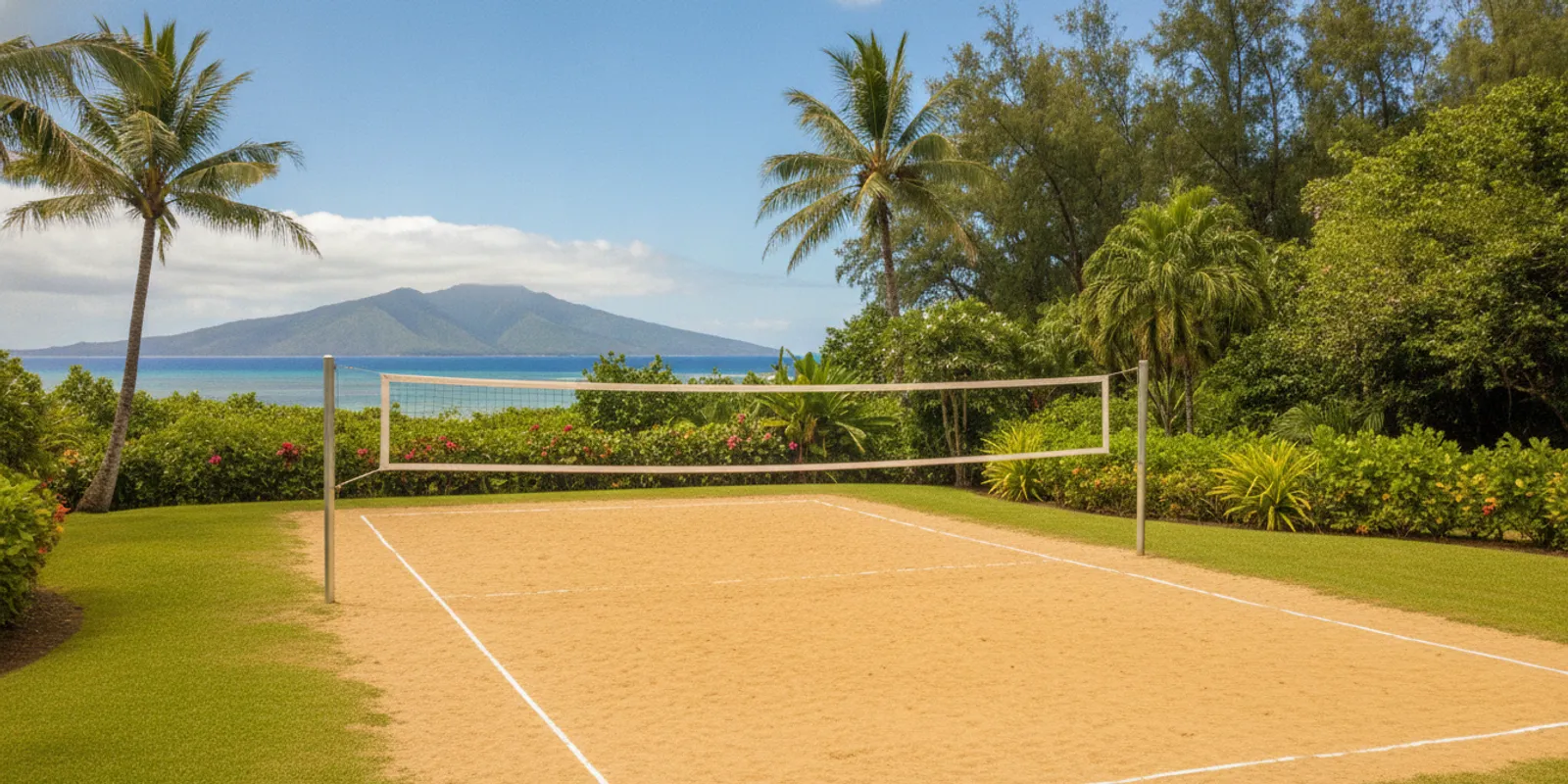
Why is there no single volleyball court construction cost?
A court may mean a marked playing area and net on an existing suitable base, or a complete facility built from the ground up. Those are different projects. New construction may involve site preparation, grading, base construction, drainage, surfacing, line markings, fencing, and equipment. Existing facilities may need only selected improvements, depending on the site’s condition and the owner’s goals.
For that reason, a headline price without a defined scope is not a reliable comparison. Ask what is included, what assumptions the estimate uses, and which site conditions could change the work. Hawaii Court Resurfacing serves Oahu, Maui, the Big Island, Kauai, Molokai, and Lanai, and its court services include construction and maintenance across multiple court types.
Which project decisions affect construction cost most?
1. New build or work on an existing court
Starting with an existing paved area can reduce the amount of new construction, but only if the base, levels, and drainage suit the intended use. A surface that looks serviceable may still have movement, cracking, or water-management issues that require attention. A new facility generally calls for a broader assessment of the site and the full build-up, rather than pricing the finish alone.
Clarify whether the project is a full new build, an upgrade to an existing court, or a conversion from another sport. The work involved in a conversion depends on the dimensions and condition of the existing facility and the changes needed for play. Review the company’s volleyball court information to see the relevant service context; the specific project still needs its own assessment.
2. Site preparation and access
Ground conditions, grading needs, existing vegetation or structures, and construction access can all affect the work. On an island site, access for people, materials, and equipment is a practical planning issue. A site visit and current photos or video can help an estimator understand the setting, but may not reveal every condition below the surface.
Share details such as the property location, access restrictions, approximate dimensions, current surface, and known drainage problems. For projects on outer islands, ask how mobilization and material delivery are handled and what the proposal includes. Hawaii Court Resurfacing describes statewide service and flat-rate pricing without hidden inter-island surcharges; confirm the specific project scope in the written estimate.
3. Drainage and water management
Rainfall and the way water moves across and around a court deserve attention in Hawaii. Poor drainage can affect usability and contribute to deterioration. The appropriate work depends on the site, existing elevations, and where water can safely flow. Drainage should not be assumed unnecessary or automatically added without evaluation.
Ask the estimator to identify observed water issues and state whether drainage work is included, excluded, or subject to further assessment. A proposal should make clear what is being addressed rather than promising that a surface alone will solve every water problem.
4. Court base, surface, and finish
The base and surface need to match the intended use and site condition. Surface preparation, repair, leveling, color coating, and line striping may be part of the scope. Hawaii’s UV exposure, humidity, salt air, rainfall, and soil movement also make material selection and repair methods important considerations. Hawaii Court Resurfacing uses a proprietary crack-filling and leveling system designed for Hawaii’s expansive volcanic and coral soils and root damage, and is an authorized SportMaster installer.
These methods are not a promise that future cracking or movement cannot happen. Existing conditions and future site movement matter. Ask the contractor to explain how proposed repairs relate to the visible condition and what limitations apply. Warranty terms should be project-specific and depend on the system, materials, installation conditions, and contract.
5. Net systems, markings, and supporting features
Equipment and amenities can be included in the build or handled separately. Confirm whether the scope covers a net and posts, line markings, fencing, windscreens, lighting, access paths, or other site features. Different uses and facility requirements may call for different selections. A proposal should distinguish the court itself from optional or separately priced components. An owner considering a multi-use facility should ask how the layouts, color areas, and line sets will be coordinated so the finished court is understandable to its users.
How can you compare the main project scopes?
The table below is a planning aid, not a price list. It shows why two proposals described as a volleyball court may cover very different work.
| Scope type | Typical work to clarify | Key questions |
|---|---|---|
| Existing court upgrade | Condition review, surface preparation, repairs, coating, markings, and equipment as needed | Is the existing base suitable? Which repairs and exclusions are specified? |
| Conversion or adaptation | Assessment of current court, revised markings or equipment, and any required surface or layout changes | Does the existing layout and condition support the intended play? |
| New court construction | Site preparation, grading, base, drainage planning, surface, markings, equipment, and possible fencing | What site work is included, and what assumptions could affect the final scope? |
| Multi-court facility | Multiple playing areas, shared access or drainage needs, and coordinated equipment and amenities | Are quantities, phasing, access, and shared infrastructure clearly described? |
What should a volleyball court proposal explain?
Compare proposals based on the work they commit to perform, not just the total. A clear estimate should help an owner understand what is known, what remains uncertain, and how a change in site conditions could affect the project. Ask for the same categories from each provider so you can compare scope instead of guessing from a short total-price line.
- Defined scope: Identify preparation, construction, surface work, markings, equipment, and optional items.
- Site assumptions: Note access, dimensions, existing conditions, and any work that needs further investigation.
- Materials and methods: Explain the specified surface system and how repairs or leveling will be approached.
- Drainage: State what water-management work is included or excluded.
- Schedule and dependencies: Identify planning steps and conditions that must be resolved before work proceeds, without unsupported start-date promises.
- Payment and warranty terms: Review the written terms for the specific project. Warranty coverage depends on the system, materials, installation conditions, and contract.
For background on planning a sand facility, the Town of Tiburon’s Beach Volleyball Overview & Feasibility document itemizes considerations such as sand, border and excavation, drainage, and fencing. It is a useful example of breaking a project budget into components, not a Hawaii price guide or specification for every court. Owners planning a sand court should treat its assumptions as a starting checklist and confirm local site and design requirements rather than transferring another town’s budget directly.
What information helps prepare a realistic estimate?
Gathering a few details in advance can make the first discussion more productive. If available, prepare:
- The property island and location, plus access or delivery constraints.
- Approximate court dimensions and whether it is an existing court or a proposed new build.
- Recent photos or video showing the full area, surface, edges, and surrounding grade.
- Known cracks, standing water, root impacts, settlement, or past repairs.
- The intended use, number of courts, desired surface type, and equipment or fencing needs.
- Your priorities, such as durability, renovation scope, phasing, or budget range.
Hawaii Court Resurfacing’s project process describes discovery and site evaluation through quote, scheduling, construction, and final walkthrough. You can also review completed project examples to understand the range of court work, while remembering that each site’s conditions differ. When sending information, distinguish what you know from what you suspect. For example, note where water remains after rain, but avoid assuming that a visible puddle identifies the underlying cause. That distinction helps an estimator focus follow-up questions and determine whether a site visit or further investigation is needed.
How should owners plan the budget?
Use early budget discussions to define priorities, not to assume every court needs the same package. If the site is sound, a focused upgrade may be appropriate. If the base, drainage, or layout needs substantial work, a more complete project may be necessary. Ask for options only when each option is technically suitable, and make sure exclusions and trade-offs are explicit.
Project investment varies with scope. Hawaii Court Resurfacing’s general guidance places smaller projects around $8,000 to $15,000, medium resurfacing or reconstruction around $20,000 to $50,000+, and full construction or large facilities at $50,000+. These are broad project-dependent ranges, not a volleyball-specific quote. A site evaluation is needed to establish what work is appropriate and what it may cost.
For a clearer planning conversation, read the company’s court planning information and consider how the court will be used over time. A durable choice is not always the most extensive choice; it is the scope that addresses the actual condition and intended use. If your desired scope exceeds the amount currently available, discuss whether phasing is practical. Separate phases should still preserve a coherent design and avoid completing an early component that later work must undo.
What should facility owners consider for larger or multi-court projects?
With multiple courts, a property owner may be planning a shared facility rather than repeating a single-court project. Discuss traffic flow, access routes, separation between play areas, shared drainage, fencing, lighting plans, storage, and the order in which work can be completed. These items interact: for example, court placement affects how people reach the playing areas, while grading and water management can involve the broader site rather than one rectangle.
For a school, hotel, association, or public facility, include the people who will maintain and operate the courts in early planning. Ask who will use the facility, whether different user groups need separate play areas, and what site operations must continue during construction. If the work is phased, define the limits of each phase, how access will be managed, and whether temporary closures affect the schedule. These are planning questions, not a substitute for design review or a site-specific proposal.
For multi-court estimates, request quantities and assumptions for each area separately, along with shared items such as access, drainage, and fencing. That makes it easier to see which costs apply to a single court and which serve the facility as a whole. It also supports realistic decisions if the owner needs to prioritize an initial phase while keeping a future expansion in view.
How can owners make a fair side-by-side comparison?
Before choosing a proposal, create a simple comparison sheet and use the same questions for each contractor. Put the stated scope in one column, assumptions in another, and items needing clarification in a third. This avoids treating a low total as a like-for-like offer when one estimate includes drainage or equipment and another excludes it.
For example, if Proposal A includes base repairs, coating, striping, and a net system while Proposal B covers only surface work, the totals describe different projects. Ask whether each provider is pricing the same court dimensions, access conditions, and finish. If the scope differs, request a revised option or clearly identify what must be purchased separately. Do not compare only the initial number without understanding the work behind it.
Also separate confirmed observations from allowances. A proposal may identify an item that cannot be fully assessed until work begins, such as an obscured condition or a below-grade issue. Ask how such work would be documented, approved, and priced before it proceeds. A written change process reduces surprises and gives the owner a chance to make an informed decision if additional work is proposed.
How can you plan the project in practical stages?
A staged planning process can keep the conversation organized, especially when several people share responsibility for the facility. Start with the purpose of the court, then work outward to the site and supporting infrastructure.
- Set the use: Decide whether the court is dedicated to volleyball or will support other activities. Note who uses it and how often, since that affects equipment, layout, and operational needs.
- Document the site: Gather dimensions, access notes, photos, and known problem areas. Record where water collects and whether nearby trees, slopes, or structures may influence the site.
- List the desired components: Separate must-haves from optional features such as fencing, windscreens, lighting, or additional play areas.
- Request an assessment: Ask for review of the base, surface, drainage, grading, and delivery logistics. Clarify which conclusions are based on observation and which require further investigation.
- Review the written scope: Check quantities, materials, exclusions, assumptions, schedule dependencies, payment terms, and warranty language before making a decision.
- Plan operations: For an active school, hotel, or community facility, determine how construction access and temporary closures will affect users.
This sequence does not replace professional design or permitting where applicable. It helps owners present a complete brief and identify questions early, so estimates can be compared on a consistent basis.
What should owners remember about volleyball court construction cost?
There is no useful universal price for a volleyball facility without knowing its site and intended scope. The biggest planning task is to identify what must be built or repaired, what can be reused, and which supporting components belong in the project. In Hawaii, access, rainfall, soil behavior, salt air, and UV exposure deserve consideration alongside the surface choice.
Use a written scope to distinguish a simple upgrade from a full construction project. Request clarification about drainage, base work, equipment, exclusions, and uncertain conditions. Broad investment ranges can help frame an early discussion, but they do not replace a project-specific estimate.
Frequently asked questions
Does the court surface determine the whole cost?
No. Surface materials and finishing are only part of the project. Site preparation, base condition, drainage, access, equipment, markings, and fencing may also affect scope and budget.
Can an existing area be converted into a volleyball court?
Possibly, but its dimensions, surface condition, levels, and drainage need to suit the intended use. An evaluation can identify what can remain and what changes are needed.
Can a crack-filling system prevent future cracks?
No repair method should be presented as a guarantee against future cracking or structural movement. The suitable repair depends on the condition and causes observed, and ongoing ground movement may affect the surface later.
How do I get a project-specific cost?
Share the location, current site details, photos if available, intended use, and desired scope. A project-specific evaluation can clarify the work and estimate. Inquiries are typically answered within 24 hours.
Review court construction and maintenance services
Volleyball court construction cost is best understood as the result of a defined scope matched to real site conditions. A careful evaluation and transparent proposal give owners a practical basis for deciding what to build or improve.