
Good pickleball strategy is not about hitting every ball hard or trying to end each rally quickly. It is about choosing a shot that fits your balance, position, and the space your opponents leave open, then preparing for the next ball. Recreational players can use a few simple cues to make more deliberate choices in singles and doubles without memorizing complicated patterns.
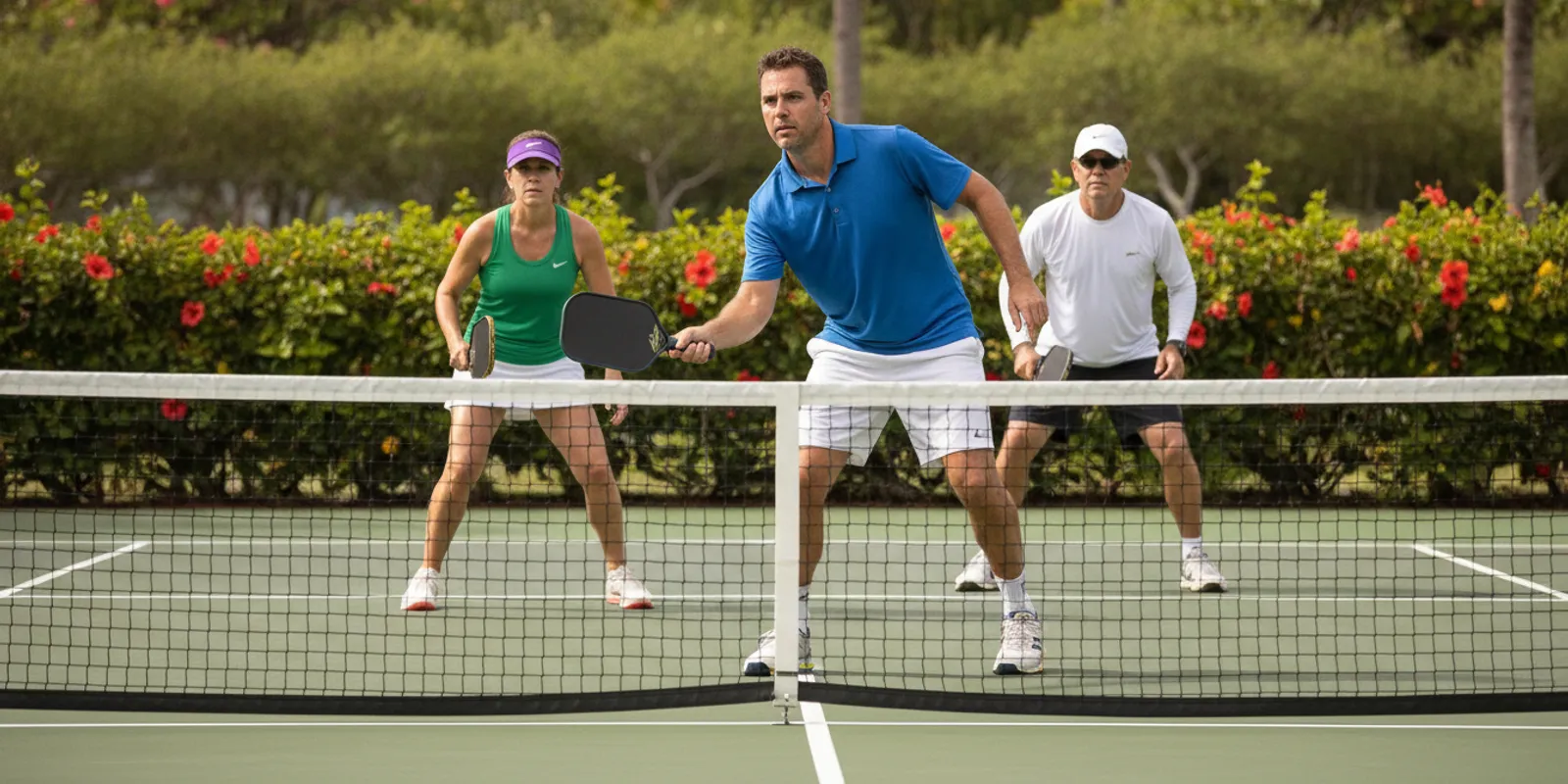
What should pickleball strategy help you decide?
A useful plan answers three questions during a rally: Where am I, where are my opponents, and what position will I be in after this shot? The answers change from one contact to the next. A ball that is easy to attack when you are balanced may be a poor choice when you are reaching, moving backward, or contacting it below net height.
Think of a shot as doing one or more jobs. It can keep the ball in play, move an opponent, give you time to recover, or create a more comfortable next ball. A winner is one possible result, but a shot that improves your position can be valuable even when the rally continues.
- Check your balance. If your feet and body are under control, you have more options. If you are stretched, choose a shot with a comfortable margin.
- Read the ball. Notice its height, pace, depth, and angle before choosing power or direction.
- Look for open space. A controlled shot away from an opponent can make them move and may limit their next choices.
- Plan your recovery. After contact, move toward a position that helps you reach likely replies instead of watching the shot.
These cues are a starting point, not fixed rules. The right decision depends on the rally, your skill, and whether a partner shares the court with you.
Where should you position yourself?
Positioning is a balance between reaching the next ball and reducing the angles an opponent can use. Farther back, you have more time to react to deep shots, but you give up the chance to take shorter balls early. Near the non-volley zone line, you can handle short balls sooner, but you need to be ready for quick exchanges and low contact.
In doubles, think about the space between partners as well as your own position. If one player moves forward while the other stays deep, the gap can become an easy target. When one player is pulled toward a sideline, the partner should be alert to the space that opens on the other side. Move together when possible, and avoid crowding one part of the court without a reason.
In singles, one player must cover both sides. After hitting from wide, avoid standing near that sideline and leaving the opposite side unattended. Recover toward a balanced area that gives you a reasonable chance to reach the opponent’s likely replies. The best spot shifts with the angle and depth of your shot, so focus on likely options rather than one exact mark.
| Situation | Positioning priority | Useful next decision |
|---|---|---|
| Balanced near the baseline | Keep time to respond while looking for a controlled approach | Advance behind a shot that is difficult to attack |
| Moving through the transition area | Stay ready to stop, adjust, or move again | Pause in balance if the opponent can hit a strong reply |
| Both doubles partners near the line | Maintain useful spacing and cover the middle | Shift together as the ball and opponents move |
| Pulled wide in singles | Recover toward the likely next reply | Use a controlled shot if needed to regain position |
| Forced deep or off balance | Buy time rather than chase an ideal position immediately | Send a safer ball, then recover as the rally allows |
Use the court lines as practical reference points, not as a substitute for reading the rally. A clearly marked playing area makes it easier to judge the boundaries and understand where you are in relation to the next shot. For facility owners reviewing a pickleball surface, see the details of pickleball court services and the company’s broader court construction and maintenance services.
How do you choose a shot that fits the ball?
Start with the ball you receive rather than the shot you wish you had. A low ball close to the net usually leaves little room for a forceful attack. A higher ball may offer an opportunity to drive or place the ball, but only if you can make contact in balance and direct it with control. When rushed, choose height and margin over an ambitious target.
- A soft shot can slow the exchange, bring an opponent forward, or make them handle a ball closer to the net. Use it when you can direct the ball with enough control to avoid giving away an easy attack.
- A drive may suit a ball in a comfortable striking zone when you can stay balanced. Aim for a useful area, not simply maximum pace.
- A lob can be an option when opponents are close to the net and you can send the ball deep. Consider their ability to turn and chase it, and be ready for the reply.
- A shot toward open space can force movement. Choose a target that leaves you able to recover, rather than trying for a narrow line from a difficult position.
- A change of direction can disrupt an opponent’s rhythm, but a late or off-balance change may expose your own court. Use it when the ball and your balance support it.
For example, if an opponent is standing close to the middle and the sideline is open, you might direct a controlled ball toward that space. If they begin anticipating it, the next opportunity may be to use the newly opened middle. There is no need to force a complicated combination. Watch how the other side responds and make the next choice from the ball you actually receive.
A useful rule of thumb is to match risk to the quality of your position. When balanced and facing a comfortable ball, you can target a smaller area. When stretched or contacting a low ball, aim with more margin and give yourself time to recover. The goal is not to avoid every risk, but to avoid asking a difficult shot to solve a difficult position all at once.
How can you build a point without forcing a winner?
Think in terms of the next useful situation, not a scripted sequence. A recreational rally might begin with an opponent positioned near the middle. You send a controlled ball toward an open side, then watch whether the opponent moves, stays balanced, or returns the ball short. Your next decision comes from that response. If they are stretched, you may have time to move forward. If the return is deep or fast, staying balanced and playing another controlled shot may be wiser.
Use a simple point-building checklist:
- Notice the starting shape. In doubles, identify whether both opponents are near the line or one is still moving up. In singles, note which side is less protected.
- Choose a manageable target. Aim for useful space rather than a narrow edge, especially if the ball is low or your feet are moving.
- Watch the response. Did your shot make someone move, create a shorter reply, or leave the opponents in a strong position?
- Reassess before the next contact. Do not decide in advance that you must attack. Let the height, pace, and placement of the next ball guide your choice.
- Recover after each shot. The value of a placement is reduced if you admire it and fail to prepare for the return.
This approach helps avoid two common traps: hitting hard simply because the ball is reachable, and repeating one placement after opponents have adapted. If your first choice does not create an opening, you have not necessarily made a mistake. Continue the rally, stay balanced, and wait for a ball that supports a more aggressive option. Patience and recovery can be more useful than trying to finish a point from an awkward position.
When should you move through the transition area?
The space between the baseline and the non-volley zone line can be challenging because you may need to handle balls at different heights while moving. Rushing forward automatically can leave you vulnerable to a ball at your feet. Staying deep automatically can give opponents time to control the rally. Treat the move forward as a sequence of decisions.
- Approach behind a ball you can control. A lower, well-directed shot may give you more time than a high ball that sits up.
- Move in stages when needed. If you cannot reach a stable position in one move, take a balanced step and prepare for the next contact instead of sprinting without control.
- Read the opponent’s contact. Be ready to stop or adjust as they strike. Continuing to run while the ball is coming back can make it harder to change direction.
- Advance when the reply gives you time. If the opponent is stretched or handling a defensive ball, use that moment to improve your position.
- Reset when under pressure. A controlled shot that slows the exchange can give you time to recover rather than forcing a low-percentage attack.
Once you are near the line, expect faster exchanges. Keep your attention on the opponent’s contact and prepare for balls directed toward your body or into the middle. Do not assume a ball near the net should always be hit hard. A soft, controlled response may keep the rally manageable and let you prepare for the next shot.
The transition decision is especially useful to review after a point. Ask yourself whether you moved because your own shot gave you time, or simply because you felt you should be at the line. If you were caught moving, consider whether a pause or a more controlled approach would have left you in better balance.
How should doubles partners communicate?
Communication helps partners avoid hesitation over a ball and coordinate who covers newly open space. Before play, agree on a short, audible call for shared balls, such as “mine,” “yours,” or “switch.” Use the call early enough to help your partner react. If both players wait until the ball is close, even a good plan may not prevent confusion.
Agree on simple expectations for the middle, but stay flexible. Position, reach, and the direction of the incoming ball can change who has the clearer play. A partner who moves toward a sideline should expect the other player to adjust to the open space. If you are unsure who should take a particular ball, discuss the situation briefly after the point and decide what to try next time.
- Call clearly when you have a direct play on the ball.
- Use the same simple words throughout the game.
- Before a serve or return, confirm a signal or plan if it will help your team.
- After an uncertain exchange, agree on one adjustment instead of assigning blame.
Communication includes movement and awareness, not just speaking. Notice whether your partner is being pulled wide, whether a gap is opening, and whether both players are advancing or recovering together. Short, useful conversation keeps attention on the next point.
How does singles strategy differ from doubles?
Singles and doubles share core ideas: stay balanced, use a shot with a purpose, and recover after contact. The difference is how much court each player must cover. In singles, a player has to manage both sidelines and recover after every shot. In doubles, partners divide coverage but must coordinate the middle and their spacing.
| Decision | Singles emphasis | Doubles emphasis |
|---|---|---|
| Recovery | Move toward a position that helps cover both sides | Recover with your partner while preserving useful spacing |
| Targeting | Move the opponent and use open court carefully | Make both opponents adjust without creating a simple gap |
| Middle balls | One player is responsible for the full court | Partners need a clear call and a flexible shared plan |
| Risk | A missed shot can leave the entire court exposed | A forced shot can disrupt both partners’ positions |
In singles, a shot that moves the opponent can create space, but you must be ready to cover the reply. In doubles, keeping a connected shape can matter as much as sending the ball to an open area. This is a broad comparison, not a complete playbook for either format. Choose one coverage idea to work on at a time, then build more detailed patterns as your experience grows.
USA Pickleball publishes official rule resources for players who need to check how court areas and play are defined. Consult USA Pickleball for current rules and related guidance; strategy choices should always stay within the rules of the format you are playing.
How can you practice better decisions?
Practice one decision at a time rather than trying to change every habit during a game. In a casual session, choose a focus such as recovering after each shot, staying balanced in transition, or calling middle balls early. Afterwards, recall one point where that focus helped and one where you were caught out of position. Specific observations are more useful than deciding generally that you need to “play smarter.”
- Positioning session: After contact, take a moment to recover toward a balanced position before watching the result of your shot.
- Shot-choice session: When off balance, prioritize a controlled ball that gives you time instead of forcing a winner.
- Transition session: Notice whether your approach shot gives you a chance to move forward safely.
- Partner session: Agree on a middle-ball call before the game and use it consistently.
- Review: After a point, identify the decision that mattered most: position, shot, recovery, or communication.
Keep the review practical. If a shot went out, ask whether the target was too narrow for your balance or whether the ball was lower than expected. If you were late to the next ball, consider whether you watched your shot instead of recovering. Small, clear adjustments can be repeated in the next rally.
Why do clear court markings and a sound surface matter?
Strategy depends partly on knowing where you are and where the ball is likely to land. Clear lines help players judge boundaries and make court positions easier to read. A consistent playing surface also helps players anticipate how the ball and their movement will respond. For facility managers, these are practical reasons to include court condition and markings in maintenance planning, not a promise that any surface removes every playing challenge.
Hawaii Court Resurfacing works on pickleball courts as well as tennis, basketball, and multi-sport courts, with services ranging from court construction to maintenance and resurfacing. Facility owners can review pickleball court resurfacing, see examples in the court project portfolio, or learn about the project process. A project assessment should account for the court’s condition, intended use, and site needs.
For more information about the company and its service area, visit Hawaii Court Resurfacing. Property owners can also contact the team to discuss a court project. Inquiries are typically answered within 24 hours.
Frequently asked questions
Is it better to hit hard or keep the ball in play?
Neither is always best. Add pace when the ball and your balance give you a controlled opportunity. When stretched, rushed, or reaching for a low ball, a safer shot can help you recover and continue the rally.
Should recreational players always move to the non-volley zone line?
No. Moving forward can improve your position when you can approach safely, but advancing behind a high or poorly controlled shot can invite pressure. Consider your shot and the opponent’s likely reply before moving.
What should doubles partners do when both can reach a middle ball?
Agree on a simple call before play and use it early. Partners can discuss who generally takes certain middle balls based on position, while remaining ready to adjust when the rally changes.
Do singles and doubles use the same strategy?
They share ideas such as balance, recovery, and purposeful shot selection, but coverage differs. Singles requires one player to manage both sides of the court, while doubles depends more on partner spacing and communication.
Discuss your pickleball court project
Use these principles as flexible guides, and adjust your choices to your balance, partner, opponents, and the situation on court.